Question
Find a point which is equidistant from the points A(-5, 4) and B(-1, 6)? How many such points are there?

Answer

Let P (h, k) be the point which is equidistant from the points A (- 5, 4) and B (-1, 6).
$\Big[\because$ distance between two point $=\sqrt{(\text{x}_2-\text{x}_1)^2+(\text{y}_2-\text{y}_1)^2}\Big]$
$\therefore$ PA = PB
$\Rightarrow (PA)^2 = (PB)^2$
$\Rightarrow (-5 - h)^2 + (4 - k)^2 = (-1 - h)^2 + (6 - k)^2$
$\Rightarrow 25 + h^2+ 10h + 16 + k^2 - 8k = 1 + h^2 + 2h + 36 + k^2 - 12k$
$\Rightarrow 25 + 10h + 16 - 8k = 1 + 2h + 36 - 12k$
$\Rightarrow 8h + 4k + 4 = 0$
$\Rightarrow 2h + k + 1 = 0$
Mid-point $\text{AB}=\Big(\frac{-5-1}{2},\frac{4+6}{2}\Big)=(-3, 5)$
$\Big[\because\text{mid-point}=\Big(\frac{\text{x}_1+\text{x}_2}{2},\frac{\text{y}_1+\text{y}_2}{2}\Big)\Big]$
At point (-3, 5), from EQ. (i).
$\Rightarrow 2h + k = 2(-3) + 5$
$\Rightarrow 2h + k = -6 + 5$
$\Rightarrow 2h + k = -1$
$\Rightarrow 2h + k +1 = 0$
So, the mid-point of AB satisfy the Eq. (i). Hence, infinite number of points, in fact all points which are solution of the equation 2h + k + 1 = 0, are equidistant from the points A and B. Replacing h, kby, x, y in above equation, we have 2 x + y + 1= 0.

Need a full question paper?

Generate a complete, print-ready paper with questions like this in minutes — across 16+ boards, with answer keys.
Start Generating Free

Similar questions

Prove the following identities:
$\frac{\sin\theta}{(\sec\theta+\tan\theta)}+\frac{\cos\theta}{(\text{cosec }\theta+\cot\theta-1)}=1$
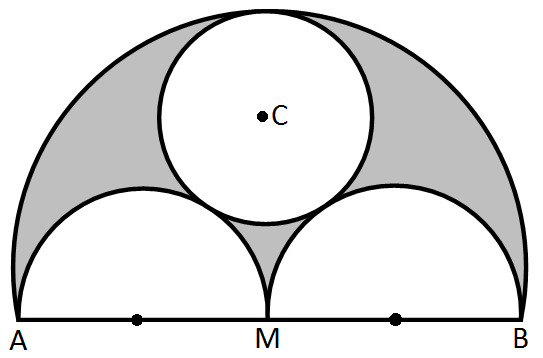
In the following figure, AB = 36cm and M is mid-point of AB. Semi-circles are drawn on AB, AMand MB as diameters. A circle with centre C touches all the three circles. Find the area of the shaded region.
A box contains cards bearing numbers 6 to 70. If one card is drawn at random from the box, find the probability that it bears:
  1. A one-digit number.
  2. A number divisible by 5.
  3. An odd number less than 30.
  4. A composite number between 50 and 70.
Solve the following systems of equations:
$\frac{1}{2(\text{x}+2\text{y})}+\frac{5}{3(3\text{x}-2\text{y})}=\frac{-3}{2}$
$\frac{5}{4(\text{x}+2\text{y})}-\frac{3}{5(3\text{x}-2\text{y})}=\frac{61}{60}$
Write the set of values of a and b for which the following system of equations has infinitely many solutions.
2x + 3y = 7
2ax + (a + b)y = 28
Susan invested certain amount of money in two schemes A and B, which offer interest at the rate of 8% per annum and 9% per annum, respectively. She received Rs. 1860 as annual interest. However, had she interchanged the amount of investments in the two schemes, she would have received Rs. 20 more as annual interest. How much money did she invest in each scheme?
Find the roots of the following quadratic equation (if they exist) by the method of completing the square.
$\text{x}^2-4\sqrt{2\text{x}}+6=0$
Find the area of $\triangle\text{ABC}$ with A(1, -4) and midpoints of sides through A being (2, -1) and (0, -1).
A man arranges to pay off a debt of ₹ 36000 by 40 monthly instalments which form an arithmetic series. When 30 of the instalments are paid, he dies leaving one-third of the debt unpaid. Find the value of the first instalment.
Two taps running together can fill a tank in $3 \frac{1}{13}$ hours. If one tap takes 3 hours more than the other to fill the tank, then how much time will each tap take to fill the tank?