MCQ
Find $A$ to $D$ in figure
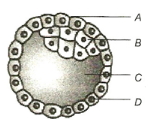
  • $A-$Breaking zona pellucida, $B-$Inner cell mass, $C-$Blastocoel, $D-$Trophoblast
  • B
    $A-$Breaking zona pellucida, $B-$Inner cell mass, $C-$ Trophoblast, $D-$Blastocoel
  • C
    $A-$Breaking zona pellucida, $B-$ Blastocoel, $C-$Inner cell mass, $D-$Trophoblast
  • D
    $A-$Breaking zona pellucida, $B-$ Trophoblast, $C-$Inner cell mass, $D-$Blastocoel
Answer

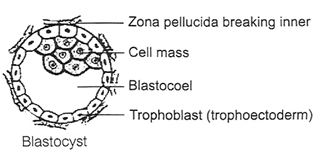
Correct option: A.
$A-$Breaking zona pellucida, $B-$Inner cell mass, $C-$Blastocoel, $D-$Trophoblast
a
Blastocyst Formation At the next stage of development (morula), which produces an embryo with about $64\; cells$, a cavity is formed with in the cell mass. This cavity is called blastocyst cavity (blastocoel) and the embryo is termed as blastocyst. Blastocyst composed of an outer envelops of cells the trophoblast or trophoectoderm and inner mass cell (embryoblast). The side of the blastocyst to which inner mass cell is attached is called embryonic pole (animal pole), while opposite side is the abembryonic pole

Need a full question paper?

Generate a complete, print-ready paper with questions like this in minutes — across 16+ boards, with answer keys.

Start Generating Free

Similar questions

Which one of the following substances in the blood in man imparts the oxygen carrying capacity to it
A polypeptide secreted into the blood by the cells in the stomach wall, stimulates the production of $HCl$ by the parietal cells of the stomach is
Using which of the following after drinking alcohol causes death
Haemophilic female marries normal male, the theoretical ratio of their offsprings regarding haemophilia will be
Match the organism with its use in biotechnology.

$(a)$ Bacillus thuringiensis $(i)$ Cloning vector
$(b)$ Thermus aquaticus $(ii)$ Construction of first $rDNA$ molecule
$(c)$ Agrobacterium tumefaciens $(iii)$ $DNA$polymerase
$(d)$ Salmonella typhimurium $(iv)$ Cry proteins

Select the correct option from the following:

$(a)\quad(b)\quad(c)\quad(d)$

Given below are two statements : one is labelled as Assertion $(A)$ and the other is labelled as Reason $(R)$.

Assertion $(A)$:

Mendel's law of Independent assortment does not hold good for the genes that are located closely on the same chromosome.

Reason $(R):$

Closely located genes assort independently.

In the light of the above statements, choose the correct answer from the options given below:

Statement I: Between 26-35 segments typhlosole present.
Statement II: This increases the effective area of absorption in the intestine.
In Australia, marsupials and placental mammals have evolved to share many similar characteristics. This type of evolution may be referred to as
Immunity tolerance developed by
The segregation of paired hereditary factors that Mendel postulated occurs during