MCQ
Find $A$ to $D$ in figure
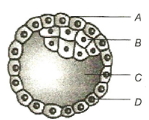
  • $A-$Breaking zona pellucida, $B-$Inner cell mass, $C-$Blastocoel, $D-$Trophoblast
  • B
    $A-$Breaking zona pellucida, $B-$Inner cell mass, $C-$ Trophoblast, $D-$Blastocoel
  • C
    $A-$Breaking zona pellucida, $B-$ Blastocoel, $C-$Inner cell mass, $D-$Trophoblast
  • D
    $A-$Breaking zona pellucida, $B-$ Trophoblast, $C-$Inner cell mass, $D-$Blastocoel
Answer

Correct option: A.
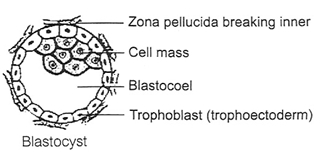
$A-$Breaking zona pellucida, $B-$Inner cell mass, $C-$Blastocoel, $D-$Trophoblast
a
Blastocyst Formation At the next stage of development (morula), which produces an embryo with about $64\; cells$, a cavity is formed with in the cell mass. This cavity is called blastocyst cavity (blastocoel) and the embryo is termed as blastocyst. Blastocyst composed of an outer envelops of cells the trophoblast or trophoectoderm and inner mass cell (embryoblast). The side of the blastocyst to which inner mass cell is attached is called embryonic pole (animal pole), while opposite side is the abembryonic pole

Need a full question paper?

Generate a complete, print-ready paper with questions like this in minutes — across 16+ boards, with answer keys.

Start Generating Free