MCQ
Find all the points of discontinuity of the function $f$ defined by

$f(x) = \left\{ {\begin{array}{*{20}{c}}
{x + 2,}&{if\,\,x\,\, < \,\,1}\\
{0,}&{if\,\,\,x = 1}\\
{x - 2,}&{if\,\,x\,\, > \,\,1}
\end{array}} \right.$

  • A
    $x=0$
  • B
    $x=-1$
  • $x=1$
  • D
    $x=2$

Answer

Correct option: C.
$x=1$
c
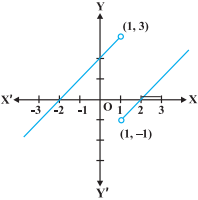
As in the previous example we find that $f$ is continuous at all real numbers $x \neq 1 .$ The left hand limit of $f$ at $x=1$ is

$\mathop {\lim }\limits_{x \to {1^ - }} f(x) = \mathop {\lim }\limits_{x \to {1^ - }} (x + 2) = 1 + 2 = 3$

The right hand limit of $f$ at $x=1$ is

$\mathop {\lim }\limits_{x \to {1^ + }} f(x) = \mathop {\lim }\limits_{x \to {1^ + }} (x - 2) = 1 - 2 =  - 1$

Since, the left and right hand limits of $f$ at $x=1$ do not coincide, $f$ is not continuous at $x=1 .$ Hence $x=1$ is the only point of discontinuity of $f .$ The graph of the function is given in the (Fig)

Need a full question paper?

Generate a complete, print-ready paper with questions like this in minutes — across 16+ boards, with answer keys.

Start Generating Free

Similar questions

The shortest distance between the lines $\frac{x-3}{2}=\frac{y+15}{-7}=\frac{z-9}{5}$ and $\frac{x+1}{2}=\frac{y-1}{1}=\frac{z-9}{-3}$ is
If $\sin(\text{x}+\text{y})=\log(\text{x}+\text{y}),$ then $\frac{\text{dy}}{\text{dx}}=$
If a line makes angles $Q_1, Q_{21}$ and $Q_3$ respectively with the coordinate axis then the value of $\cos^2 \text{Q}_{1} + \cos^2 \text{Q}_{2} + \cos^2 \text{Q}_{3}:$
Let $h(x)=$ $\frac{{5{{(f(x))}^3}}}{3} + \frac{{{{(f(x))}^2}}}{2} + 2f(x)+ 100$ Where $f(x)$ is a differentiable function. Then which one of the following is correct
If $P(A)=\left(\frac{1}{2}\right), P(B)=0$, then the value of $P(A / B)$ will be
Let three matrices $A =$$\left[ {\begin{array}{*{20}{c}}2&1\\4&1\end{array}} \right]$ ; $B =$$\left[ {\begin{array}{*{20}{c}}3&4\\2&3\end{array}} \right]$ and $C =$$\left[ {\begin{array}{*{20}{c}}3&{ - 4}\\{ - 2}&3\end{array}} \right]$ then $T_r(A) + t_r$ $\left( {\frac{{ABC}}{2}} \right)$ $+$ $t_r$$\left( {\frac{{A{{(BC)}^2}}}{4}} \right)$  $+$ $t_r$ $\left( {\frac{{A{{(BC)}^3}}}{8}} \right)$ $+$ ....... $+ \infty =$
A linear programming of linear functions deals with:
If $f:[1,\; + \infty ) \to [2,\; + \infty )$ is given by $f(x) = x + \frac{1}{x}$ then ${f^{ - 1}}$ equals
The value of $\left| {\,\begin{array}{*{20}{c}}{441}&{442}&{443}\\{445}&{446}&{447}\\{449}&{450}&{451}\end{array}\,} \right|$ is
Let $f(x)=x^5+2 x^3+3 x+1, x \in R$, and $g(x)$ be a function such that $g(f(x))=x$ for all $x \in R$. Then $\frac{g(7)}{g^{\prime}(7)}$ is equal to :