Question
Find an expression for the electric field strength at a distant point situated (i) on the axis and (ii) along the equatorial line of an electric dipole.
OR
Derive an expression for the electric field intensity at a point on the equatorial line of an electric dipole of dipole moment $\vec{\text{p}}$ and length 2a. What is the direction of this field?
Answer

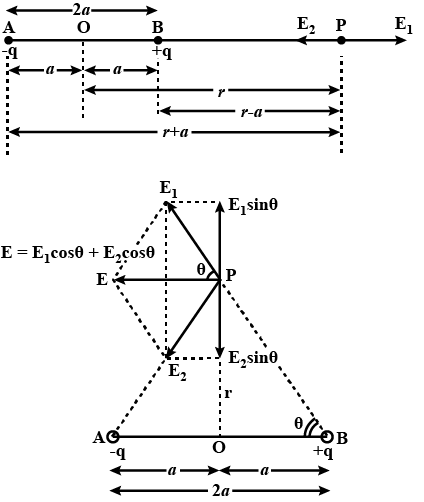
Consider an electric dipole AB. The charges -q and +q of dipole are situated at A and B respectively as shown in the figure. The separation between the charges is 2a. Electric dipole moment, p = q.2a The direction of dipole moment is from -q to +q.Image
  1. At axial or end-on position: Consider a point P on the axis of dipole at a distance r from mid-point O of electric dipole.
The distance of point P from charge +q at B is BP = r - a.
And distance of point P from charge -q at A is, AP = r + a.
Let $E_1$ and $E_2$ be the electric field strengths at point P due to charges +q and -q respectively.
We know that the direction of electric field due to a point charge is away from positive charge and towards the negative charge. Therefore,
$\text{E}_1=\frac{1}{4\pi\in_0}\frac{\text{q}}{(\text{r}-\text{a})^2}$ (from B to P)
and $\text{E}_2=\frac{1}{4\pi\in_0}\frac{\text{q}}{(\text{r}+\text{a})^2}$ (from P to A)
Clearly the directions of electric field strengths $\vec{\text{E}}_1$ and $\vec{\text{E}}_2$ along the same line but opposite to each other and $E_1 > E_2$ because positive charge is nearer.
$\therefore$ The resultant electric field due to electric dipole has magnitude equal to the difference of $E_1$ and $E_2$ direction from B to P i.e.,
$E = E_1 - E_2$
$=\frac{1}{4\pi\in_0}\frac{\text{q}}{(\text{r}-\text{a})^2}-​​\frac{1}{4\pi\in_0}\frac{\text{q}}{(\text{r}+\text{a})^2}$
$=\frac{\text{q}}{4\pi\in_0}=\Big[\frac{1}{(\text{r}-\text{a})^2}-\frac{1}{(\text{r}+\text{a})^2}\Big]=\frac{\text{q}}{4\pi\in_0}\bigg[\frac{(\text{r}+\text{a})^2-(\text{r}-\text{a})^2}{(\text{r}^2-\text{a}^2)^2}\bigg]$
$=\frac{\text{q}}{4\pi\in_0}\frac{4\text{ra}}{(\text{r}^2-\text{a}^2)^2}=\frac{1}{4\pi\in_0}\frac{2(\text{q}2\text{a})\text{r}}{(\text{r}^2-\text{a}^2)^2}$
But q.21 = p (electric dipole moment)
$\therefore\ \text{E}=\frac{1}{4\pi\in_0}\frac{2\text{pr}}{(\text{r}^2-\text{a}^2)^2}\dots(\text{i})$
If the dipole is infinitely small and point P is far away from the dipole, then r >> l, therefore equation (i) may be expressed as,
$\text{E}=\frac{1}{4\pi\in_0}\frac{2\text{pr}}{\text{r}^4}$ or $\text{E}=\frac{1}{4\pi\in_0}\frac{2\text{p}}{\text{r}^3}\dots(\text{ii})$
This is the expression for the electric field strength at axial position due to a short electric dipole.
  1. At a point of equatorial line: Consider a point P on broad side on the position of dipole formed of charges +q and -q at separation 2a. The distance of point P from mid-point (O) of electric dipole is r. Let $\vec{\text{E}}_1$ and $\vec{\text{E}}_2$ be the electric field strengths due to charges +q and -q of electric dipole.
From fig. $\text{AP}=\text{BP}=\sqrt{\text{r}^2+\text{a}^2}$
$\therefore\ \vec{\text{E}}=\frac{1}{4\pi\in_0}\frac{\text{q}}{\text{r}^2+\text{a}^2}$ along B to P
$\vec{\text{E}}_2=\frac{1}{4\pi\in_0}\frac{\text{q}}{\text{r}^2+\text{a}^2}$ along P to A
Clearly $\vec{\text{E}}_1$ and $\vec{\text{E}}_2$ are equal in magnitude i.e., $|\vec{\text{E}}_1|=|\vec{\text{E}}_2|$ or $E_1 = E_2$​​​​​​​
To find the resultant of $\vec{\text{E}}_1$ and $\vec{\text{E}}_2,$ we reslove them into rectangular components.
Component of $\vec{\text{E}}_1$ Parallel to $​​\text{AB}=\text{E}_1\cos\theta,$ in the direction to $\vec{\text{BA}}$
Component of $\vec{\text{E}}_1$ perpendicular to $​​\text{AB}=\text{E}_1\sin\theta,$ along OP
Component of $\vec{\text{E}}_2$ Parallel to $​​\text{AB}=\text{E}_2\cos\theta,$ in the direction to $\vec{\text{BA}}$
Component of $\vec{\text{E}}_2$ perpendicular to $​​\text{AB}=\text{E}_2\sin\theta,$ along PO
Clearly, comoponents of $\vec{\text{E}}_1$ and $\vec{\text{E}}_2$ perpendicular to $​​\text{AB}=\text{E}_1\sin\theta$ and $\text{E}_2\sin\theta$ being equal and opposite cancel each other, while the components of $\vec{\text{E}}_1$ and $\vec{\text{E}}_2$ parallel to $​​\text{AB}=\text{E}_1\cos\theta$ and $\text{E}_2\cos\theta,$ being in the same direction add up and give the resultant electric field whose direction is parallel to $\vec{\text{BA}}.$
$\therefore$ Resultant electric field at P is $​​\text{E}=\text{E}_1\cos\theta+\text{E}_2\cos\theta$
But $\text{E}_1=\text{E}_2=\frac{1}{4\pi\in_0}\frac{\text{q}}{(\text{r}^2+\text{a}^2)}$
From the figure, $\cos\theta=\frac{\text{OB}}{\text{PB}}=\frac{\text{l}}{\sqrt{\text{r}^2+\text{a}^2}}=\frac{\text{l}}{(\text{r}^2+\text{a}^2)^{1/2}}$
$\text{E}=2\text{E}_1\cos\theta=2\times\frac{1}{4\pi\in_0}\frac{\text{q}}{(\text{r}^2+\text{a}^2)}.\frac{\text{l}}{(\text{r}^2+\text{a}^2)^{1/2}}$
$=\frac{1}{4\pi\in_0}\frac{2\text{ql}}{(\text{r}^2+\text{a}^2)^{3/2}}$
But q.2l = p = electric dipole moment ...(iii)
$\therefore\ \text{E}=\frac{1}{4\pi\in_0}\frac{\text{p}}{(\text{r}^2+\text{a}^2)^{3/2}}$
If dipole is infinitesimal and point P is far away, we have a << r, so $l^2$ may be neglected as compared to $r^2$ and so equation (iii) gives,
$\text{E}=\frac{1}{4\pi\in_0}\frac{\text{p}}{(\text{r}^2)^{3/2}}=\frac{1}{4\pi\in_0}\frac{\text{p}}{\text{r}^3}$
i.e., electric field strength due to a short dipole at broadside on position.
$\text{E}=\frac{1}{4\pi\in_0}\frac{\text{p}}{\text{r}^3}$ in the direction parallel to $\vec{\text{BA}}\dots(\text{iv})$
Its direction is parallel to the axis of dipole from positive to negative charge. It may be noted clearly from equations (ii) and (iv) that electric field strength due to a short dipole at any point is inversely proportional to the cube of its distance from the dipole and the electric field strength at axial position is twice that at broad-side on position for the same distance.
Important: Note the important point that the electric field due to a dipole at large distances falls off as $\frac{1}{\text{r}^3}$ and not as $\frac{1}{\text{r}^2}$ as in the case of a point charge.

Need a full question paper?

Generate a complete, print-ready paper with questions like this in minutes — across 16+ boards, with answer keys.

Start Generating Free

Similar questions

An electric kettle used to prepare tea, takes 2 minutes to boil 4 cups of water (1 cup contains 200cc of water) if the room temperature is 25C.
  1. If the cost of power consumption is Rs. 1.00 per unit (1 unit - 1000 watt-hour), calculate the cost of boiling 4 cups of water.
  2. What will be the corresponding cost if the room temperature drops to 5°C?
Consider a two slit interference arrangements (Fig.) such that the distance of the screen from the slits is half the distance between the slits. Obtain the value of D in terms of λ such that the first minima on the screen falls at a distance D from the centre O.
A hole of radius $r_1$ is made centrally in a uniform circular disc of thickness d and radius $r_2.$ The inner surface $($a cylinder of length d and radius $r_1)$ is maintained at a temperature $\theta_1$ and the outer surface $($a cylinder of length d and radius $r_2)$ is maintained at a temperature $\theta_2(\theta_1>\theta_2).$ The thermal conductivity of the material of the disc is K. Calculate the heat flowing per unit time through the disc.
A long wire carrying a current i is bent to form a plane angle $\alpha.$ Find the magnetic field B at a point on the bisector of this angle situated at a distance x from the vertex.
The frequency of vibration of a string depends on the length L between the nodes, the tension F in the string and its mass per unit length m. Guess the expression for its frequency from dimensional analysis.
An electron is emitted with negligible speed from the negative plate of a parallel-plate capacitor charged to a potential difference V. The separation between the plates is d and a magnetic field Bexists in the space, as shown in the figure. Show that the electron will fail to strike the upper plates if $\text{d}>\Big(\frac{2\text{m}_\text{e}\text{v}}{\text{eB}^2}\Big)^{\frac{1}{2}}.$
Assume that there is no repulsive force between the electrons in an atom but the force between positive and negative charges is given by Coulomb’s law as usual. Under such circumstances, calculate the ground state energy of a He-atom.
A servo voltage stabiliser restricts the voltage output to 220V ± 1%. If an electric bulb rated at 220V, 100W is connected to it, what will be the minimum and maximum power consumed by it?
A ball is thrown horizontally from a point 100m above the ground with a speed of 20m/s. Find:
  1. The time it takes to reach the ground.
  2. The horizontal distance it travels before reaching the ground.
  3. The velocity (direction and magnitude) with which it strikes the ground.
Explain the principle of superposition in terms of position vectors of charges.