Question
Find $\frac{d y}{d x}$ if : $y^3+\cos (x y)=x^2-\sin (x+y)$

Answer

Given that: $y^3+\cos (x y)=x^2-\sin (x+y)$
Differentiate $w . r . t . x$.
$
\begin{aligned}
& \frac{d}{d x}\left(y^3\right)+\frac{d}{d x}[\cos (x y)]=\frac{d}{d x}\left(x^2\right)-\frac{d}{d x}[\sin (x+y)] \\
& 3 y^2 \frac{d}{d x}(y)-\sin (x y) \frac{d}{d x}(x y)=2 x-\cos (x+y) \frac{d}{d x}(x+y) \\
& 3 y^2 \frac{d y}{d x}-\sin (x y)\left[x \frac{d y}{d x}+y(1)\right]=2 x-\cos (x+y)\left[1+\frac{d y}{d x}\right] \\
& 3 y^2 \frac{d y}{d x}-x \sin (x y) \frac{d y}{d x}-y \sin (x y)=2 x-\cos (x+y)-\cos (x+y) \frac{d y}{d x} \\
& 3 y^2 \frac{d y}{d x}-x \sin (x y) \frac{d y}{d x}+\cos (x+y) \frac{d y}{d x}=2 x+y \sin (x y)-\cos (x+y) \\
& {\left[3 y^2-x \sin (x y)+\cos (x+y)\right] \frac{d y}{d x}=2 x+y \sin (x y)-\cos (x+y) } \\
\therefore & \frac{d y}{d x}=\frac{2 x+y \sin (x y)-\cos (x+y)}{3 y^2-x \sin (x y)+\cos (x+y)}
\end{aligned}
$

Need a full question paper?

Generate a complete, print-ready paper with questions like this in minutes — across 16+ boards, with answer keys.

Start Generating Free

Similar questions

If $|\vec{\text{a}}|=2,\big|\vec{\text{b}}\big|=5$ and $\big|\vec{\text{a}}\times\vec{\text{b}}\big|=8,$ find $\vec{\text{a}}.\vec{\text{b}}.$
Find the vector equation of the line passing through the point having position vector

$\hat{i}+2 \hat{j}+3 \hat{k}$ and perpendicular to vectors $\hat{i}+\hat{j}+\hat{k}$ and $2 \hat{i}-\hat{j}+\hat{k}$.
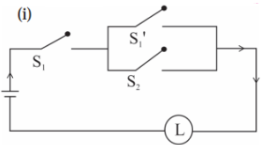
Give an alternative equivalent simple circuits for the following circuits :
Image
Evaluate the following integrals:
$\int \frac{1}{(\text{x}-1)\sqrt{2\text{x}+3}}\text{ dx}$
Evaluate the following integrals:
$\int\sec^42\text{x}\text{ dx}$
Solve the following differential equations:
$\sqrt{1+\text{x}^2}\ \text{dy}+\sqrt{1+\text{y}^2}\ \text{dx}=0$
Find the value of $\cos ^{-1}\left(\frac{3}{5}\right)+\cos ^{-1}\left(\frac{4}{5}\right)$
Show that lines $\bar{r}=(\hat{i}+4 \hat{j})+\lambda(\hat{i}+2 \hat{j}+3 \hat{k})$ and

$\bar{r}=(3 \hat{j}-\hat{k})+\mu(2 \hat{i}+3 \hat{j}+4 \hat{k})$

Write the angle between the curves $y = e^{-x}$ and $y = e^x$ at their point of intersections.
A laboratory blood test is $99\%$ effective in detecting a certain disease when its infection is present. However, the test also yields a false positive result for $0.5\%$ of the healthy person tested (i.e. if a healthy person is tested, then, with probability $0.005,$ the test will imply he has the disease). If $0.1\%$ of the population actually has the disease, what is the probability that a person has the disease given that his test result is positive?