Question
Find $\frac{\text{dy}}{\text{dx}}$
$\text{y}=(\tan\text{x})^{\cot\text{x}}+(\cot\text{x})^{\tan\text{x}}$

Answer

Here,
$\text{y}=(\tan\text{x})^{\cot\text{x}}+(\cot\text{x})^{\tan\text{x}}$
$\text{y}=\text{e}^{\log(\tan\text{x})^{\cot\text{x}}}+\text{e}^{\log(\cot\text{x})^{\tan\text{x}}}$
$\big[\text{Since},\log_\text{e}\text{e}=1,\log\text{a}^\text{b}=\text{b}\log\text{a}\big]$
$\text{y}=\text{e}^{\cot\text{x}\log\tan\text{x}}+\text{e}^{\tan\text{x}\log(\cot\text{x})}$
Differentiating it with respect to x using rule and product rule,
$\frac{\text{dy}}{\text{dx}}=\frac{\text{d}}{\text{dx}}\big(\text{e}^{\cot\text{x}\log\tan\text{x}}\big)+\frac{\text{d}}{\text{dx}}\big(\text{e}^{\tan\text{x}\log\cot\text{x}}\big)$
$=\text{e}^{\cot\text{x}\log\tan\text{x}}\frac{\text{d}}{\text{dx}}(\cot\text{x}\log\tan\text{x})+\text{e}^{\tan\text{x}\log\cot\text{x}}\frac{\text{d}}{\text{dx}}(\tan\text{x}\log\cot\text{x})$
$=\text{e}^{\log(\tan\text{x})^{\cot\text{x}}}\Big[\cot\text{x}\frac{\text{d}}{\text{dx}}\log\tan\text{x}+\log\tan\text{x}\frac{\text{d}}{\text{dx}}\cot\text{x}\Big] \\ +\text{e}^{\log(\cot\text{x})^{\tan\text{x}}}\Big[ \tan\text{x}\frac{\text{d}}{\text{dx}} \log\cot\text{x}+\log\cot\text{x}\frac{\text{d}}{\text{dx}}(\tan\text{x})\Big]$
$=(\tan\text{x})^{\cot\text{x}}\Big[\cot\text{x}\times\Big(\frac{1}{\tan\text{x}}\Big)\frac{\text{d}}{\text{dx}}(\tan\text{x})+\log\tan\text{x}(-\text{cosec}^2\text{x})\Big] \\ +(\cot\text{x})^{\tan\text{x}}\Big[\tan\text{x}\big(\frac{1}{\cot\text{x}}\big)\frac{\text{d}}{\text{dx}}(\cot\text{x})+\log\cot\text{x}\big(\sec^2\text{x}\big)\Big]$
$=(\tan\text{x})^{\cot\text{x}}\Big[(1)\big(\sec^2\text{x}\big)-\text{cosec}^2\text{x}\log\tan\text{x}\Big] \\ +(\cot)^{\tan\text{x}}\Big[(1)\big(-\text{cosec}^2\text{x}\big)+\sec^2\text{x}\log\cot\text{x}\Big]$
$\frac{\text{dy}}{\text{dx}}=(\tan\text{x})^{\cot\text{x}}\Big[\sec^{2\text{x}}-\text{cosec}^2\text{x}\log\tan\text{x}\Big] \\ +(\cot)^{\tan\text{x}}\Big[\sec^2\text{x}\log\cot\text{x}-\text{cosec}^2\text{x}\Big]$

Need a full question paper?

Generate a complete, print-ready paper with questions like this in minutes — across 16+ boards, with answer keys.
Start Generating Free

Similar questions

Evaluate the following integrals as limit of sum:
$\int\limits^{2}_{0}\big(\text{x}^2+\text{x}\big)\text{dx}$
Show that the right circular cylinder of given surface and maximum volume is such that its height is equal to the diameter of the base.
Draw a rough sketch of the graph of the function $\text{y}=2\sqrt{1-\text{x}^{2}}, \text{x}\in [0, 1] $ and evaluate the area enclosed between the curve and the x-axis.
The total area of a page is $150\ cm^2.$ The combined width of the margin at the top and bottom is $3\ cm$ and the side $2\ cm.$ What must be the dimensions of the page in order that the area of the printed matter may be maximum?
verify that $\text{y}=\text{e}^{\text{m}\cos^{-1}}$ is a solution of the differential equation $(1+\text{x}^2)\frac{\text{d}^2\text{y}}{\text{dx}^2}-\text{x}\frac{\text{dy}}{\text{dx}}-\text{m}^2\text{y}=0$
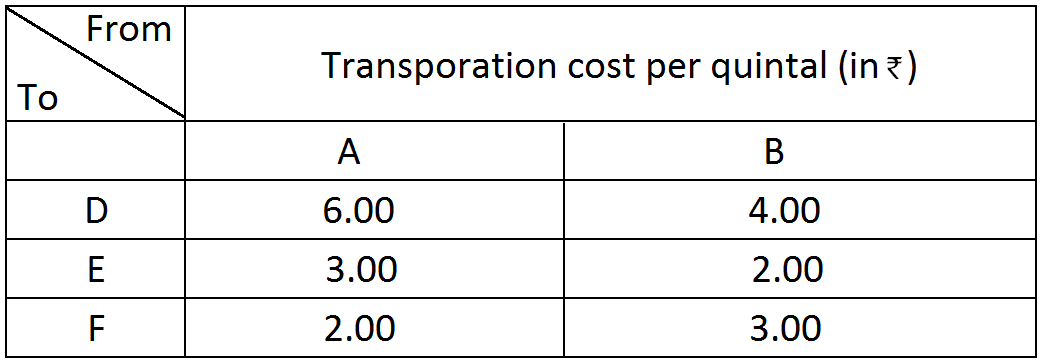
Tow godowns$, A$ and $B,$ have grain storage capacity of $100$ quintals and $50$ quintals respectively. They supply to $3$ ration shops$, D, E$ and $F,$ whose requirements are $60, 50$ and $40$ quintals respectively. The cost of transportation per quintal from the godowns to the shops are given in the following table:

How should the supplies be transported in order that the transportation cost is minimum? 
Prove that the points $\hat{\text{i}}-\hat{\text{j}},\ 4\hat{\text{i}}+3\hat{\text{j}}+\hat{\text{k}}$ and $2\hat{\text{i}}-4\hat{\text{j}}+5\hat{\text{k}}$ are the vertices of a right-angled triangle.
A and B throw a pair of dice alternately. A wins the game if he gets a total of 6 and B wins if she gets a total of 7. It A starts the game, find the probability of winning the game by A in third throw of the pair of dice.
Evaluate the following integrals:$\int\frac{\text{x}^2}{\text{x}^2+6\text{x}+12}\text{ dx}$
Show that the function $f: R \rightarrow\{x \in R:-1 < x<1\}$ defined by $f(x)=\frac{x}{1+|x|}, x \in R$ is one-one and onto function.