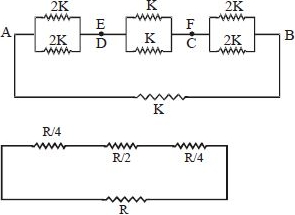
MCQ
Find effective thermal resistance between $A$ & $B$ of cube made up of $12$ rods of same dimensions and shown given thermal conductivity. [ $l =$ length of rod, $a =$ cross section area of rod]
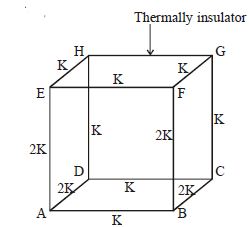
  • A
    $\frac{l}{{ka}}$
  • B
    $\frac{2l}{{ka}}$
  • C
    $\frac{4l}{{7ka}}$
  • $\frac{l}{{2ka}}$

Answer

Correct option: D.
$\frac{l}{{2ka}}$
d
Let $\mathrm{R}=\frac{1}{\mathrm{K}} \cdot \frac{l}{\mathrm{a}}$

$R_{e q}=\frac{R}{2}=\frac{1}{2}\left(\frac{\ell}{k a}\right)$

Need a full question paper?

Generate a complete, print-ready paper with questions like this in minutes — across 16+ boards, with answer keys.

Start Generating Free

Similar questions

A vertical column $50$ $cm$ long at $50°C$ balances another column of same liquid $60 \,cm$ long at $100°C$. The coefficient of absolute expansion of the liquid is
A helicopter is flying horizontally with a speed $'v'$ at an altitude $'{h}'$ has to drop a food packet for a man on the ground. What is the distance of helicopter from the man when the food packet is dropped?
Water falls from a tap, down the streamline.
The relation between the gas pressure $P$ and average kinetic energy per unit volume $E$ is
A Carnot engine with sink's temperature at $17\,^oC$ has $50\%$ efficiency. By how much should its source temperature be changed to increases its efficiency to $60\%$ ?...... $K$
The $SI$ unit of magnetic permeability is
Two boys are standing at the ends $A$ and $B$ of a ground where $AB = a$. The boy at $B$ starts running in a direction perpendicular to $AB$ with velocity ${v_1}.$ The boy at $A$ starts running simultaneously with velocity $v$ and catches the other boy in a time $t$, where $t$ is
Consider $a$ one-dimensional collision that involves $a$ body of mass $m_1$ originally moving in the positive $x$ direction with speed $v_0$ colliding with a second body of mass $m_2$ originally at rest. The collision could be completely inelastic, with the two bodies sticking together, completely elastic, or somewhere in between. After the collision, $m_1$ moves with velocity $v_1 $ while $m_2$ moves with velocity $v_2$.

$(A)$ $If \,m_1 > m_2$,

$(B)$ $If\, m_1 < m_2$,

In a surface tension experiment with a capillary tube water rises upto $0.1\, m$. If the same experiment is repeated on an artificial satellite, which is revolving around the earth, water will rise in the capillary tube upto a height of
$A$ uniform disc is rolling on a horizontal surface. At a certain instant $B$ is the point of contact and $A$ is at height $2R$ from ground, where $R$ is radius of disc.