MCQ
Find incorrect comparison of second ionisation energy
- ✓$Te < Sb$
- B$In > Sr$
- C$He > B$
- D$Fe < Fe^+$
It is not easy to remove electron from half filled $P$ orbital.
Hence second ionisation energy of $T e$ is greater than $Sb$.
Generate a complete, print-ready paper with questions like this in minutes — across 16+ boards, with answer keys.

$\begin{array}{*{20}{c}}
{\,\,\,\,\,O} \\
{\,\,\,\,\,||} \\
{HOC{H_2}C{H_2} - C - OC{H_2}C{H_3}}
\end{array}$ $\xrightarrow{{PCC}}(A)\,\xrightarrow[{(1\,\,molar\,\,equivalent)}]{{{H_2}C \equiv CHMgBr}}(B)$ $\xrightarrow{{N{H_4}Cl\,/\,{H_2}O}}\,(C)\,\,\xrightarrow[{{H_2}O}]{{KOH}}\,$ $\xrightarrow{{{H_3}{O^ \oplus }}}\,\,\xrightarrow[{pyridine}]{{\begin{array}{*{20}{c}}
{\,\,\,\,\,\,\,O} \\
{\,\,\,\,\,\,||} \\
{{{(C{H_3} - C)}_2}O}
\end{array}}}(D)$
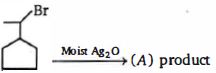
Given :
Molar mass $N =14\,g\,mol ^{-1} ; O =16\,g\,mol ^{-1} ; C =12\,g\,mol ^{-1} ; H =1\,g\,mol ^{-1}$;