MCQ
find out the reactivity order with $LiAlH_4$

- A$A > B > C > D$
- ✓$B > C > D > A$
- C$D > C > B > A$
- D$B > D > C > A$
Generate a complete, print-ready paper with questions like this in minutes — across 16+ boards, with answer keys.
$CH _{3} OH (1)+\frac{3}{2} O _{2}( g ) \rightarrow CO _{2}( g )+2 H _{2} O (1)$
the amount of heat produced as measured by bomb calorimeter is $726 \,kJ\, mol ^{-1}$ at $27^{\circ} C$. The enthalpy of combustion for the reaction is $- x \,kJ\,mol ^{-1}$, where $x$ is $.....$ (Nearest integer)
$\left(\right.$ Given $: R =8.3\, J\,K ^{-1} \,mol ^{-1}$ )

| Column $I$ | Column $II$ |
| $(a)\,XeO_6^{-4}$ | $(P)$ Tetrahedral |
| $(b)\,ClO_2$ | $(Q)\,V-$ Shape |
| $(c)\,NH_4^+$ | $(R)$ Trigonal Bipyramidal |
| $(d)\,XeO_3F_2$ | $(S)$ Octahedral |
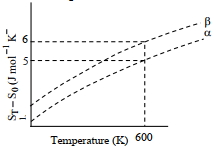
(image)
The transition temperature for $\alpha$ to $\beta$ phase change is $600 \mathrm{~K}$ and $C_{p, \beta}-C_{p, \alpha}=1 \mathrm{~J} \mathrm{~mol}^{-1} \mathrm{~K}^{-1}$. Assume $\left(C_{p, \beta}-C_{p, \alpha}\right)$ is independent of temperature in the range of 200 to $700 \mathrm{~K} . \mathrm{C}_{p, \alpha}$ and $C_{p, \beta}$ are heat capacities of $\alpha$ and $\beta$ phases, respectively.
($1$)The value of entropy change, $\mathrm{S}_\beta-\mathrm{S}_\alpha$ (in $\mathrm{J} \mathrm{mol}^{-1} \mathrm{~K}^{-1}$ ), at $300 \mathrm{~K}$ is. . . . . . .
[Use : $\ln 2=0.69$ Given : $S_\beta-S_\alpha=0$ at $\left.0 \mathrm{~K}\right]$
($2$) The value of enthalpy change, $\mathrm{H}_\beta-\mathrm{H}_\alpha$ (in $J$ mol ${ }^{-1}$ ), at $300 \mathrm{~K}$ is
Give the answer quetion ($1$) and ($2$)