Question
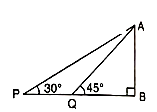
Find $PQ,$ if $AB = 150\ m, \angle P = 30^\circ$ and $\angle Q = 45^\circ.$
.
Answer

From $\triangle APB$
$\tan 30^{\circ}=\frac{ AB }{ PB } $
$\frac{1}{\sqrt{3}}=\frac{150}{ PB }$
$PB =150 \sqrt{3}$
$PB = 259.80\ m$
Also, from $\triangle ABQ$
$\tan 45^{\circ}=\frac{ AB }{ BQ }$
$1=\frac{150}{ BQ }$
$BQ = 150\ m$
Therefore,
$PQ = PB - BQ$
$PQ = 259.80 - 150$
$PQ = 109.80\ m$

Need a full question paper?

Generate a complete, print-ready paper with questions like this in minutes — across 16+ boards, with answer keys.
Start Generating Free

Similar questions

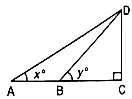
If $\tan x^{\circ}=\frac{5}{12}$,$\tan y^\circ = \frac{3}{4}$ and $AB = 48\ m;$ find the length of $CD.$
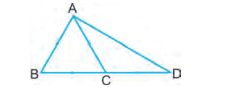
In the given figure, $\triangle A B C$ is an equilateral triangle and $B C$ is produced to $D$ such that $B C=C D$. Prove that $A D \perp A B$.
Image
Find the area of a trapezium whose parallel sides measure 10 cm and 8 cm respectively and the distance between these sides is 6 cm .
$\frac{5}{x+1}-\frac{2}{y-1}=\frac{1}{2}, \frac{10}{x+1}+\frac{2}{y-1}=\frac{5}{2}$, where $x \neq-1$ and $x \neq 1$
In a triangle, the sum of two angles is equal to the third angle. If the difference between these two angles is $20^\circ ,$ determine all the angles.
If $\frac{a}{b}=\frac{b}{c}$, prove that $(a+b+c)(a-b+c)=\left(a^2+b^2+c^2\right)$.
(Hint. Let $\frac{a}{b}=\frac{b}{c}=k$. Then, $b=c k$ and $a=b k$.
$\therefore b=c k$ and $a=c k^2$.
Put these values in required identity and show that L.H.S. = R.H.S.]
A chord of length $8 \ cm$ is drawn at a distance of $3 \ cm$ from the center of the circle.Calculate the radius of the circle.
Evaluate the following:$\frac{5 \cot 5^{\circ} \cot 15^{\circ} \cot 25^{\circ} \cot 35^{\circ} \cot 45^{\circ}}{7 \tan 45^{\circ} \tan 55^{\circ} \tan 65^{\circ} \tan 75^{\circ} \tan 85^{\circ}}+\frac{2 \operatorname{cosec} 12^{\circ} \operatorname{cosec} 24^{\circ} \cos 78^{\circ} \cos 66^{\circ}}{7 \sin 14^{\circ} \sin 23^{\circ} \sec 76^{\circ} \sec 67^{\circ}}$
Draw frequency polygons for each of the following frequency distribution:$(a)$ using histogram;$(b)$ without using histogram
$C.I$ $5 -15$ $15 -25$ $25 -35$ $35 - 45$ $45-55$ $55-65$
$ƒ$ $8$ $16$ $18$ $14$ $8$ $2$
A man borrows $Rs. 10,000$ at $5\%$ per annum compound interest. He repays $35\%$ of the sum borrowed at the end of the first year and $42\%$ of the sum borrowed at the end of the second year. How much must he pay at the end of the third year in order to clear the debt ?