Question
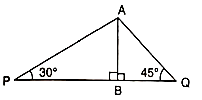
Find $PQ,$ if $AB = 150\ m, \angle P = 30^\circ $ and $\angle Q = 45^\circ .$

Answer

From $\triangle APB$
$\tan 30^{\circ}=\frac{ AB }{ PB } $
$\frac{1}{\sqrt{3}}=\frac{150}{ PB }$
$PB =150 \sqrt{3}$
$PB = 259.80\ m$
Also, from $\triangle ABQ$
$\tan 45^{\circ}=\frac{ AB }{ BQ }$
$1=\frac{150}{ BQ }$
$BQ = 150\ m$
Therefore,
$PQ = PB + BQ$
$PQ = 259.80 + 150$
$PQ = 409.80\ m$

Need a full question paper?

Generate a complete, print-ready paper with questions like this in minutes — across 16+ boards, with answer keys.
Start Generating Free

Similar questions

Solve for $\mathrm{x}$ and $\mathrm{y}$; if $\mathrm{x}>0$ and $\mathrm{y}>0 ; \log \mathrm{xy}=\log \frac{x}{y}+2 \log 2=2$
Draw a graph of each of the following equations: $x + y - 3 = 0$
Image
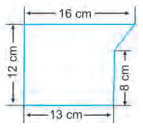
The cross-section of a piece of metal 2 m in length is shown in the adjoining figure.
Calculate : (i) the area of its cross-section;
(ii) the volume of piece of metal;
(iii) the weight of piece of metal to the nearest kg, if 1 $cm ^3$ of the metal weighs 6.5 g.
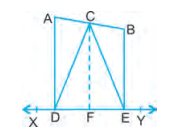
Two points A and B lie on the same side of a line XY . If $AD \perp XY$ and $BE \perp XY$ meet XY in D and E respectively and $C$ is the mid-point of $A B$, show that $CD = CE$.
Image
The length, breadth, and height of a rectangular solid are in the ratio $6 : 4 :3$. If the total surface area is $1728 \ cm^2$. Find its dimensions.
A police car is ordered to chase a speeding car which is $5 \ km$ ahead and is travelling at an average speed of $80 \ km/h$. The police car is running at an average speed of $100 \ km/h$. How long it take for the police car to overtake the speeding car?
Find the median of the following sets of numbers.$25, 11, 15, 10, 17, 6, 5, 12.$
A rectangular cardboard sheet has length $32\ cm$ and breadth $26\ cm$. Squares each of side $3\ cm$, are cut from the corners of the sheet and the sides are folded to make a rectangular container. Find the capacity of the container formed.
Solve :$\frac{3}{2 x}+\frac{2}{3 y}=-\frac{1}{3}, \frac{3}{4 x}+\frac{1}{2 y}=-\frac{1}{8}$
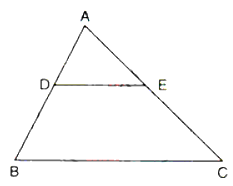
In $\triangle ABC, DE$ is parallel to $BC$ and $DE = 3:8.$

Find:$(i) AD : BD(ii) AE,$ if $AC = 16.$