Question
Find product: $\big(\frac{1}{8}\text{x}^2\text{y}^4\big)×\big(\frac{1}{4}\text{x}^4\text{y}^2\big)×(\text{xy})×5$

Answer

To multiply algebraic expressions, we can use commutative and associative laws along with the law of indices, $a^m \times a^n=a^{m+n}$.
We have:
$\big(\frac{1}{8}\text{x}^2\text{y}^4\big)×\big(\frac{1}{4}\text{x}^4\text{y}^2\big)×(\text{xy})×5$
$=\big(\frac{1}{8}×\frac{1}{4}×5\big)×\big(\text{x}^2×\text{x}^4×\text{x}\big)×\big(\text{y}^4×\text{y}^2×\text{y}\big)$
$=\big(\frac{1}{8}×\frac{1}{4}×5\big)×\big(\text{x}^{2+4+1}\big)×\big(\text{y}^{4+2+1}\big)$
$=\frac{5}{32}\text{x}^7\text{y}^7$
To verify the result, we substitute $x = 1$ and $y = 2$ in LHS; we get:
$\text{LHS}=\big(\frac{1}{8}\text{x}^2\text{y}^4\big)×\big(\frac{1}{4}\text{x}^4\text{y}^2\big)×(\text{xy})×5$
$=\big(\frac{1}{8}×(1)^{2}×(2)^{4}\big)×\big(\frac{1}{4}×(1)^{4}×(2)^{2}\big)×(1×2)×5$
$=\big(\frac{1}{8}×(1)^{2}×(2)^{4}\big)×\big(\frac{1}{4}×1×4\big)\times(1\times2)\times5$
$=2×1×2×5$
$=20$
Substituting $x = 1$ and $y = 2$ in $RHS$, we get:​
$\text{RHS}=\frac{5}{32}\text{x}^7\text{y}^7$
$=\frac{5}{32}(1)^7(2)^7$
$=\frac{5}{32}\times1\times128$
$=20$
Because $LHS$ is equal to $RHS$, the result is correct.
Thus, the answer is $=\frac{5}{32}\text{x}^7\text{y}^7.$

Need a full question paper?

Generate a complete, print-ready paper with questions like this in minutes — across 16+ boards, with answer keys.

Start Generating Free

Similar questions

Simplify: $\frac{7}{9}+\frac{3}{-4}$
Find three rational numbers between $\frac{2}{3}$ and $\frac{3}{4}$.
By what number should the following numbers be multiplied to get a perfect square in each case? Also, find the number whose square is the new number.
$7776$
The following chart gives the growth in height
(in terms of percentage) of boys and girls with their respective ages:
Age (in yr)BoysGirls
872%77%
975%81%
1078%84%
1181%88%
1284%91%
1388%95%
1492%98%
1595%99%
1698%99.5%
1799%100%
18100%100%
Draw the line graph of above data on the same sheet and answer the following question
(i) In which year both the boys and the girls achieve their maximum height?
(ii) Who grows faster at puberty (14-16 yr of age)?
Draw a graph for the following.
Side of square $($in $cm)$ $2$ $3$ $4$ $5$ $6$
Area $($in $cm^2)$ $4$ $9$ $16$ $25$ $36$
Is it a line graph?
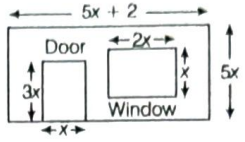
The given figure shows the dimensions of a wall having a window and a door of a room. Write an algebraic expression for the area of the wall to be painted.
Image
Let us draw some human figures. Measure your friend’s body—the lengths of their head, torso, arms, and legs. Write the ratios as mentioned below -
Image
From a pipe of inner radius $0.75\ cm$, water flows at the rate of $7\ m$ per second. Find the volume in litres of water delivered by the pipe in $1$ hour.
Find the square root in decimal form: $3600.720036$
Find the least number which must be subtracted from $825$ so as to get a perfect square. Also find the square root of the perfect square so obtained.