Question
Find rational numbers a and b such that:$\frac{2-\sqrt{5}}{2+\sqrt{5}}=\text{a}\sqrt{5}+\text{b}$

Answer

$\frac{2-\sqrt{5}}{2+\sqrt{5}}=\text{a}\sqrt{5}+\text{b}$we have,
$\frac{2-\sqrt{5}}{2+\sqrt{5}}$
$=\frac{2-\sqrt{5}}{2+\sqrt{5}}\times\frac{2-\sqrt{5}}{2-\sqrt{5}}$
$=\frac{\big(2-\sqrt{5}\big)^2}{(2)^2-\big(\sqrt{5}\big)^2}$
$=\frac{(2)^2-2\times2\sqrt{5}+\big(\sqrt{5}\big)^2}{4-5}$
$=\frac{4-4\sqrt{5}+5}{-1}$
$=-\big(-4\sqrt{5}+9\big)$
$=4\sqrt{5}-9$
Now,
$\frac{2-\sqrt{5}}{2+\sqrt{5}}=\text{a}\sqrt{5}+\text{b}$
$\Rightarrow4\sqrt{5}-9=\text{a}\sqrt{5}+\text{b}$
$\Rightarrow\text{a}=4$ and $\text{b}=-9$

Need a full question paper?

Generate a complete, print-ready paper with questions like this in minutes — across 16+ boards, with answer keys.
Start Generating Free

Similar questions

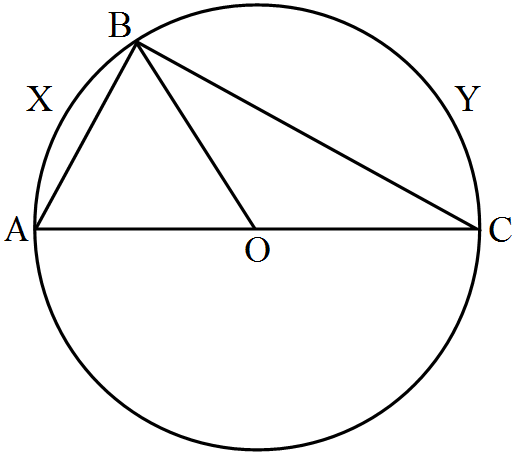
In the given figure, if O is the circumcentre of $\angle\text{ABC},$ then find the value of $\angle\text{OBC} + \angle\text{BAC.}$
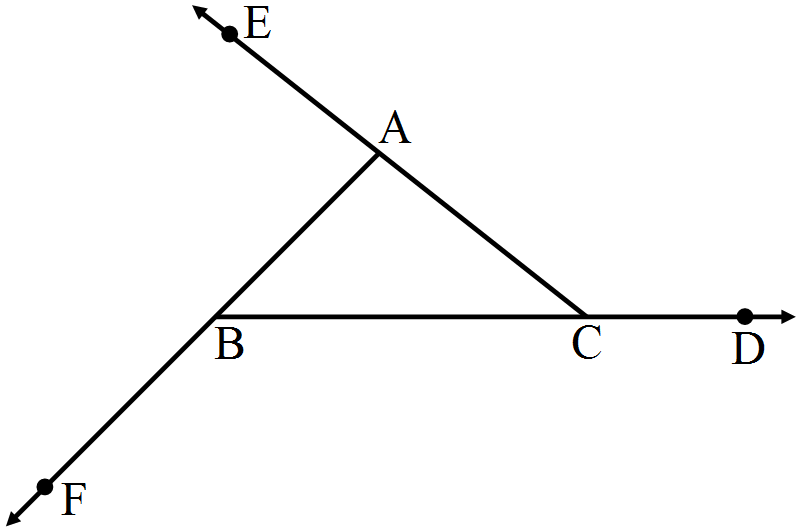
If the sides of a triangle are produced in order, prove that the sum of the exterior angles so formed is equal to four right angles.
Locate $\sqrt{10}$ on the number line.
In the following, using the remainder theorem, find the remainder when f(x) is divided by g(x) and verify the by actual division:
$f(x) = x^4 - 3x^2 + 4, g(x) = x - 2$
If two straight lines intersect each other, prove that the ray opposite to the bisector of one of the angles thus formed bisects the vertically opposite angle.
In a parallelogram ABCD, the bisector of $\angle\text{A}$ also bisects BC at X. Find AB : AD.
ABC is a triangle and through A, B, C lines are drawn parallel to BC, CA and AB respectively intersecting at P, Q and R. Prove that the perimeter of $\triangle\text{PQR}$ is double the perimeter of $\triangle\text{ABC}.$
The following table shows the interest paid by a company (in lakhs):
Year
1995–96
1996–97
1997–98
1998–99
1999–2000
Interest (in lakhs of rupees)
20
25
15
18
30
Draw the bar graph to represent the above information.
In the following, use factor theorem to find whether polynomial g(x) is a factor of polynomial f(x) or, not:
$f(x) = x^3 - 6x^2 + 11x - 6, $
$g(x)=x^2 - 3x + 2$
In $\triangle\text{ABC},$ side AB is produced to D so that $\text{BD}=\text{BC}.$ if $\angle\text{B}=60^\circ$ and $\angle\text{A}=70^\circ.$ Prove that: (i) AD > CD (ii) AD > AC