Question
Find the actual lower and upper-class limits and also the class marks of the classes:$1.1 - 2.0, 2.1 -3.0$ and $3.1 - 4.0.$

Answer

In the case of frequency $1.1 - 2.0$ the lower-class limit is $1.05,$ upper$-$class limit is $2.05$ and classmark.
is $1.05 - 2.05$
$\frac{1.05+2.05}{2}$
$=\frac{3.10}{2} $
$ =1.55$
In the case of frequency $2.1 - 3.0$ the lower$-$class limit is $2.05,$ upper$-$class limit is $3.05$ and classmark.
is $2.05 - 3.05$
$\frac{2.1+3.0}{2} $
$ =\frac{5.10}{2} $
$=2.55$
In the case of frequency $3.1 - 4.0$ the lower class limit is $3.05,$ the upper class limit is $4.05$ and classmark.
is $3.05 - 4.05$
$\frac{3.1+4.0}{2} $
$=\frac{7.10}{2}$
$=3.55$

Need a full question paper?

Generate a complete, print-ready paper with questions like this in minutes — across 16+ boards, with answer keys.
Start Generating Free

Similar questions

A kite is flying with a thread 150 m long. If the thread is assumed stretched straight and makes an angle of $60^{\circ}$ with the horizontal, find the height of the kite above the ground. (Take $\sqrt{3}$ =1.73.)
Image
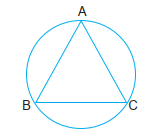
Case Study : There is a circular park in a colony. The diameter of the park is 40 m . Three poles A, B and C have been eracted at equal distances on the boundary of the park. These poles have been connected with each other using straight wires, as shown in the figure.
Based on the above information, answer the following questions : [Use $\pi=3.14$ ]
1. The circumference of the circular park is:
(a) 125.6 m
(b) 130 m
(c) 251.2 m
(d) 257.2 m
2. A child cycles along the boundary of the park in clockwise direction. The distance covered by the child in going from B to C is:
(a) 41.8 m
(b) 83.7 m
(c) 20.9 m
(d) 125.6 m
3. $\triangle ABC$ is :
(a) a scalene triangle
(b) a right triangle
(c) an equilateral triangle
(d) an isosceles triangle
4. If we draw perpendicular from $B$ on $A C$, then it will pass through:
(a) centre of the circle
(b) circomentre of the circle
(c) centroid of the circle
(d) all the above
5. The length of the piece of wire used to connect any two poles is :
(a) 20 m
(b) $20 \sqrt{3} m$
(c) $20 \sqrt{2} m$
(d) $60 \sqrt{3} m$
Construct a quadrilateral ABCD in which $AB =4.5 cm, BC =5.2 cm, CD =5 cm$, $DA =4.7 cm$ and $\angle ABC =75^{\circ}$.
Solve the following simultaneous equations by the substitution method$:\ 0.5x + 0.7y = 0.74,0.3x + 0.5y = 0.5$
Find graphically the vertices of the triangle, whose sides are given by $3y = x + 18, x + 7y = 22$ and $y + 3x = 26.$
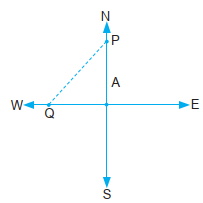
Case Study: An aeroplane (P) leaves an airport (A) and flies towards north at 400 km/h. At the same time another aeroplane (Q) leaves the same airport and flies towards west at 300 km/h.
Image
Based on the above information, answer the following questions :
Q.1. Distance covered by aeroplane P in 1.5 hours is :
(a) 600 km (b) 650 km (c) 700 km (d) 800 km
Q.2. Distance covered by aeroplane Q in 1.5 hours is :
(a) 600 km. (b) 550 km (c) 500 km (d) 450 km
Q.3. The distance between the two aeroplanes after a certain period of time is represented by the line segment :
(a) AP (b) AQ (c) PQ (d) AS
Q.4. After 1.5 hours, which aeroplane travelled longer distance and by how much?
(a) P, 150 km (b) Q, 150 km (c) P, 600 km (d) Q, 450 km
Q.5. After 1.5 hours, the distance between the two aeroplanes is :
(a) 600 km (b) 650 km (c) 700 km (d) 750 km
In a quadrilateral $\text{ABCD}, AB = AD$ and $CB = CD$.Prove that :$(i) AC$ bisects $\angle BAD.(ii) AC$ is the perpendicular bisector of $BD.$
The following frequency distribution table shows the cost of living in a city in a period of $2$ years. Draw histogram for this frequency distribution:
Cost of living $2000 - 2500$ $2500 - 3000$ $3000 - 3500$ $3500 - 4000$ $4000 - 4500$ $4500 - 5000$ $5000 - 5500$ $5500 - 6000$
No. of months $3$ $4$ $2$ $5$ $3$ $2$ $4$ $1$
Rohit purchased a $TV$ for $Rs.15,000$ and sold it at $20\%$ above the cost price. If the selling price includes $Rs. 1000$ as tax, find his net profit and profit percent.
Solve for $x$ and $y$ :$\frac{y+7}{5}=\frac{2 y-x}{4}+3 x-5;\frac{7-5 x}{2}+\frac{3-4 y}{6}=5 y-18$