MCQ
Find the amount of heat supplied to decrease the volume of an ice water mixture by $1 \,\,cm^3$ without any change in temperature. $(\rho_ {ice} = 0.9 \rho_{water}, L_{ice} = 80 \,\,cal/gm).$ ......... $cal$
  • A
    $360$
  • B
    $500$
  • $720$
  • D
    none of these

Answer

Correct option: C.
$720$
c
$x$ gm ice convert into $x$ gm water

$\frac{x}{0.9}-x=1 \Rightarrow x=\frac{0.9}{0.1}=9$

$\therefore Q=9 \times 80=720 \mathrm{cal}$

Need a full question paper?

Generate a complete, print-ready paper with questions like this in minutes — across 16+ boards, with answer keys.

Start Generating Free

Similar questions

A particle executes simple harmonic motion. Its amplitude is $8 \,cm$ and time period is $6 \,s$. The time it will take to travel from its position of maximum displacement to the point corresponding to half of its amplitude, is ............. $s$
An aeroplane moving horizontally with a speed of $720 \,km/h$ drops a food pocket, while flying at a height of $396.9\, m$. the time taken by a food pocket to reach the ground and its horizontal range is (Take $g = 9.8 m/sec^{2}$)
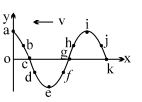
The figure represents the instantaneous picture of a longitudinal harmonic wave travelling along the negative $x$-axis. Identify the correct statement $(s)$ related to the movement of the points shown in the figure. The points of maximum compression are
Consider the following statements about sound passing through a gas.
$A.$ The pressure of the gas at a point oscillates in time.
$B.$ The position of a small layer of the gas oscillates in time.
A body of mass $2\, kg$ moves under a force of $(2 \hat{ i }+3 \hat{ j }+5 \hat{ k }) \,N$. It starts from rest and was at the origin initially. After $4 \,s$, its new coordinates are $(8, b, 20)$. The value of $b$ is ........ . (Round off to the Nearest Integer)
If potential energy is given by $U =\frac{ a }{ r ^{2}}-\frac{ b }{ r } .$ Then find out maximum force. (Given $a =2, b =4)$
Which of the following quantities is zero, when a uniform object is being supported at its centre of gravity?
A ball is released from a height $h$. If $t_{1}$ and $t_{2}$ be the time required to complete first half and second half of the distance respectively. Then, choose the correct relation between $t_{1}$ and $t_{2}$.
Young's modulus of steel is $1.9 \times 10^{11} \mathrm{~N} / \mathrm{m}^2$. When expressed in CGS units of dynes $/ \mathrm{cm}^2$, it will be equal to $(1 \mathrm{~N}=$ $10^5$ dyne, $1 \mathrm{~m}^2=10^4 \mathrm{~cm}^2)$.
 
A projectile can have the same range $R$ for two angles of projection. If $t_1$ and $t_2$ be the times of flights in the two cases, then the product of the two time of flights is proportional to