Question
Find the angle between the lines whose direction ratios are proportional to a, b, c and b - c, c - a, a - b.

Answer

Given, that the direction ratios of lines are proportional to a, b, c and b - c, c - a, a - b.
Let, $\vec{\text{x}}$ and $\vec{\text{y}}$ be the vector parallel to these lines respectively, so
$\vec{\text{x}}=\text{a}\hat{\text{i}}+\text{b}\hat{\text{j}}+\text{c}\hat{\text{k}}$
And, $\vec{\text{y}}=(\text{b}-\text{c})\hat{\text{i}}+(\text{c}-\text{a})\hat{\text{j}}+(\text{a}-\text{b})\hat{\text{k}}$
Let, $\theta$ be the angle between $\vec{\text{x}}$ and $\vec{\text{y}}$, so,
$\cos\theta=\frac{\vec{\text{x}}\times\vec{\text{y}}}{\big|\vec{\text{x}}\big|\big|\vec{\text{y}}\big|}$
$=\frac{(\text{a}\hat{\text{i}}+\text{b}\hat{\text{j}}+\text{c}\hat{\text{k}})[(\text{b}-\text{c})\hat{\text{i}}+(\text{c}-\text{a})\hat{\text{j}}+(\text{a}-\text{b})\hat{\text{k}}]}{\sqrt{\text{a}^2+\text{b}^2+\text{c}^2}\sqrt{{(\text{b}-\text{c})^2+(\text{c}-\text{a})^2+(\text{a}-\text{b})^2}}}$
$=\frac{(\text{a})(\text{b}-\text{c})+\text{b}(\text{c}-\text{a})+\text{c}(\text{a}-\text{b})}{\sqrt{\text{a}^2+\text{b}^2+\text{c}^2\sqrt{\text{b}^2+\text{c}^2-2\text{bc}+\text{c}^2+\text{a}^2-2\text{ac}+\text{a}^2+\text{b}^2-2\text{ab}}}}$
$\cos\theta=\frac{\text{ab}-\text{ac}+\text{bc}-\text{ba}+\text{ca}-\text{bc}}{\sqrt{\text{a}^2+\text{b}^2+\text{c}^2}\sqrt{2\text{a}^2+2\text{b}^2+2\text{c}^2-2\text{ab}-2\text{bc}-2\text{ca}}}$
$\cos\theta=0$
$\theta=\cos^{-1}(0)$
$\theta=\frac{\pi}{2}$
Angle between the lines $=\frac{\pi}{2}$

Need a full question paper?

Generate a complete, print-ready paper with questions like this in minutes — across 16+ boards, with answer keys.
Start Generating Free

Similar questions

If the function $\text{f: R}\rightarrow\text{R}$ be defined by $\text{f(x) = 2x - 3 and g : R}\rightarrow\text{R by g(x) = x}^{3} + 5,$ then find the value of $\text{(fog)}^{-1}(\text{x}).$
Find the shortest distance between the lines $\frac{\text{x}+1}{7}=\frac{\text{y}+1}{-6}=\frac{\text{z}+1}{0}$ and $\frac{\text{x}-3}{1}=\frac{\text{y}-5}{-2}=\frac{\text{z}-7}{1}.$
Solve the following determinant equations:
$\begin{vmatrix}1&\text{x}&\text{x}^3\\1&\text{b}&\text{b}^3\\1&\text{c}&\text{c}^3\end{vmatrix}=0,\text{b}\neq\text{c}$
Find the coordinates of the foot of the perpendicular and the perpendicular distance of the point P(3, 2, 1) from the plane 2x – y + z + 1 = 0. Find also, the image of the point in the plane.
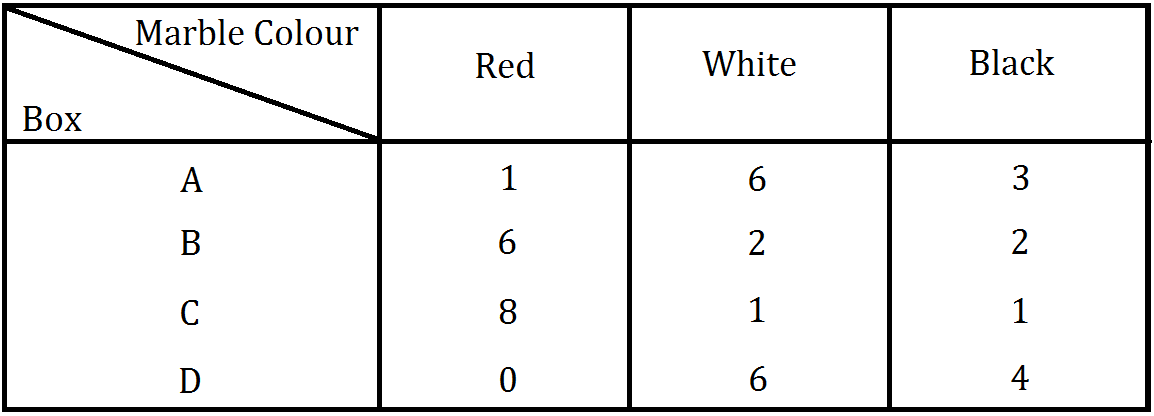
Suppose we have four boxes A, B, C, D containing coloured marbles as given below:
One of the boxes has been selected at random and a single marble is drawn from it. If the marble is red, what is the probability that it was drawn from,
  1. Box A?
  2. Box B?
  3. Box C?
At what points on the following curves, is the tangent parallel to x-axis?
$\text{y}=\text{e}^{1-\text{x}^2}\text{ on }[-1,1]$
A man, 2m tall, walks at the rate of $1\frac{2}{3}\text{m/s}$ towards a street light which is $5\frac{1}{3}\text{m}$ above the ground. At what rate is the tip of his shadow moving? at what rate is the length of the shadow changing when he is $3\frac{1}{3}\text{m}$ from the base of the light?
Evaluate the following integrals:
$\int\frac{1}{\text{x}^2-10\text{x}+34}\text{dx}$
A manufacturer produces two products A and B. Both the products are processed on two different machines. The available capacity of first machine is 12 hours and that of second machine is 9 hours per day. Each unit of product A requires 3 hours on both machines, and each unit of product B requires 2 hours on first machine and 1 hour on second machine. Each unit of product A is sold at 7 profit and that of B at a profit of 4. Find the production level per day for maximum profit graphically.
find the area of the region ${(x, y) : y^2 < 8x, x^2 + y^2 < 9}.$