Question
Find the angles between the lines whose direction cosines $l, m, n$ satisfy the equations $5l + m + 3n = 0$ and $5mn − 2nl + 6lm = 0$

Answer

$ 51+m+3 n=0\ldots[Given]$
$\therefore m=-(5 I+3 n)\ldots(i)$
$5 m n-2 n l+6 l m=0\ldots[Given] \$
$therefore-5(5 l+3 n) n-2 n l-6 l(5 l+3 n)=0\ldots[[From (i)]$
$\therefore-25\left|n-15 n^2-2 n l-30\right|^2-18 n l=0$
$\therefore-\left.30\right|^2-45 \ln -15 n^2=0$
$\therefore 21^2+3 \ln +n^2=0$
$\therefore(2 l+n)(1+n)=0$
$\therefore n =-21 \text { or } n =-1$
If $n=-2 I$, then from (i), we get
$ m=-[5 \mid+3(-2 l)]$
$\therefore m=1$
$\therefore m=1, n=-21 $
$\therefore$ Direction ratios of the first line are proportional to $I , I ,-2 l$
i.e., $1,1,-2$
If $n=-1$, then from (i), we get
$ m=-[5 \mid+3(-1)]$
$\therefore m=-21$
$\therefore m=-21, n=-1 $
$\therefore$ Direction ratios of the second line are proportional to $I ,-2 l ,- I$
i.e., $1,-2,-1$
Let $\theta$ be the angle between the two lines.
$ \therefore \cos \theta=\left|\frac{1(1)+1(2)+(-2)(-1)}{\sqrt{1^2+1^2+(-2)^2} \cdot \sqrt{1^2+(-2)^2+(-1)^2}}\right|$
$=\left|\frac{1-2+2}{\sqrt{1+1+4} \cdot \sqrt{1+4+1}}\right|$
$=\left|\frac{1}{\sqrt{6} \cdot \sqrt{6}}\right|$
$=\frac{1}{6}$
$\therefore \theta=\cos ^{-1}\left(\frac{1}{6}\right) $

Need a full question paper?

Generate a complete, print-ready paper with questions like this in minutes — across 16+ boards, with answer keys.

Start Generating Free

Similar questions

Find the equations of the tangents to the curve $x^2+y^2-2 x-4 y+1=0$ which are parallel

to the X-axis

Find the volume of the parallelopiped whose vertices are $A (3, 2, -1), B (-2, 2, -3) C (3, 5, -2)$ and $D (-2, 5, 4).$
Find the expected value, variance and standard derivation of random variable $X$ whose probability mass function $(p.m.f.)$ is given below
$X =x$ $1$ $2$ $3$
$P ( X =x)$ $\frac{1}{5}$ $\frac{2}{5}$ $\frac{2}{5}$
Find the inverse of the following matrices by the adjoint method : $\left[\begin{array}{ccc}1 & 0 & 0 \\ 3 & 3 & 0 \\ 5 & 2 & -1\end{array}\right]$
Differentiate the following w. r. t. x.$(x+1)^{\frac{3}{2}}(2 x+3)^{\frac{5}{2}}(3 x+4)^{\frac{2}{3}}$ for $x \geq 0$
If the centroid of a tetrahedron OABC is (1, 2, -1) where A = (a, 2, 3), B = (1, b, 2), C = (2, 1, c) respectively, find the distance of P (a, b, c) from the origin.
Show that the combined equation of a pair of lines through the origin and each making an

angle of $\alpha$ with the line $x+y=0$ is $x^2+2(\sec 2 \alpha) x y+y^2=0$.
Without using truth table prove that $(p \wedge q) \vee(\sim p \wedge q) \vee(p \wedge \sim q) \equiv p \vee q$
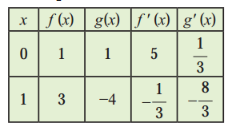
Suppose that the functions f and g and their derivatives with respect to x have the following values at x = 0 and x = 1.

Image

(i) The derivative of f[g(x)] w.r.t. x at x = 0 is _______ (ii) The derivative of g[f(x)] w.r.t. x at x = 0 is _______

(iii) The value of $\left[\frac{d}{d x}\left[x^{10}+f(x)\right]^{-2}\right]_{x=1}$ is

(iv) The derivative of f[(x+g(x))] w.r.t. x at x = 0 is _______

The volume of the spherical ball is increasing at the rate of $4\pi \ cc/\sec.$ Find the rate at which the radius and the surface area are changing when the volume is 288 π cc