Question
Find the angular separation between the consecutive bright fringes in a Young's double slit experiment with blue$-$green light of wavelength $500\ nm$. The separation between the slits is $2.0 \times 10^{-3}m$.
Answer

Given that, $\lambda=500\text{nm}=500\times10^{-9}\text{m}$ and $d = 2 \times 10^{-3}m$

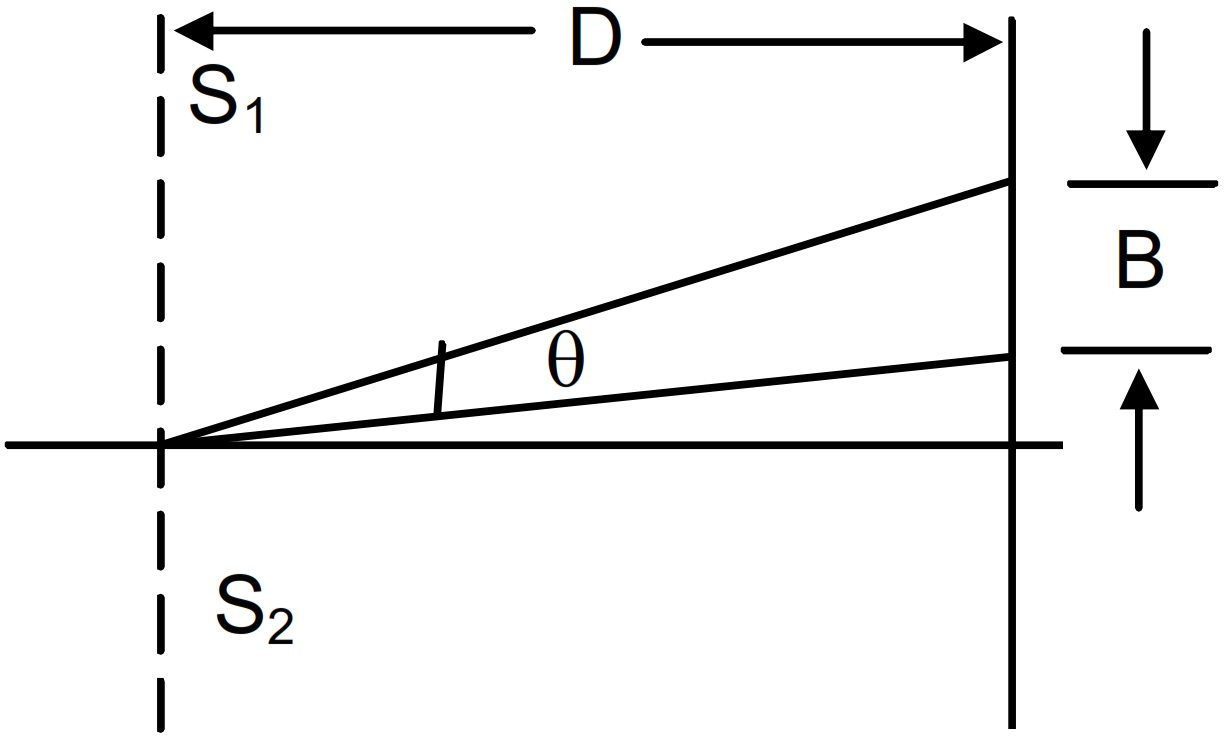
As shown in the figure, angular separation $\theta=\frac{\beta}{\text{D}}=\frac{\lambda\text{D}}{\text{dD}}=\frac{\lambda}{\text{d}}$
So, $\theta=\frac{\beta}{\text{D}}=\frac{\lambda}{\text{d}}=\frac{500\times10^{-9}}{2\times10^{-3}}=250\times10^{-6}$
$= 25 \times 10^{-5}$ radian $= 0.014$ degree.

Need a full question paper?

Generate a complete, print-ready paper with questions like this in minutes — across 16+ boards, with answer keys.
Start Generating Free

Similar questions

The magnetic field inside a tightly wound, long solenoid is $\text{B}=\mu_0\text{ni}.$ It suggests that the field does not depend on the total length of the solenoid, and hence if we add more loops at the ends of a solenoid the field should not increase. Explain qualitatively why the extra-added loops do not have a considerable effect on the field inside the solenoid.
When $40\ kV$ is applied across an $X-$ray tube, $X-$ray is obtained with a maximum frequency of $9.7 \times 10^{18}Hz.$ Calculate the value of Planck constant from these data.
Why are small pieces of paper attracted by a dry comb rubbed against dry hair?
Electric charge is distributed in a small volume. The electric flux passing through a total charge enclosed by a spherical surface of radius 10 cm is 10 Vm . Then what will be the flux associated with a concentric sphere of radius 20 cm ?
A 30.0cm long wire having a mass of 10.0g is fixed at the two ends and is vibrated in its fundamental mode. A 50.0cm long closed organ pipe, placed with its open end near the wire, is set up into resonance in its fundamental mode by the vibrating wire. Find the tension in the wire. Speed of sound in air = 340m/s.
A string is wrapped over the edge of a uniform disc and the free end is fixed with the ceiling. The disc moves down, unwinding the string. Find the downward acceleration of the disc.
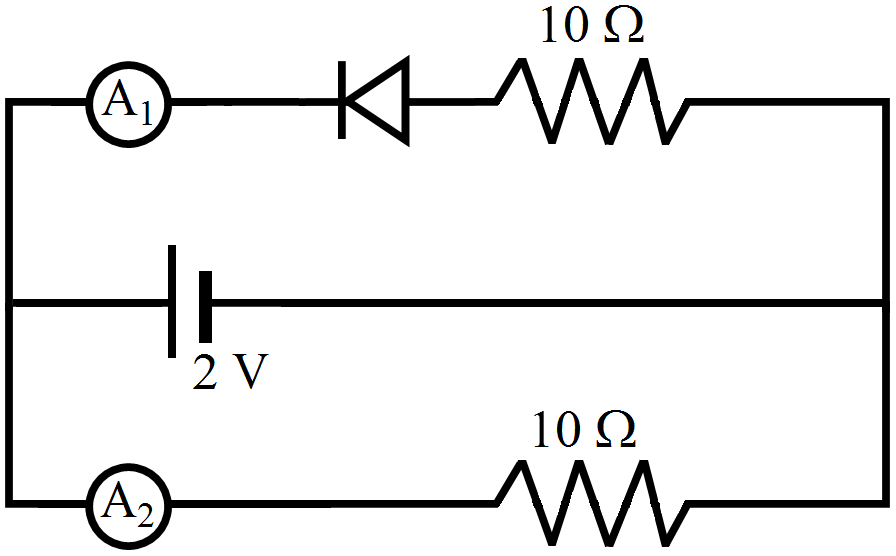
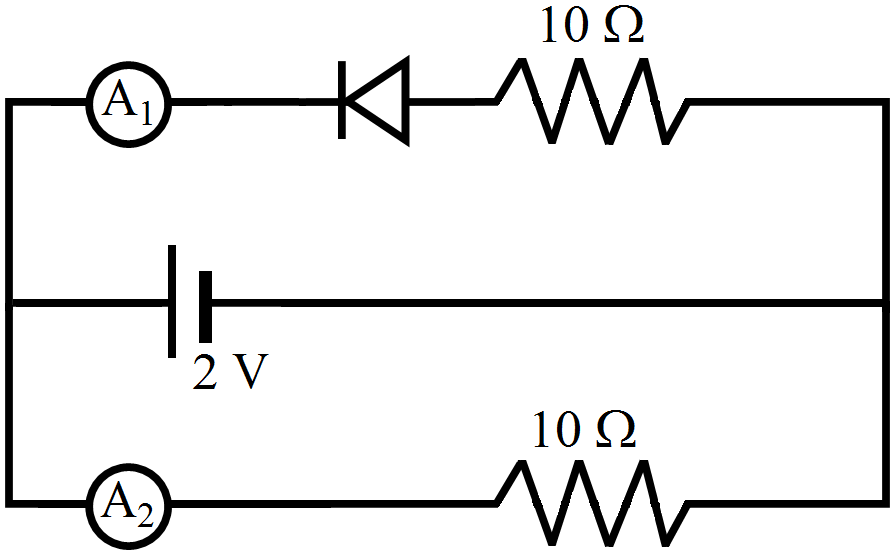
What are the readings of the ammeters $A_1$ and $A_2$ shown in figure. Neglect the resistance of the meters.​​​​​​​
A nearsighted person cannot clearly see beyond 200cm. Find the power of the lens needed to see objects at large distances.
Write the formula to find the Rydberg's constant and what is the value of their constant?
What are the (a) momentum, (b) de-Broglie wavelength of an electron with kinetic energy of 120 eV. ? Find.