Question
Find the area between the curves $y = x$ and $y = x^2$​​​​​​​.

Answer

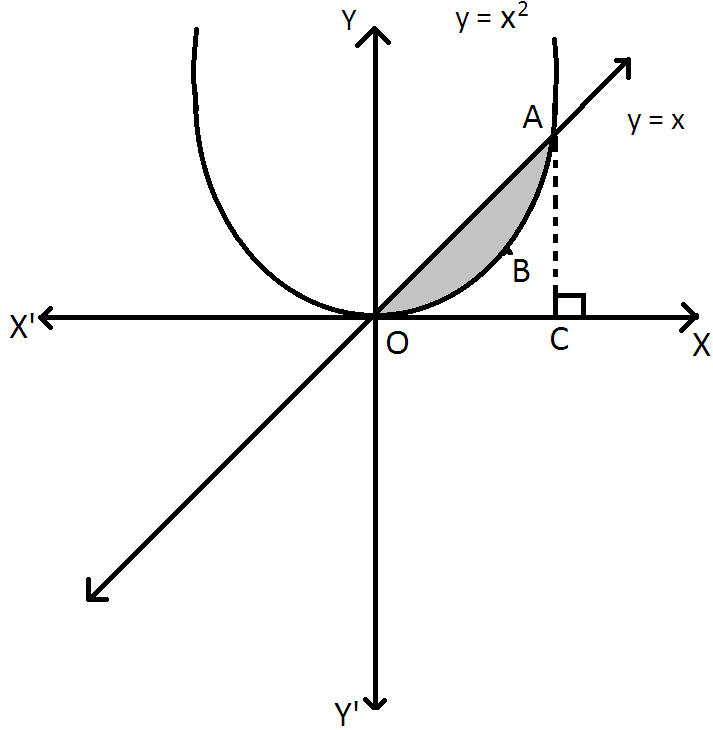
The required area is represented by the shaded area OBAO as

The points of intersection of the curves, $y = x$ and $y = x^2$, is $A(1, 1)$.
We draw AC perpendicular to x-axis.
$\therefore$ Area (OBAO) = Area $(\Delta\text{ OCA})$ - Area (OCABO) ...(i)
$=\int\limits^1_0\text{x dx}-\int\limits^1_0\text{x}^2\text{dx}$
$=\Big[\frac{\text{x}^2}{2}\Big]^1_0-\Big[\frac{\text{x}^3}{3}\Big]^1_0$
$=\frac12-\frac13$
$=\frac16\text{ units}$

Need a full question paper?

Generate a complete, print-ready paper with questions like this in minutes — across 16+ boards, with answer keys.
Start Generating Free

Similar questions

Using differentials, find the approximate values of the following:
$\sin\Big(\frac{22}{14}\Big)$
Find the equation of the plane that bisects the line segment joining the points (1, 2, 3) and (3, 4, 5) and is at right angle to it.
$\text{If y = 3} \cos (\log\text{x}) + 4\sin (\log \text{x}), \text{then show that x}^{2} .\frac{\text{d}^{2}{\text{y}}}{\text{dx}^{2}} + \text{y} = 0$
Differentiate the following functions with respect to x:
$\sin^{-1}\Big\{\frac{\sqrt{1+\text{x}}+\sqrt{1-\text{x}}}{2}\Big\},0<\text{x}<1$
One kind of cake requires 200 g of flour and 25 g of fat, and another kind of cake requires 100 g of flour and 50 g of fat. Find the maximum number of cakes which can be made from 5 kg of flour and 1 kg of fat assuming that there is no shortage of the other ingredients used in making the cakes.
Find the shortest distance between the following pairs of lines whose cartesian equation are:
$\frac{\text{x}-3}{1}=\frac{\text{y}-5}{-2}=\frac{\text{z}-7}{1}$ and $\frac{\text{x}+1}{7}=\frac{\text{y}+1}{-6}=\frac{\text{z}+1}{1}$
Differentiate the following functions with respect to x:
$\frac{\text{e}^{2\text{x}}+\text{e}^{-2\text{x}}}{\text{e}^{2\text{x}}-\text{e}^{-2\text{x}}}$
Differentiate the function given in Exercise:
$(\text{x}\cos\text{x})^\text{x}+(\text{x}\sin\text{x})^{\frac{1}{\text{x}}}$
There are three coins. One is two headed coin, another is a biased coin that comes up heads 75% of the time and third is an unbiased coin. One of the three coins is chosen at random and tossed, it shows heads, what is the probability that it was the two headed coin?
Prove the following identities:
$\begin{vmatrix}\text{a}^3&2&\text{a}\\\text{b}^3&2&\text{b}\\\text{c}^3&2&\text{c}\end{vmatrix}$
$=2(\text{a}-\text{b})(\text{b}-\text{c})(\text{c}-\text{a})(\text{a}+\text{b}+\text{c})$