Question
Find the area bounded by curves $\left\{(\text{x, y}):\text{y}\geq\text{x}^2 \text{ and y}=|\text{x}|\right\}.$
Answer

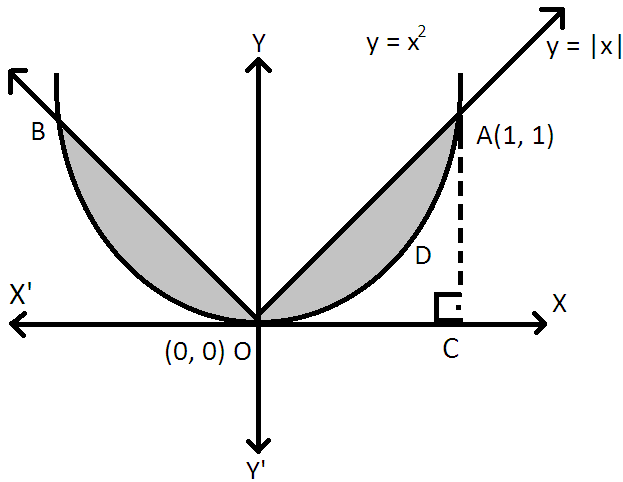
The area bounded by the curves, $\left\{(\text{x, y}):\text{y}\geq\text{x}^2 \text{ and y}=|\text{x}|\right\},$ is represented by the shaded region as

It can be observed that the required area is symmetrical about y-axis.
Required area = 2[Area(OCAO) - Area(OCADO)]
$=2\Bigg[\int\limits^1_0\text{x dx}-\int\limits^1_0\text{x}^2\text{dx}\Bigg]$
$=2\bigg[\Big[\frac{\text{x}^2}{2}\Big]^1_0-\Big[\frac{\text{x}^3}{3}\Big]^1_0\bigg]$
$=2\Big[\frac12-\frac13\Big]$
$=2\Big[\frac16\Big]=\frac13\text{units}$

Need a full question paper?

Generate a complete, print-ready paper with questions like this in minutes — across 16+ boards, with answer keys.

Start Generating Free

Similar questions

Find the binomial distribution whose mean is 5 and variance $\frac{10}{3}.$
Show that $\text{y}=\text{ae}^{2\text{x}}+\text{be}^{-\text{x}}$ is a solution of the differential equation $\frac{\text{d}^2\text{y}}{\text{dx}^2}-\frac{\text{dy}}{\text{dx}}-2\text{y}=0$
Of all the closed cylindrical cans (right circular), of a given volume of 100 cubic centimeters, find the dimensions of the can which has the minimum surface area?
A dietician wishes to mix together two kinds of food X and Y in such a way that the mixture contains at least 10 units of vitamin A, 12 units of vitamin B and 8 units of vitamin C. The vitamin contents of one kg food is given below:
Food
Vitamin A
Vitamin B
Vitamin C
X
1
2
3
Y
2
2
1
One kg of food X costs Rs. 16 and one kg of food Y costs Rs 20. Find the least cost of the mixture which will produce the required diet?
If $\text{x}\sqrt{1+\text{y}}+\text{y}\sqrt{1+\text{x}}=0,$ prove that $(1+\text{x})^2\frac{\text{dx}}{\text{dx}}+1=0$
Find the particular solution of the differential equation
$2y e^{x/y} dx + (y – 2x e^{x/y}) dy = 0,$ given that $x = 0$ when $y = 1.$
If $\text{y}=(\text{x}-1)\log(\text{x}-1)-(\text{x}+1)\log(\text{x}+1)$ prove that $\frac{\text{dy}}{\text{dx}}=\log\Big(\frac{\text{x}-1}{1+\text{x}}\Big)$
In a bank principal increases at the rate of 5% per year. An amount of Rs $1000$ is deposited with this bank, how much will it worth after $10$ years $(e^{0.5_=}1.648).$
Solve the following differential equation
$\cos\text{x }\frac{\text{dy}}{\text{dx}}-\cos2\text{x}=\cos3\text{x}$
Find $\frac{\text{dy}}{\text{dx}}$
$\text{y}=\text{x}^{\log\text{x}}+(\log\text{x}^\text{x})$