Question
Find the area bounded by the curve $\text{y}=\sin\text{x}$ between x = 0 and $\text{x}=2\pi.$
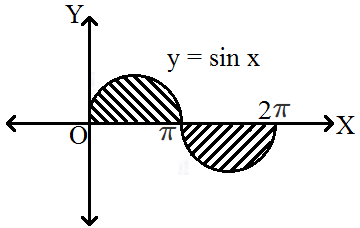
Answer

Required area $=\int\limits^{2\pi}_0\sin\text{x dx}=\int\limits^{\pi}_0\sin\text{x dx}+\Big|\int\limits^{2\pi}_\pi\sin\text{x dx}|$ $=-\big[\cos\text{x}\big]^\pi_0+\Big|\big[-\cos\text{x}\big]^{2\pi}_\pi\Big|$ $=-\big[\cos\pi-\cos0\big]+\Big|-\big[\cos2\pi-\cos\pi\big]\Big|$
$=-\big[-1-1\big]+\big|-(1+1)\big|$ $=2+2=4\text{ sq. units}$

Need a full question paper?

Generate a complete, print-ready paper with questions like this in minutes — across 16+ boards, with answer keys.

Start Generating Free

Similar questions

Find $\left| {\vec a} \right|$ and $\left| {\vec b} \right|$ if $\left( {\vec a + \vec b} \right).\left( {\vec a - \vec b} \right) = 8$ and $\left| {\vec a} \right| = 8\left| {\vec b} \right|$
Using the fact that $\sin(\text{A}+\text{B})=\sin\text{A}\cos\text{B}+\cos\text{A}\sin\text{B}$and the differentiation, obtain the sum formula for cosines.
If $​​\vec{\text{a}}+​​\vec{\text{b}}​​+\vec{\text{c}}=\vec{0,}$ show that the angle $\theta$ between the vectors $​​\vec{\text{b}}$ and $\vec{\text{c}}$ is given by $\cos\theta=\frac{|\vec{\text{a}}|^2-\big|\vec{\text{b}}\big|^2-|\vec{\text{c}}|^2}{2\big|\vec{\text{b}}\big||\vec{\text{c}}|}.$
Find the value of $\cot \frac{1}{2} \bigg[ \cos^{-1} \frac{\text{2x}}{\text{1 + x}^{2}} + \sin^{-1} \frac{1- \text{y}^{2}}{\text{1+ y}^{2}}\bigg], \text{|x|} < 1, \text{y} > 0 \text{ and xy} < 1.$
Write minors and cofactors of the element of $\left| {\begin{array}{*{20}{c}} 1&0&0 \\ 0&1&0 \\ 0&0&1 \end{array}} \right|$
Let $A = {1, 2, 3},$ and let $R_1 = {(1, 1), (1, 3), (3, 1), (2, 2), (2, 1), (3, 3)}$. Find whether or not the relations $R_1$ on $A$ is:
  1. Reflexive.
  2. Symmetric.
  3. Transitive.
Evaluate the following integrals:$\int\frac{1}{\sqrt{(1-\text{x}^2)\big\{9+\big(\sin^{-1}\text{x}\big)^2\big\}}}\text{ dx}.$
Evaluate the following definite integrals:
$\int_{0}^\limits{\frac{\pi}{4}}\text{x}^2\sin\text{x}\text{ dx}$
Solve system of linear equations, using matrix method.
x - y + 2z=7
3x + 4y - 5z = -5
2x - y + 3z = 12
Find in vector form as wel as in cartesian form, the equation of the line passing through the points $A(1, 2, -1)$ and $B(2, 1, 1)$.