Question
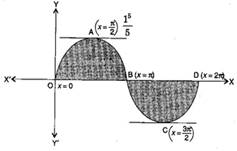
Find the area bounded by the curve y = sin x between x = 0 and $x = 2\pi $
Answer

Equation of the curve is y = sin x …(i)
$\therefore y = \sin x \geqslant 0$ for $0 \leqslant x \leqslant \pi $ i.e., graph is in first and second quadrant.
And $y = \sin x \leqslant 0$ for $\pi \leqslant x \leqslant 2\pi $ i.e., graph is in third and fourth quadrant.

If tangent is parallel to x - axis, then $\frac{{dy}}{{dx}} = 0$
$ \Rightarrow \cos x = 0$
$ \Rightarrow x = \frac{\pi }{2},\frac{{3\pi }}{2}$
Table of values for curve y = sin x between x = 0 and $x = 2\pi $

x

0

$\frac{\pi }{2}$

$\pi $

$\frac{{3\pi }}{2}$

$2\pi $

y

0

1

0

- 1

0

Now Required shaded area = Area OAB + Area BCD
$= \left| {\int\limits_0^\pi {ydx} } \right| + \left| {\int\limits_\pi ^{2\pi } {ydx} } \right|$
$= \left| {\int\limits_0^\pi {\sin xdx} } \right| + \left| {\int\limits_\pi ^{2\pi } {\sin xdx} } \right|$
$= \left| { - \left( {\cos x} \right)_0^\pi } \right| + \left| { - \left( {\cos x} \right)_\pi ^{2\pi }} \right|$
$= \left| { - \left( {\cos \pi - \cos 0} \right)} \right| + \left| { - \left( {\cos 2\pi - \cos \pi } \right)} \right|$
$= \left| { - \left( { - 1 - 1} \right)} \right| + \left| { - \left( {1 + 1} \right)} \right|$
= 2 + 2 = 4 sq. units

Need a full question paper?

Generate a complete, print-ready paper with questions like this in minutes — across 16+ boards, with answer keys.

Start Generating Free

Similar questions

Evalute the following integrals:
$\int\frac{1}{\sqrt{1-\text{x}^2}(2+3\sin^{-1}\text{x})}\text{dx}$
An urn contains 10 white and 3 black balls. Another urn contains 3 white and 5 black balls. Two are drawn from first urn and put into the second urn and then a ball is drawn from the latter. Find the probability that its is a white ball.
Find the real solutions of the equation $\tan^{-1}\sqrt{\text{x}(\text{x}+1)}+\sin^{-1}\sqrt{\text{x}^2+\text{x}+1}=\frac{\pi}{2}.$
Find the value of $\lambda$ so that the following lines are perpendicular to each other.$\frac{\text{x}-5}{5\lambda+2}=\frac{2-\text{y}}{5}=\frac{1-\text{z}}{-1},\frac{\text{x}}{1}=\frac{2\text{y}+1}{4\lambda}=\frac{1-\text{z}}{-3}$
Show that the relation R defined by (a, b) R (c, d) $\Rightarrow$ a + d = b + c on the set N × N is an equivalence relation.
Write the ratio in which the plane $4x + 5y − 3z = 8$ divides the line segment joining the points $(−2, 1, 5)$ and $(3, 3, 2).$
In answering a question on a multiple choice questions test with four choices in each question, out of which only one is correct, a student either guesses or copies or knows the answer. The probability that he makes a guess $\frac{1}{4}$
and the probability the he copies is also $\frac{1}{4}$ The probability that the answer is correct, given that he copied it is $\frac{3}{4}$ Find the probability that he knows the answer to the question, given that he correctly answered it.
Evaluate the following integrals:$\int\frac{\text{e}^\text{x}}{(1+\text{e}^{\text{x}})(2+\text{e}^\text{x})}\text{dx}$
Show that the relation $''\geq''$ on the set R of all real numbers is reflexive and transitive but not symmetric.
Find the general solution of the differential equation $\left(1+x^2\right) \frac{d y}{d x}-x=2 \tan ^{-1} x$