Question
Find the area enclosed by the curve $\text{x}=3\cos\text{t}, \text{y}=2\sin\text{t}.$
Answer

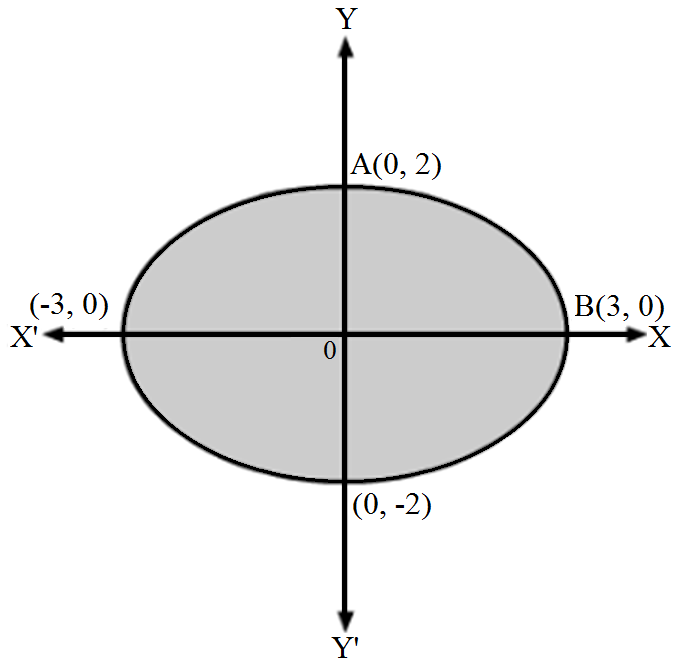
The given curve $\text{x}=3\cos\text{t}, \text{y}=2\sin\text{t}$in t respesent the parmetric of the elipse. Eliminating the t, we get $\frac{\text{x}^{2}}{9}+\frac{\text{y}^{2}}{4}=\cos^{2}\text{t}+\sin^{2}\text{t}=1$ This represents the cartesion eqution of the elioes with center (0, 0). The coordinates of the vertics are (3, 0) and (0, 2)
Required area = Area of the shaded region = 4 × Area of the region OABO $=4\times \int\limits_{0}^{3}\text{y}\text{dx} $ $=4\times \int\limits_{0}^{3}\sqrt{4(1-\frac{\text{x}^{2}}{9})}\text{dx}$ $=4\times \frac{2}{3}\int\limits_{0}^{3}\sqrt{9-\text{x}^{2}}{})\text{dx}$ $=\frac{8}{3}\Big[(0+\frac{9}{2}\sin^{-1}1)-(0+0)\Big] $ $=\frac{8}{3}\times\frac{9}{2}\times\frac{\pi}{2}$ $=6\pi\ \text{sq.}\ \text{units}$

Need a full question paper?

Generate a complete, print-ready paper with questions like this in minutes — across 16+ boards, with answer keys.

Start Generating Free

Similar questions

Three persons $A, B, C$ throw a die in succession till one gets a 'six' and wins the game. Find their respective probabilities of winning.
Find the particular solution of the differential equation $\text{x}\cos\Big(\frac{\text{y}}{\text{x}}\Big)\frac{\text{dy}}{\text{dx}}=\text{y}\cos\Big(\frac{\text{y}}{\text{x}}\Big)+\text{x},$ given that when $\text{x}=1,\text{y}=\frac{\pi}4$.
A manufacturer has three machine I, II, III installed in his factory. Machines I and II are capable of being operated for at most 12 hours whereas machine III must be operated for atleast 5 hours a day. She produces only two items M and N each requiring the use of all the three machines.
The number of hours required for producing 1 unit each of M and N on the three machines are given in the following table:
Item
Number of hours required on machines
 
I
II
III
M
1
2
1
N
2
1
1.25
She makes a profit of Rs. 600 and Rs. 400 on items M and N respectively. How many of each item should she produce so as to maximise her profit assuming that she can sell all the items that she produced? What will be the maximum profit?
Evaluate the following definite integrals:
$\int\limits_{\frac{\pi}{2}}^{\pi}\text{e}^{\text{x}}\Big(\frac{1-\sin\text{x}}{1-\cos\text{x}}\Big)\text{dx}$
Evaluate the following intregals:
$\int\frac{18}{(\text{x}+2)(\text{x}^2+4)}\text{ dx}$
$\begin{vmatrix}-\text{a}(\text{b}^2+\text{c}^2-\text{a}^2)&2\text{b}^3&2\text{c}^3\\2\text{a}^3&-\text{b}(\text{c}^2+\text{a}^2-\text{b}^2)&2\text{c}^3\\2\text{a}^3&2\text{b}^3&-\text{c}(\text{a}^2+\text{b}^2-\text{c}^2)\end{vmatrix}$
$=\text{abc}(\text{a}^2+\text{b}^2+\text{c}^2)$
Evaluate the following integrals:
$\int\limits_{0}^{\frac{\pi}{4}}\big(\text{a}^2\cos^2\text{x}+\text{b}^2\sin^2\text{x}\big)\text{dx}$
A firm has to transport 1200 packages using large vans which can carry 200 packages each and small vans which can take 80 packages each. The cost for engaging each large van is Rs. 400 and each small van is Rs. 200. Not more than Rs. 3000 is to be spent on the job and the number of large vans can not exceed the number of small vans. Formulate this problem as a LPP given that the objective is to minimise cost.
Write the number of points where f(x) = |x| + |x − 1| is continuous but not differentiable.
$=\begin{bmatrix}1&1&\text{x}\end{bmatrix}\begin{bmatrix}1&0&2\\0&2&1\\2&1&0\end{bmatrix}\begin{bmatrix}1\\1\\1\end{bmatrix}=0,$ find x.