Question
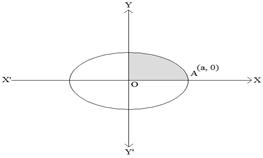
Find the area enclosed by the ellipse $\frac{{{x^2}}}{{{a^2}}} + \frac{{{y^2}}}{{{b^2}}} = 1$
Answer

$\frac{{{x^2}}}{{{a^2}}} + \frac{{{y^2}}}{{{b^2}}} = 1$
$ = 4\int_0^a {\frac{b}{a}\sqrt {{a^2} - {x^2}} dx} $
$=\frac{4b}{a} \left[ {\frac{x}{2}\sqrt{a^2-x^2}+\frac{a^2}{2}sin^{-1}(\frac{x}{a})} \right]_0^a$
$=\frac{4b}{a} \left[ {(\frac{a}{2}×0+\frac{a^2}{2}sin^{-1}1)-0} \right]$
$= \frac{4b}{a}\frac{a^2}{2}\frac{π}{2}$
$ = \pi ab$ sq. units

Need a full question paper?

Generate a complete, print-ready paper with questions like this in minutes — across 16+ boards, with answer keys.

Start Generating Free

Similar questions

verify that $\text{y}=\text{cx}+2\text{c}^2$ is a solution of the differential equation $2\Big(\frac{\text{d}\text{y}}{\text{dx}}\Big)^2-\text{x}\frac{\text{dy}}{\text{dx}}+\text{y}=0$
Write a value of $\int\frac{\cos\text{x}}{\sin\text{x}\log\sin\text{x}}\text{ dx}$
Find $\frac{\text{dy}}{\text{dx}}$ in the following cases:
$xy = c^2$
Test whether the following relations $R_1$ are:
  1. Reflexive.
  2. Symmetric.
  3. Transitive.
$R_1$ on $Q_0$ defined by $(\text{a, b})\in\text{R}_1\Leftrightarrow\ \text{a}=\frac{1}{\text{b}}.$
Evaluate the following integrals:$\int\frac{1}{\sqrt{2\text{x}-\text{x}^2}}\text{ dx}$
Show that $\text{Ax}^2+\text{By}^2=1$ is a solution of the differential equation $\text{x}\Big\{\text{y}=\text{x}\frac{\text{d}^2\text{y}}{\text{dx}^2}+\Big(\frac{\text{dx}}{\text{dy}}\Big)^2\Big\}=\text{y}\frac{\text{dy}}{\text{dx}}.$
Evaluate the following definite integrals:
$\int_{0}^\limits{\frac{\pi}{2}}\sin\text{x }\sin2\text{x}\text{ dx}$
Find the vector equation of the plane with intercepts 3, -4 and 2 on x, y and z-axis respectively.
An instructor has a test bank consisting of 300 easy True/False questions, 200 difficult True/False questions, 500 easy multiple choice questions and 400 difficult multiple choice questions. If a question is selected at random from the test bank, what is the probability that it will be an easy question given that it is a multiple choice question?
If the sum of two unit vectors is a unit vector prove that the magnitude of their difference is $\sqrt{3.}$