Question
Find the area included between the parabolas y2 = 4ax and x2 = 4 by.
Answer

To find area enclosed by

y2 = 4ax ..(i)

x2 = 4by ...(ii)

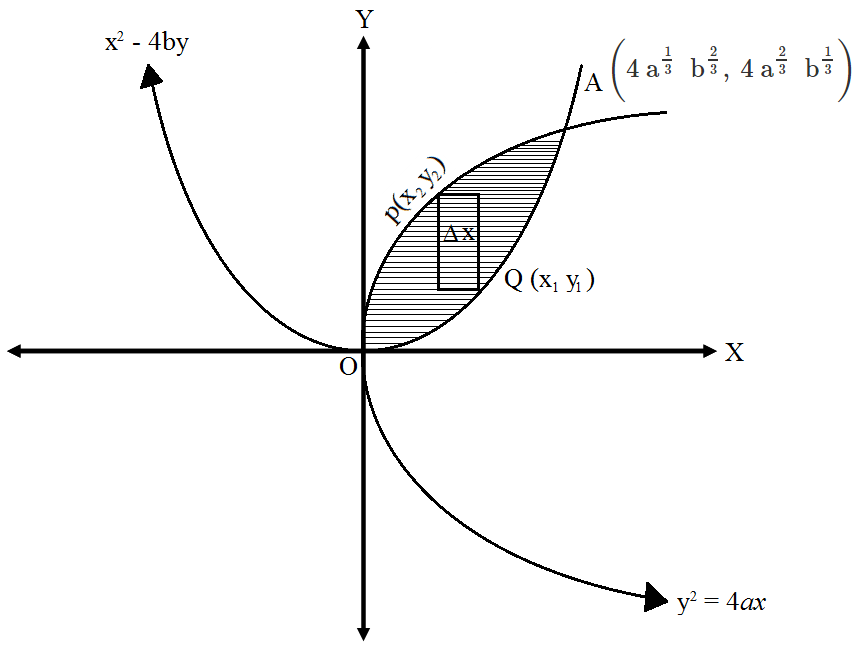
Equation (i) represents a parabola with vertex (0. 0) at origin and axis as x-axis and equation (ii) represents a line parallel to vertex (0, 0) y-axis.

points of intersection of parbola are (0, 0) and $\Big(4\text{a}\frac{1}{3}\ \text{b}\frac{2}{3}, 4\text{a}\frac{2}{3}\ \text{b}\frac{1}{3}\Big)$

A rough sketch of the equations is as below :

The shaded region is requrid slides from x = 0 to $\text{x}=4\text{a}\frac{1}{3}\ \text{b}\frac{2}{3}$

Requrided area = Region OQAPO

$=\int\limits_{0}^{4\text{a}\frac{1}{3}\text{b}\frac{2}{3}}(\text{y}_{1}-\text{y}_{2})\text{dx} $

$=\int\limits_{0}^{4\text{a}\frac{1}{3}\text{b}\frac{2}{3}}\Big(2\sqrt{\text{a}}.\sqrt{\text{x}}-\frac{\text{x}^{2}}{4\text{b}}\Big)\text{dx}$

$=\bigg[2\sqrt{\text{a}}.\frac{2}{3}\sqrt{\text{x}}-\frac{\text{x}^{3}}{12\text{b}}\Big)\text{dx}\bigg]^{4\text{a}\frac{1}{3}\text{b}\frac{2}{3}}$

$=\frac{32\sqrt{\text{a}}}{3}\text{a}\frac{1}{3}\ \text{b}\frac{2}{3}\ \text{a}\frac{1}{6}\ \text{b}\frac{1}{3}-\frac{64\text{ab}^{2}}{12\text{b}}$

$=\frac{32}{3}\text{ab}-\frac{16}{3}\text{ab}$

$=\frac{16}{3}\ \text{sq.}\ \text{units}$

Need a full question paper?

Generate a complete, print-ready paper with questions like this in minutes — across 16+ boards, with answer keys.

Start Generating Free

Similar questions

Find whether the function is differentiable at x = 1 and x = 2
$\text{f(x)}=\begin{cases}\text{x} & \text{x}\leq1\\2-\text{x} & 1\leq\text{x}\leq2\\-2+3\text{x}&\text{x}>2\end{cases}$
Find the coordinate of the point P where the line through $\text{A(3, – 4, –5) and B (2, –3, 1)}$ crosses the plane passing through three points L(2, $\text{2, 1), M(3, 0, 1) and N(4, –1, 0).}$ Also, find the ratio in which P divides the line segment AB.
 
Prove that the curves y2 = 4x and x2 + y2 - 6x + 1 = 0 touch each other at the point (1, 2).
The management committee of a residential colony decided to award some of its members (say x) for honesty, some (say y) for helping others and some others (say z) for supervising the workers to keep the colony neat and clean. The sum of all the awardees is 12. Three times the sum of awardees for cooperation and supervision added to two times the number of awardees for honesty is 33. If the sum of the number of awardees for honesty and supervision is twice the number of awardees for helping others, using matrix method, find the number of awardees of each category. Apart from these values, namely, honesty, cooperation and supervision, suggest one more value which the management of the colony must include for awards.
It is given that the Rolle's theorem holds for the function f(x) = x3 + bx2 + cx, $\text{x}\in[1,2]$ at the point $\text{x}=\frac{4}{3},$ the values of b and c.
Solve the following differential equation:
$\frac{\text{dy}}{\text{dx}}\cos(\text{x}-\text{y})=1$
Five bad oranges are accidently mixed with 20 good ones. If four oranges are drawn one by one successively with replacement, then find the probability distribution of number of bad oranges drawn. Hence find the mean and variance of the distribution.
Evaluate the following integrals:
$\int_{0}^\limits{1}\text{x}\tan^{-1}\text{x}\text{ dx} $
If li, mi, ni ; i = 1, 2, 3 denotes the direction cosines of three mutually perpendicular vectors in space, prove that AAT = I, where
$\text{A}=\begin{bmatrix}\text{l}_1&\text{m}_1&\text{n}_1\\\text{l}_2&\text{m}_2&\text{n}_2\\\text{l}_3&\text{m}_3&\text{n}_3 \end{bmatrix}.$
Solve the differential equation (1 + y2) tan-1x dx + 2y (1 + x2) dy = 0.