Question
Find the average velocity of a projectile between the instants it crosses half the maximum height. It is projected with a speed u at an angle $\theta$ with the horizontal.
Answer

Total of flight $\text{T}=\frac{2\text{u}\sin\theta}{\text{g}}$
Average velocity $=\frac{\text{change in displacement}}{\text{time}}$
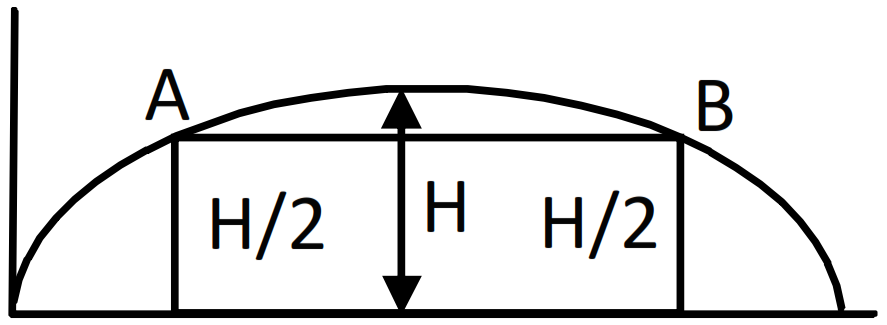
From the figure, it can be said AB is horizontal. So there is no effect of vertical component of the velocity during this displacement.
So because the body moves at a constant speed of $'\text{u}\cos\theta'$ in horizontal direction.
The average velocity during this displacement will be $\text{u}\cos\theta$ in the horizontal direction.

Need a full question paper?

Generate a complete, print-ready paper with questions like this in minutes — across 16+ boards, with answer keys.
Start Generating Free

Similar questions

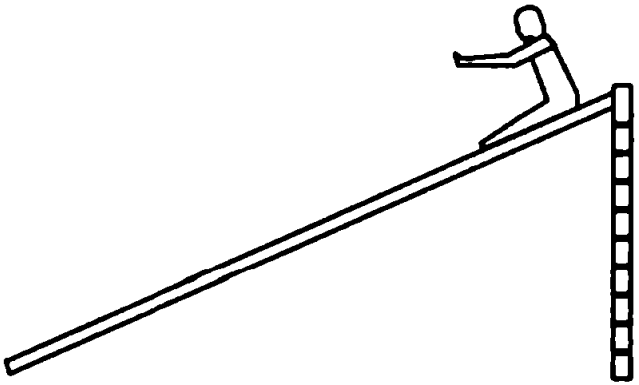
In a children's park, there is a slide which has a total length of 10m and a height of 8.0m (figure). Vertical ladder are provided to reach the top. A boy weighing 200N climbs up the ladder to the top of the slide and slides down to the ground. The average friction offered by the slide is three tenth of his weight. Find
  1. The work done by the ladder on the boy as he goes up.
  2. The work done by the slide on the boy as he comes down. Neglect any work done by forces inside the body of the boy.
Consider a head-on collision between two particles of masses $m_1$ and $m_2$. The initial speeds of the particles are $u_1$ and $u_2$ in the same direction. The collision starts 2 at t = 0 and the particles interact for a time interval $\triangle\text{t}.$ During the collision, the speed of the first particle varies as.$\text{v}(\text{t})=\text{u}_1+\frac{\text{t}}{\triangle\text{t}}(\text{v}_1-\text{u}_1).$
Find the speed of the second particle as a function of time during the collision.
A free atom of iron emits $\text{K}_\alpha$ X-rays of energy 6.4keV. Calculate the recoil kinetic energy of the atom. Mass of an iron atom $= 9.3 \times 10^{-26}kg.$
In a periodic table the average atomic mass of magnesium is given as 24.312 u. The average value is based on their relative natural abundance on earth. The three isotopes and their masses are $^{24}_{12}\text{Mg }23.98504\text{u}),^{25}_{12}\text{Mg }(24.98584\text{u})\text{ and }^{26}_{12}\text{Mg }(25.98259\text{u}).$ The natural abundance of $^{24}_{12}\text{Mg}\text{ is }78.99\%$ by mass. Calculate the abundances of other two isotopes.
A boy is holding a smooth, hollow and non-conducting pipe vertically with charged spherical ball of mass 10 g carrying a charge of +10 mC inside it which is free to move along the axis of the pipe. The boy is moving the pipe from East to West direction in the presence of magnetic field of 2T. With what minimum velocity, should the boy move the pipe such that the ball does not move along the axis. Also determine the direction of the magnetic field.
Explain briefly the process of charging a parallel plate capacitor when it is connected across a d.c. battery. A capacitor of capacitance ‘C’ is charged to ‘V’ volts by a battery. After some time the battery is disconnected, and the distance between the plates is doubled. Now a slab of dielectric constant, 1 < k < 2, is introduced to fill the space between the plates. How will the following be affected:
  1. The electric field between the plates of the capacitor.
  2. The energy stored in the capacitor.
Justify your answer by writing the necessary expressions.
We are given the following atomic masses:
${ }_{92}^{238} U=238.05079 u$
${ }_2^4 H e=4.00260 u$
${ }_{90}^{234} Th =234.04363 u$
${ }_1^1 H=1.00783 u$
${ }_{91}^{237} Pa=237.05121 u $
Here the symbol Pa is for the element protactinium $(Z = 91).$
$i.$ Calculate the energy released during the alpha decay of ${ }_{92}^{238} U$.
$ii.$ Calculate the kinetic energy of the emitted $\alpha$-particles.
$iii.$ Show that ${ }_{92}^{238} U$ can not spontaneously emit a proton.
Two parallel wires carry equal currents of 10A along the same direction and are separated by a distance of 2.0cm. Find the magnetic field at a point which is 2.0cm away from each of these wires
The near vision of an average person is 25cm. To view an object with an angular magnification of 10, what should be the power of the microscope?
Prove that the magnitude of electric current in a circuit is proportional to the drift velocity of free electrons. Verify Ohm's law with the help of drift velocity.