MCQ
Find the coordinates of the point which divides the line segment joining the points $(3,-3)$ and $(8,4)$ in the ratio $2: 1$ internally.
  • A
    $(-1,2)$
  • B
    $(3,-6)$
  • C
    $(-2,1)$
  • None of these

Answer

Correct option: D.
None of these
(d) : Let $R(x, y)$ divides the join of $P(3,-3)$ and $Q(8,4)$ in the ratio $2: 1$ internally.
$
\therefore \quad x=\frac{2(8)+1(3)}{2+1}=\frac{16+3}{3}=\frac{19}{3}
$
and $y=\frac{2(4)+1(-3)}{2+1}=\frac{8-3}{3}=\frac{5}{3}$
Thus, the coordinates of $R$ are $\left(\frac{19}{3}, \frac{5}{3}\right)$.

Need a full question paper?

Generate a complete, print-ready paper with questions like this in minutes — across 16+ boards, with answer keys.
Start Generating Free

Similar questions

The pair of linear equations $y = 0$ and $y = -6$ has.
A box contains cards numbered 6 to 55. A card is drawn at random from the box. The probability that the drawn card has a number which is a perfect square, is
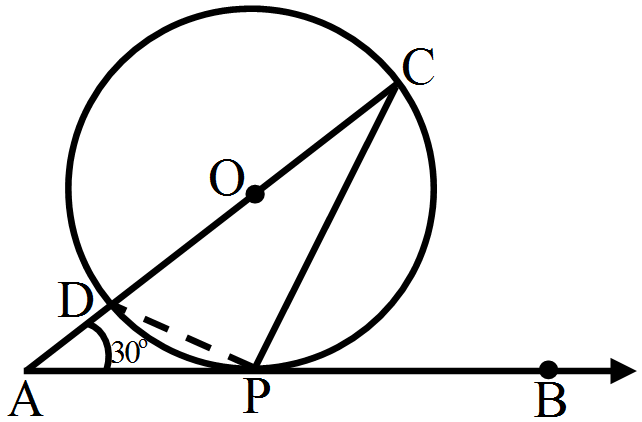
In the given figure, O is the centre of the circle. AB is the tangent to the circle at the point P. If $\angle\text{PAO} = 30^\circ$ then $\angle\text{CPB} + \angle\text{ACP}$ is equal to:
The mid$-$point of the line$-$segment $AB$ is $P(0, 4).$ If the coordinates of $B$ are $(-2, 3)$ then the co$-$ordinates of $A$ are
How many tangents can be drawn to a circle from a point on it?
If the polynomial $f(x)=a x^3+b x-c$ is divisible by the polynomial $g(x)=x^2+b x+c$ and $c \neq 0$, then $a b=$
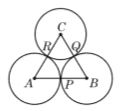
In the given figure, three circles with centres $A, B, C$ respectively touch each other externally. If $A B=5 cm , B C=7 cm$ and $C A=6 cm$, then the radius of the circle with centre $A$ is
Image
Directions: In the following questions, the Assertions $(A)$ and Reason$(s) (R)$ have been put forward. Read both the statements carefully and choose the correct alternative from the following:
Assertion: The value of $k$ for which the system of linear equations $kx - y = 2$ and $6x - 2y = 3$ has a unique solution is $3$.
Reason: The system of linear equations $a_1 x+b_1 y+c_1=0$ and $a_2 x+b_2 y+c_2=0$ has a unique solution if $\frac{\text{a}_1}{\text{a}_2}\ne\frac{\text{b}_1}{\text{b}_2}$
A card is drawn at random from a pack of $52$ cards. The probability that the card is drawn is neither an ace nor a king is :
If $a =2^2 \times 3^x, b=2^2 \times 3 \times 5, c =2^2 \times 3 \times 7$ and LCM $( a , b , c )=3780$, then $x$ is equal to