Question
Find the cube of: $a-\frac{1}{a}+b$

Answer

Using $(a+b+c)^3 $
$ =a^3+b^3+c^3+3 a^2 b+3 a^2 c+3 b^2 a+3 c^2 a+6 a b c$
$\left(a-\frac{1}{a}+b\right) $
$ = a^3+\left(-\frac{1}{a}\right)^3+b^3+3 a^2\left(-\frac{1}{a}\right)+3 a^2+3\left(-\frac{1}{a}\right)^2 b+3\left(-\frac{1}{a}\right)^2 a+3 b^2a+3 b^2\left(-\frac{1}{a}\right)+6 a\left(-\frac{1}{a}\right) b$
$=a^3-\frac{1}{a^3}+b^3-3 a+3 a^2 b+\frac{3 b}{a^2}+\frac{3}{a}+3 b^2 a-\frac{3 b^2}{a}-6 b .$

Need a full question paper?

Generate a complete, print-ready paper with questions like this in minutes — across 16+ boards, with answer keys.
Start Generating Free

Similar questions

Prove that if the diagonals of a parallelogram are equal then it is a rectangle.
Find $x$, if : $\left(\sqrt{\frac{3}{5}}\right)^{x+1}=\frac{125}{27}$
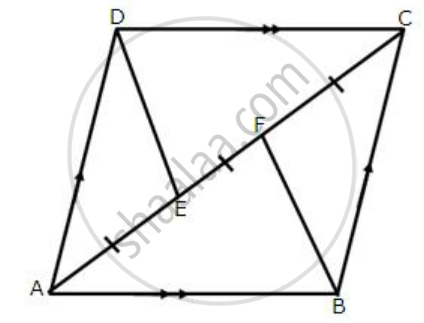
The alongside figure shows a parallelogram $\text{ABCD}$ in which $A E=E F$ $= FC$.
Prove that:$(i) DE$ is parallel to $FB(ii) DE = FB(iii) \text{DEBF}$ is a parallelogram.
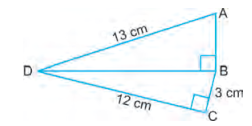
In the given figure, ABCD is a quadrilateral in which $B C=3 cm$, $AD =13 cm, DC =12 cm$ and $\angle ABD =$ $\angle BCD =90^{\circ}$. Calculate the length of AB .
Image
In a quadrilateral $\text{ABCD};$ prove that:$(i) AB+ BC + CD > DA,(ii) AB + BC + CD + DA > 2AC,(iii) AB + BC + CD + DA > 2BD$
In an isosceles $\triangle ABC,$ sides $AB$ and $AC$ are equal. If point $D$ lies in base $BC$ and point $E$ lies on $BC$ produced $(BC$ being produced through vertex $C)$, prove that$:(i) AC > AD'(ii) AE > AC'(iii) AE > AD$
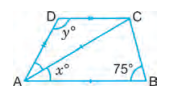
In the given figure, AC is the bisector of $\angle A$. If $AB = AC$, $AD = CD$ and $\angle ABC =75^{\circ}$, find the values of $x$ and $y$.
Image
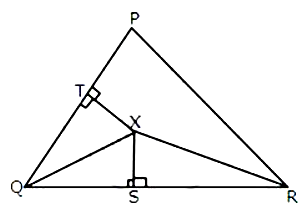
In the adjoining figure, $\mathrm{OX}$ and $\mathrm{RX}$ are the bisectors of the angles $Q$ and $R$ respectively of the $\triangle P Q R$.If $X S \perp Q R$ and $X T \perp P Q$;

prove that: $(i) \triangle \mathrm{XTQ} \cong \triangle \mathrm{XSQ}.(ii) \mathrm{PX}$ bisects angle $\mathrm{P}$
Image
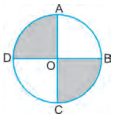
AC and BD are two perpendicular diameters of a circle with centre O. If AC = 16 cm, calculate the area and perimeter of the shaded part. (Take $\pi$ = 3.14)
[Hint: Perimeter of the shaded parts = 2(OA + OD + arc AD)
$\begin{aligned} & =2\left(8+8+\frac{3.14 \times 8 \times 90}{360}\right) cm =57.12 cm \\ \text { Area of the shaded parts } & =2 \times(\text { area of quadrant } O A D) \\ & \left.=\frac{(2 \times \pi \times 8 \times 8 \times 90)}{360} cm^2=100.48 cm^2\right]\end{aligned}$
If $\theta=30^{\circ}$, verify that: $\sin 2 \theta=\frac{2 \tan \theta}{1++\tan ^2 \theta}$