Question
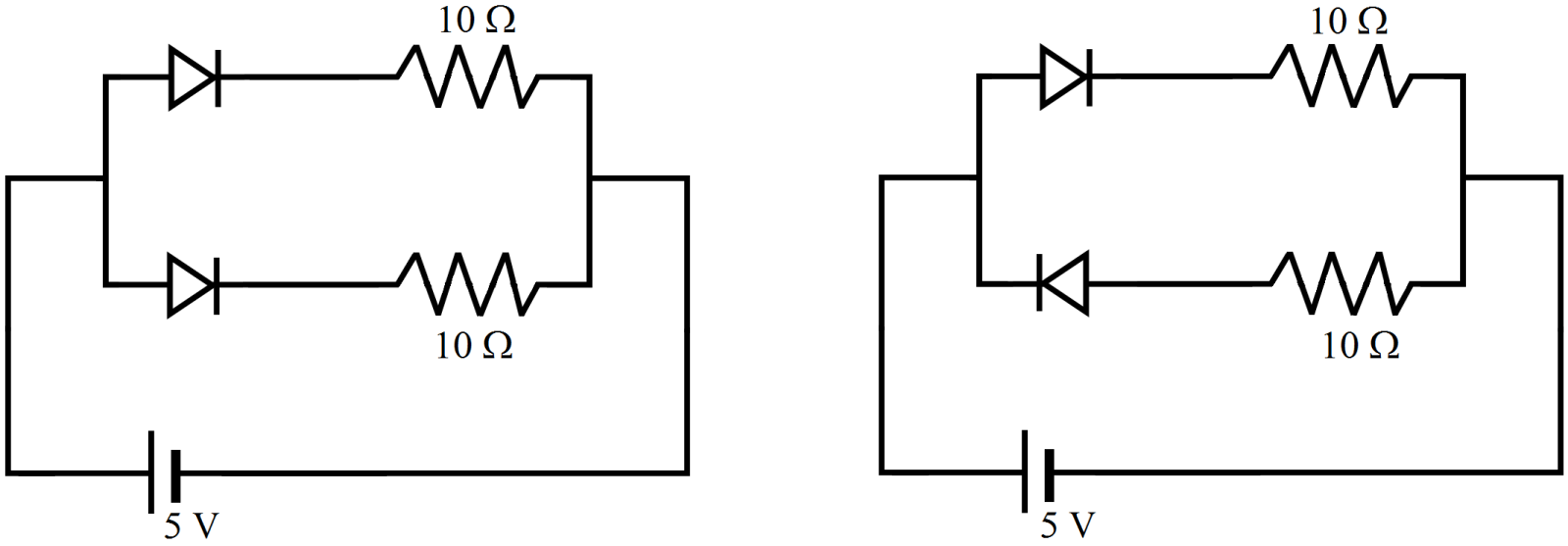
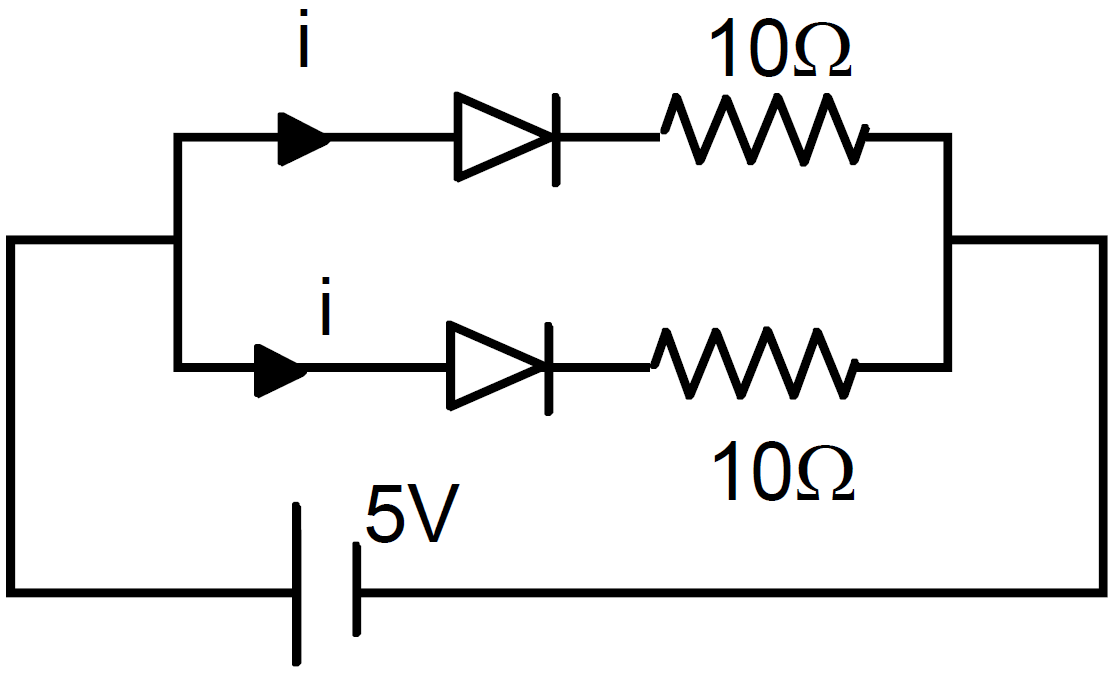
Find the current through the battery circuits shown in figure.
Answer

Both diodes are forward biased. Thus the net diode resistance is 0. $\text{i}=\frac{5}{\frac{10\times10}{10+10}}=\frac{5}{5}=1\text{A}$
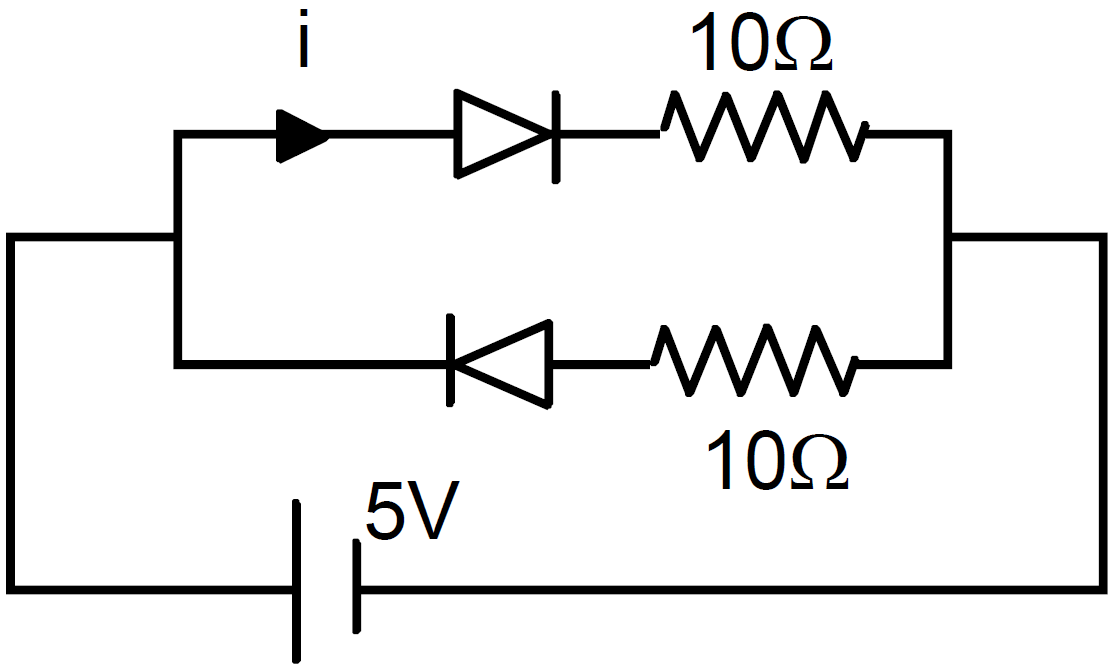
One diode is forward biased and other is reverse biased. $\text{i}=\frac{\text{V}}{\text{R}_\text{net}}=\frac{5}{10+0}=\frac{1}{2}=0.5\text{A}$

Need a full question paper?

Generate a complete, print-ready paper with questions like this in minutes — across 16+ boards, with answer keys.
Start Generating Free

Similar questions

Let us assume that our galaxy consists of $2.5 \times 10^{11}$ stars each of one solar mass. How long will a star at a distance of $50,000 \mathrm{ly}$ from the galactic centre take to complete one revolution? Take the diameter of the Milky Way to be $10^5 \mathrm{ly}$.
An ideal gas is trapped between a mercury column and the closed-end of a narrow vertical tube of uniform base containing the column. The upper end of the tube is open to the atmosphere. The atmospheric pressure equals 76cm of mercury. The lengths of the mercury column and the trapped air column are 20cm and 43cm respectively. What will be the length of the air column when the tube is tilted slowly in a vertical plane through an angle of 60°? Assume the temperature to remain constant.
The number of harmonic components in the oscillations are represented by, $\text{y}=4\cos^2$ at $\sin4\text{t}$. What are What are their corresponding angular frequencies?
A stone of mass m is tied to an elastic string of negligble mass and spring constant k. The unstretched length of the string is L and has negligible mass. The other end of the string is fixed to a nail at a point P. Initially the stone is at the same level as the point P. The stone is dropped vertically from point P.
  1. Find the distance y from the top when the mass comes to rest for an instant, for the first time.
  2. What is the maximum velocity attained by the stone in this drop?
  3. What shall be the nature of the motion after the stone has reached its lowest point?
Give example of a motion where x > 0, v < 0, a > 0 at a particular instant.
The benches of a gallery in a cricket stadium are 1m wide and 1m high. A batsman strikes the ball at a level one metre above the ground and hits a mammoth sixer. The ball starts at 35m/s at an angle of 53° with the horizontal. The benches are perpendicular to the plane of motion and the first bench is 110m from the batsman. On which bench will the ball hit?
A block of mass 25kg is raised by a 50kg man in two different ways as shown in Fig. What is the action on the floor by the man in the two cases? If the floor yields to a normal force of 700N, which mode should the man adopt to lift the block without the floor yielding?
A particle of mass $0.2kg$, has an initial speed of $5ms^{-1}$ at the bottom of a rough inclined plane of inclination $30°$ and vertical height $0.5m$. What is the speed of the particle as it reaches the top of the inclived plane?
Two narrow bores of diameters 3.0 mm and 6.0 mm are joined together to form a U-tube open at both ends. If the Utube contains water, what is the difference in its levels in the two limbs of the tube ? Surface tension of water at the temperature of the experiment is $7.3 \times 10^{-2} \mathrm{~N} \mathrm{~m}^{-1}$. Take the angle of contact to be zero and density of water to be $1.0 \times 103 \mathrm{~kg} / \mathrm{m}^{-3}\left(\mathrm{~g}=9.8 \mathrm{~m} / \mathrm{s}^{-2}\right)$.
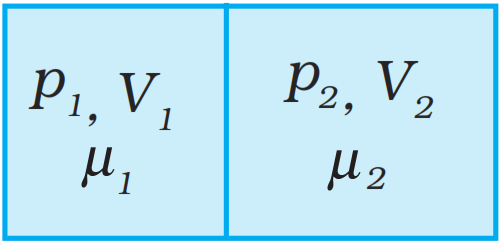
The container shown in Fig. has two chambers, separated by a partition, of volumes $\mathrm{V}_1=2.0$ litre and $\mathrm{V}_2=3.0$ litre. The chambers contain $\mu_1=4.0$ and $\mu_2=5.0$ moles of a gas at pressures $\mathrm{p}_1=1.00 \mathrm{~atm}$ and $\mathrm{p}_2=2.00 \mathrm{~atm}$. Calculate the pressure after the partition is removed and the mixture attains equilibrium.