Question
✓
Answer
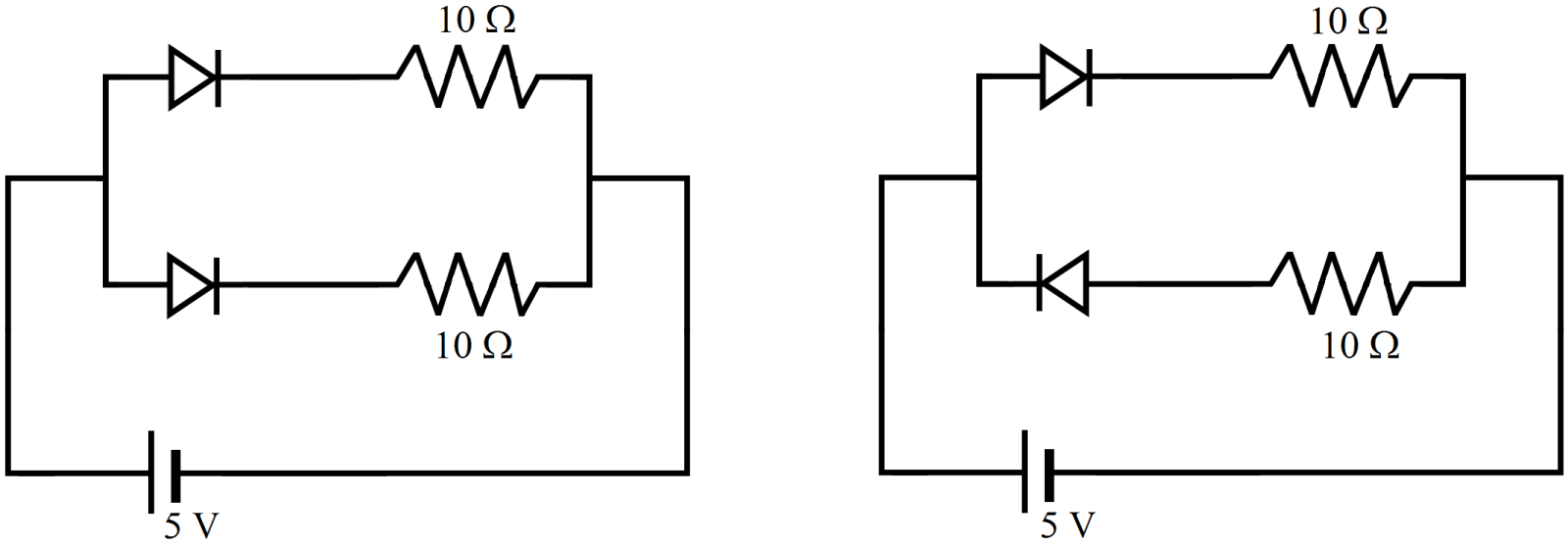
Both diodes are forward biased. Thus the net diode resistance is 0.
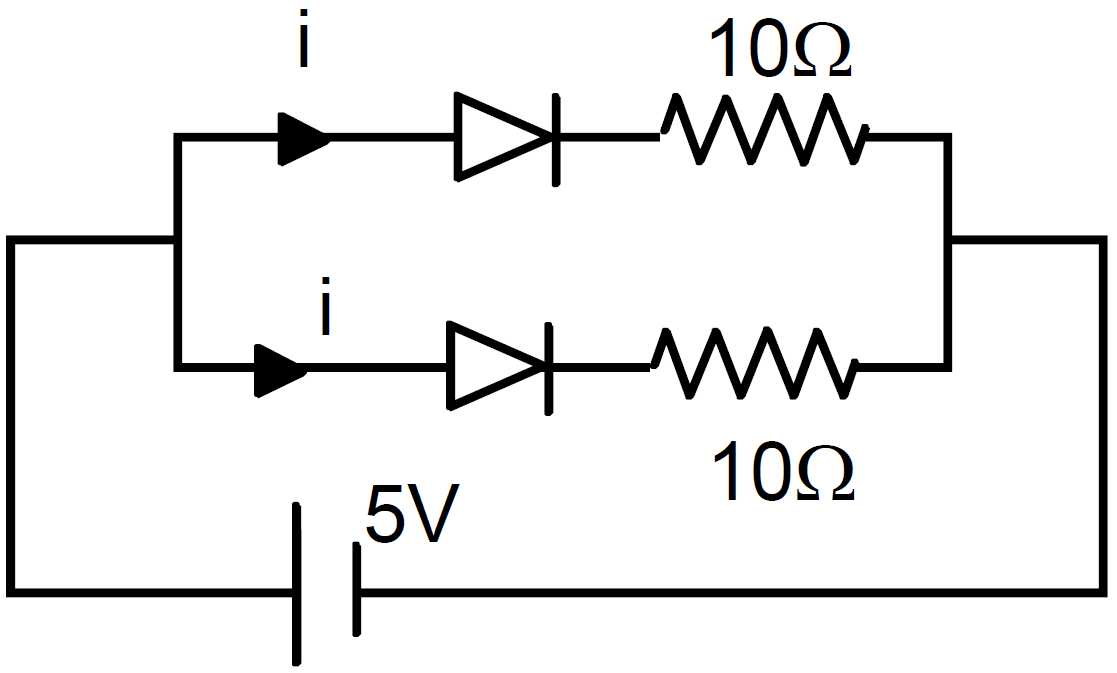
$\text{i}=\frac{5}{\frac{10\times10}{10+10}}=\frac{5}{5}=1\text{A}$
One diode is forward biased and other is reverse biased.
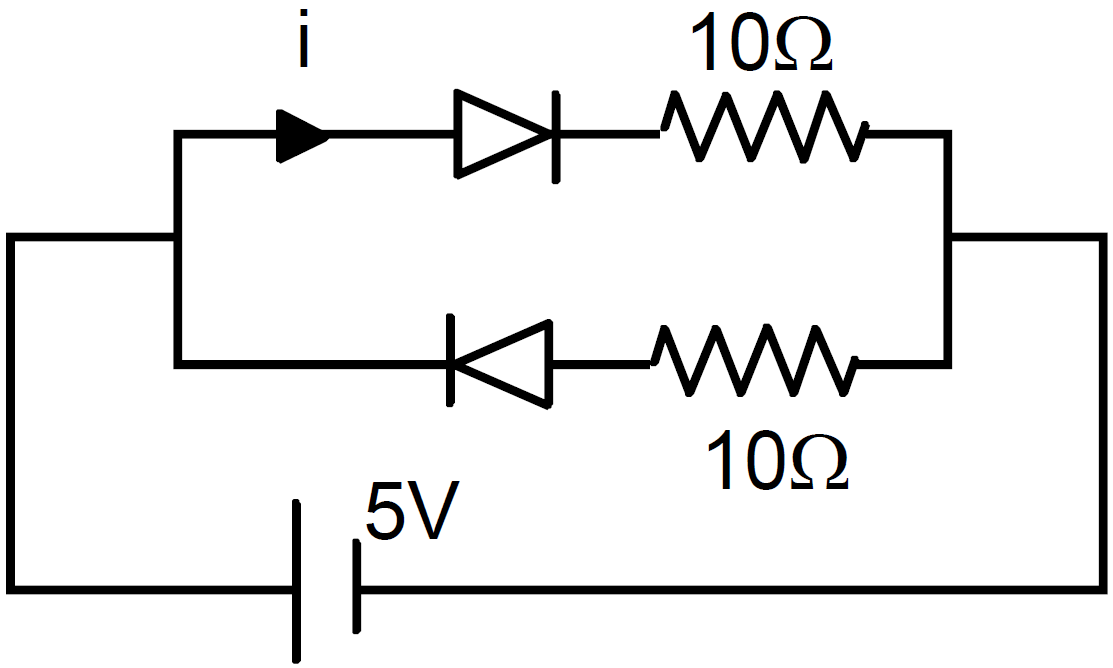
$\text{i}=\frac{\text{V}}{\text{R}_\text{net}}=\frac{5}{10+0}=\frac{1}{2}=0.5\text{A}$
$\text{i}=\frac{5}{\frac{10\times10}{10+10}}=\frac{5}{5}=1\text{A}$
One diode is forward biased and other is reverse biased.
$\text{i}=\frac{\text{V}}{\text{R}_\text{net}}=\frac{5}{10+0}=\frac{1}{2}=0.5\text{A}$
Need a full question paper?
Generate a complete, print-ready paper with questions like this in minutes — across 16+ boards, with answer keys.
Explore more
More "Long Answer Type Questions [5M]" from Semiconductor Electronic: Material, Devices And Simple Circuits→Semiconductor Electronic: Material, Devices And Simple Circuits — all question types→Physics STD 12 Science question papers→Bihar Board STD 12 Science question papers→Bihar Board question paper generator→
Similar questions
Suppose that the radius of cross-section of the wire used in the previous problem is r. Find the increase in the radius of the loop if the magnetic field is switched off. Young's modulus of the material of the wire is Y.
a. Explain why, for any charge configuration, the equipotential surface through a point is normal to the electric field at that point.
Draw a sketch of equipotential surfaces due to a single charge (-q), depicting the electric field lines due to the charge.
b. Obtain an expression for the work done to dissociate the system of three charges placed at the vertices of an equilateral triangle of side a as shown alongside.
Draw a sketch of equipotential surfaces due to a single charge (-q), depicting the electric field lines due to the charge.
b. Obtain an expression for the work done to dissociate the system of three charges placed at the vertices of an equilateral triangle of side a as shown alongside.
The equation of motion of a particle started at t = 0 is given by $\text{x}=5\sin\big(20\text{t}+\frac{\pi}{3}\big)$ where x is in centimetre and t in second. When does the particle.
→- First come to rest.
- First have zero acceleration.
- First have maximum speed?
If the tension in the cable supporting an elevator is equal to the weight of the elevator, the elevator may be:
- Going up with increasing speed.
- Going down with increasing speed.
- Going up with uniform speed.
- Going down with uniform speed.
It is found that yellow light does not eject photoelectrons from a metal. Is it advisable to try with orange light? With green light?
A hydrogen atom moving at speed υ collides with another hydrogen atom kept at rest. Find the minimum value of υ for which one of the atoms may get ionized. The mass of a hydrogen atom = 1.67 × 10⁻²⁷kg.
A copper wire having resistance 0.01 ohm in each metre is used to wind a 400-turn solenoid of radius 1.0cm and length 20cm. Find the emf of a battery which when connected the solenoid will eauee a magnetic field of 1.0 × 10⁻²T near the centre of the solenoid.
Find the maximum magnifying power of a compound Microscope having a 25 diopter lens as the objective, a 5 diopter lens as the eyepiece and the separation 30cm between the two lenses. The least distance for clear vision is 25cm.
The radii of curvature of a lens are +20cm and +30cm. The material of the lens has a refracting index 1.6. Find the focal length of the lens.
→- If it is placed in air.
- If it is placed in water $(\mu=1.33).$
A 20cm long conducting rod is set into pure translation with a uniform velocity of 10cm/s-1 perpendicular to its length. A uniform magnetic field of magnitude 0.10T exists in a direction perpendicular to the plane of motion.
- Find the average magnetic force on the free electrons of the rod.
- For what electric field inside the rod, the electric force on a free elctron will balance the magnetic force? How is this electric field created?
- Find the motional emf between the ends of the rod.