Question
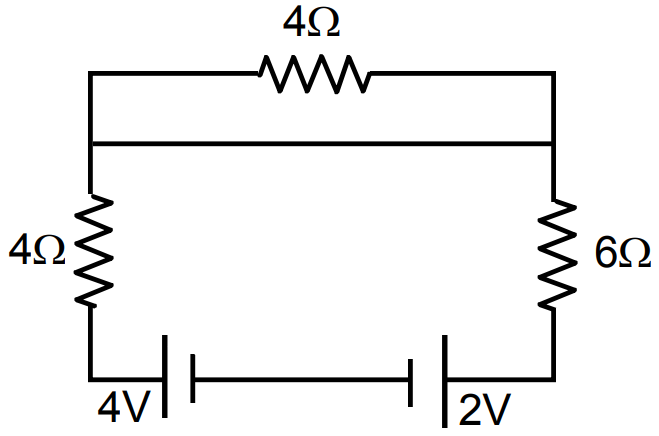
Find the currents through the three reaiators shown in figure.

Answer


  1. Current through (1) $4\Omega$ resistor = 0
  2. Current through (2) and (3)
net E = 4V - 2V = 2V
(2) and (3) are in series,
$\text{R}_\text{eff}=4+6=10\Omega$
$\text{i}=\frac{2}{10}=0.2\text{A}$
Current through (2) and (3) are 0.2A.

Need a full question paper?

Generate a complete, print-ready paper with questions like this in minutes — across 16+ boards, with answer keys.
Start Generating Free

Similar questions

Two monochromatic beams $A$ and $B$ of equal intensity I, hit a screen. The number of photons hitting the screen by beam A is twice that by beam $B$. Then what inference can you make about their frequencies?
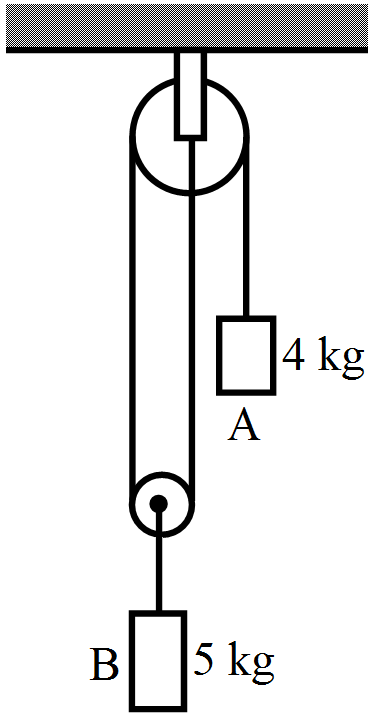
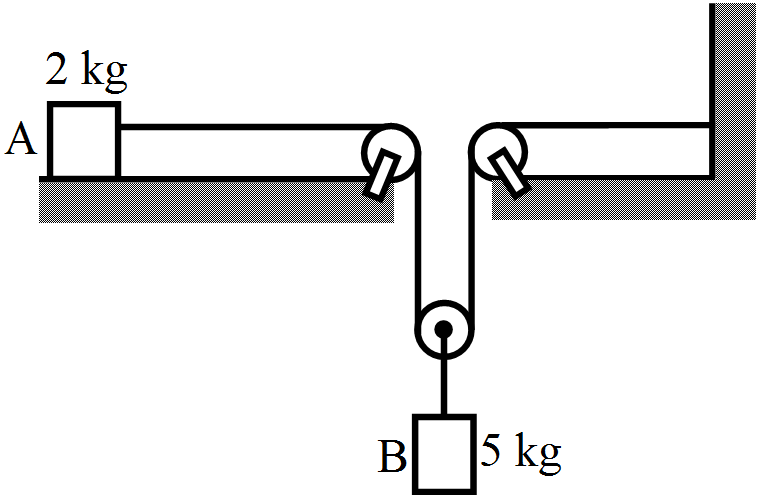
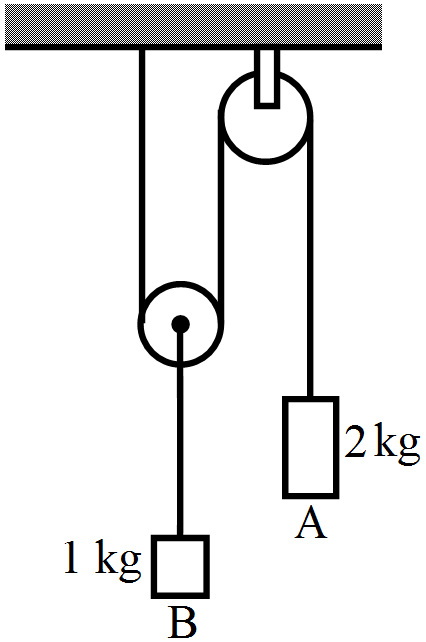
Find the acceleration of the blocks A and B in the three situations shown in figure.


A magnetic field of $(4.0\times10^{-3}\vec{\text{k}})$ T exerts a force of $(4.0\vec{\text{i}}+3.0\vec{\text{j}})\times10^{-10}$ N on a particle with a charge of $1.0\times10^{-9}\text{C}$ and going in the x−y plane. Find the velocity of the particle.
A small piece of cesium metal $(\phi = 1 ·9 eV)$ is kept at a distance of $20\ cm$ from a large metal plate having a charge density of $1.0 \times 10^{-9}C/m^2$ on the surface facing the cesium piece. A monochromatic light of wavelength $400\ nm$ is incident on the cesium piece. Find the minimum and the maximum kinetic energy of the photoelectrons reaching the large metal plate. Neglect any change in electric field due to the small piece of cesium present.
State Ampere's circuital law. Using Ampere's circuital law, derive an expression for the magnetic field along the axis of a toroidal solenoid.
If neutrons exert only attractive force, why don't we have a nucleus containing neutrons alone?
Monochromatic light of wavelength 632.8 nm is produced by a helium-neon laser. The power emitted is 9.42 mW.
(a) Find the energy and momentum of each photon in the light beam.
(b) How many photons per second on the average arrive at a target irradiated by this beam? (Assume the beam to have uniform cross-section which is less than target area), and
(c) How fast does a hydrogen atom have to travel in order to have the same momentum as that of the photon?
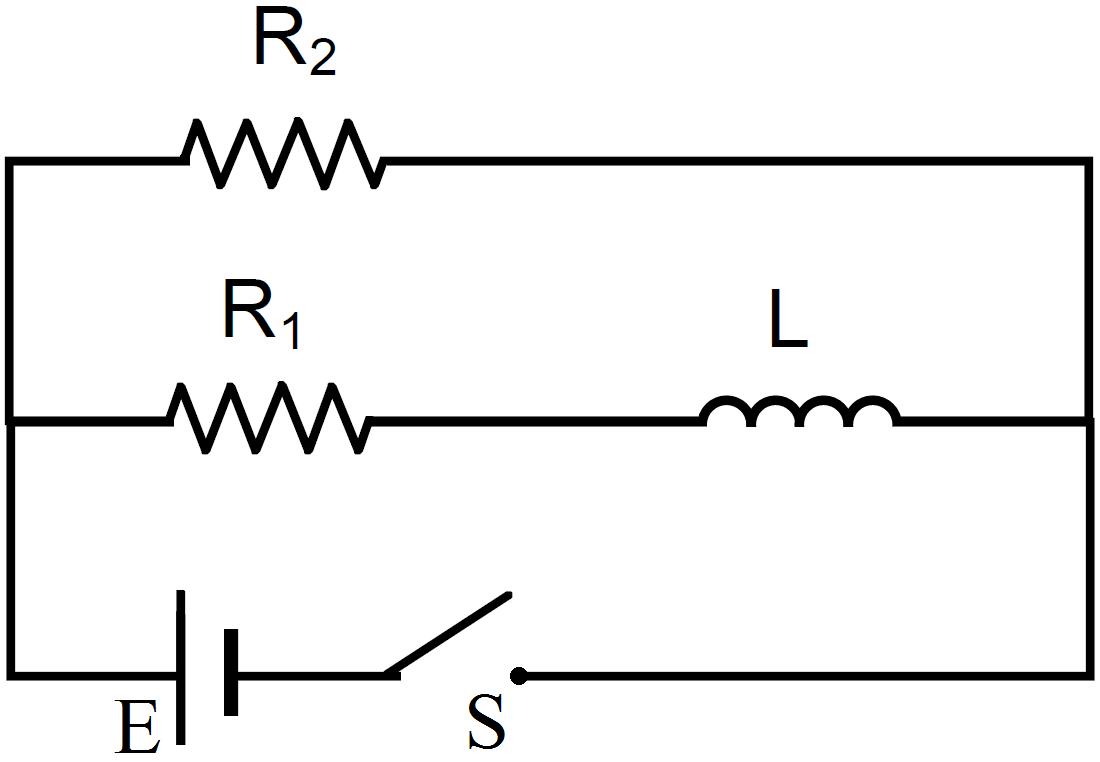
Consider the circuit shown in figure:
  1. Find the current through the battery a long time after the switch S is closed.
  2. Suppose the switch is again opened at $t = 0$. What is the time constant of the discharging circuit?
  3. Find the current through the inductor after one time constant.
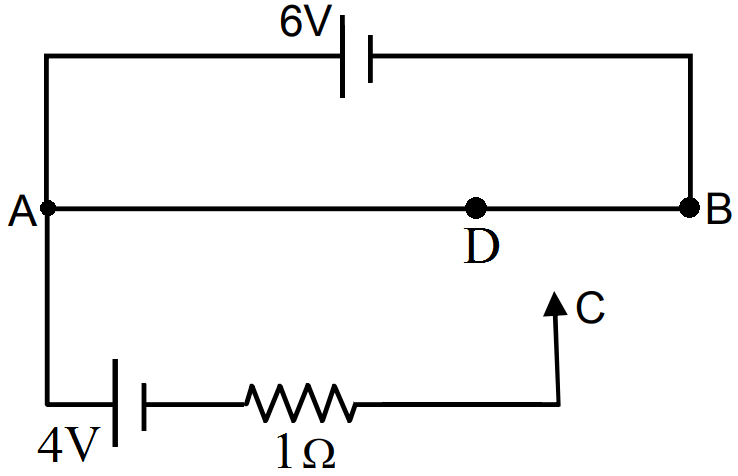
A $6$ volt battery of negligible internal resistance is connected across a uniform wire $AB$ of length $100\ cm.$ The positive terminal of another battery of emf $4V$ and internal resistance $1\Omega$ is joined to the point $A$, as shown in the figure. Take the potential at $B$ to be zero.
$(a)$ What are the potentials at the points $A$ and $C$?
$(b)$ At which point $D$ of the wire $AB$, the potential is equal to the potential at $C$?
$(c)$ If the points $C$ and $D$ are connected by a wire, what will be the current through it?
$(d)$ If the $4V$ battery is replaced by a $7.5V$ battery, what would be the answers of parts $(a)$ and $(b)$?
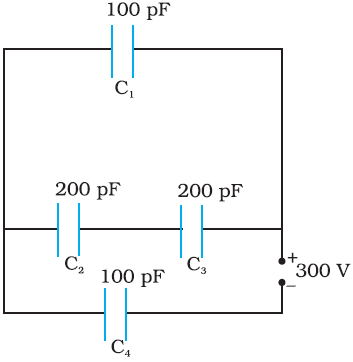
Obtain the equivalent capacitance of the network in Fig. For a $300V$ supply, determine the charge and voltage across each capacitor.