Question
Find the difference between the compound interest compounded yearly and half$-$yearly on $Rs. 10,000$ for $18$ months at $10\%$ per annum.

Answer

$(i)$ When interest is compounded yearly:
Given : $P=R s .10,000 ; n=18$ months $=1 \frac{1}{2}$ year and $r=10 \% p.a.$
For $1$year
$A=P\left(1+\frac{r}{100}\right)^n\left(1+\frac{r}{200}\right)^{\frac{1}{ Z }} \times Z$
$=10,000 \times \frac{11}{10} \times \frac{21}{20}$
$=1020 \times 11$
$=11,550$
When interest is compounded half$-$yearly
$A=P\left(1+\frac{r}{200}\right)^{n \times 2}$
$=10,000\left(1+\frac{10}{200}\right)^{\frac{3}{\nexists} \times \not 2}$
$=10,000 \times \frac{21}{20} \times \frac{21}{20} \times \frac{21}{20}$
$=\frac{105 \times 441}{4}$
$=\frac{46305}{4}$
$=11576.25$
$=\frac{46305}{4}$
$=11576.25$
Therefore, the difference between both $C.I$
$₹11,576.25 - ₹11,550$
$= ₹26.25$
Therefore, the difference between both $C.I$

Need a full question paper?

Generate a complete, print-ready paper with questions like this in minutes — across 16+ boards, with answer keys.
Start Generating Free

Similar questions

A rectangular tank is 25 m long and 7.5 m deep. If 540 $m ^3$ of water be drawn off the tank, the level of water in the tank goes down by 1.8 m.
Calculate : (i) the width of the tank,
(ii) the capacity of the tank.
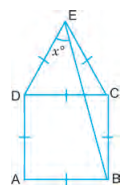
In the adjoining figure, equilateral $\triangle E D C$ surmounts square ABCD . If $\angle DEB =x^{\circ}$, find the value of $x$.
Image
A and B together can do a piece of work in 6 days. If A's one day's work be $1 \frac{1}{2}$ times the one day's work of B, find in how many days, each alone can finish the work.
Solve the following systems of equation by using the method of cross multiplication:
$3 x-5 y=19,7 x-3 y=1$
Use the table given below to find:
$(a)$ The actual class limits of the fourth class.
$(b)$ The class boundaries of the sixth class.
$(c)$ The class mark of the third class.
$(d)$ The upper and lower limits of the fifth class.
$(e)$ The size of the third class.
Class Interval Frequency
$30 - 34$ $7$
$35 - 39$ $10$
$40 - 44$ $12$
$45 - 49$ $13$
$50 - 54$ $8$
$55 - 59$ $4$
The consecutive angles of a parallelogram are in the ratio $3:6$. Calculate the measures of all the angles of the parallelogram.
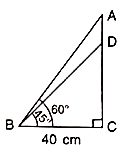
Find the length of $AD.$Given: $\angle ABC = 60^\circ.\angle DBC = 45^\circ$ and $BC = 40\ cm.$
Solve for $x$ and $y :\frac{y+7}{5}=\frac{2 y-x}{4}+3 x-5; \frac{7-5 x}{2}+\frac{3-4 y}{6}=5 y-18$
If $\frac{x^2+1}{x}=3 \frac{1}{3}$ and $\mathrm{x}>1 ;$ Find If $x^3-\frac{1}{x^3}$
Solve the following systems of equations by using the method of cross multiplication:
2x + 5y = 1, 2x + 3y = 3