Question
Find the dimensions of:

  1. Angular speed $\omega.$
  2. Angular acceleration $\alpha.$
  3. Torque $\tau$ and
  4. Moment of interia I.
Some of the equations involving these quantities are

$\omega=\frac{\theta_2-\theta_1}{\text{t}_2-\text{t}_1},\alpha=\frac{\omega_2-\omega_1}{\text{t}_2-\text{t}_1},\tau=\text{F.r}$ and $\text{I = mr}^2.$

The symbols have standard meanings.
Answer

  1. Angular speed $\omega=\frac{\theta}{\text{t}}=[\text{M}^0\text{L}^0\text{T}^{-1}]$

  2. Angular acceleration $\alpha=\frac{\omega}{\text{t}}=\frac{\text{M}^0\text{L}^0\text{T}^{-1}}{\text{T}}=[\text{M}^0\text{L}^0\text{T}^{-2}]$

  3. Torque $\tau=\text{Fr}=[\text{MLT}^{-2}][\text{L] = [ML}^2\text{T}^{-2}]$

  4. Moment of inertia $=\text{Mr}^2=[\text{M}][\text{L}^2]=[\text{ML}^2\text{T}^0]$

Need a full question paper?

Generate a complete, print-ready paper with questions like this in minutes — across 16+ boards, with answer keys.

Start Generating Free

Similar questions

In which of the following examples of motion, can the body be considered approximately a point object:
A tumbling beaker that has slipped off the edge of a table.
Out of formulae:
  1. $\text{y}=\text{a}\sin\frac{2\pi\text{t}}{\text{T}}$
  2. $\text{y}=\text{a}\sin\text{vt}$
for the displacement y of a particle undergoing a certain periodic motion, rule out the wrong formula on dimensional grounds.
[where a = maximum displacement of the particle, v = speed of the particle, T = time period of motion.]
A parallel beam of monochromatic light is used in a Young's double slit experiment. The slits are separated by a distance d and the screen is placed parallel to the plane of the slits. Show that if the incident beam makes an angle $\theta=\sin^{-1}\Big(\frac{\lambda}{2\text{D}}\Big)$ with the normal to the plane of the slits, there will be a dark fringe at the centre P0 of the pattern.
The electric current in a discharging R-C circuit is given by $\text{i}=\text{i}_0\text{e}^{-\frac{\text{t}}{\text{RC}}}$ where i0, R and C are constant parameters and t is time. Let $\text{i}_0=2.00\text{A},\text{R}=600\times10^5\Omega$ and $\text{C}=0.500\mu\text{F}.$
  1. Find the current at t = 0.3s.
  2. Find the rate of change of current at t = 0.3s.
  3. Find approximately the current at t = 0.31s.
An athelete takes 2.0s to reach his maximum speed of 18.0km/h. What is the magnitude of his average acceleration?
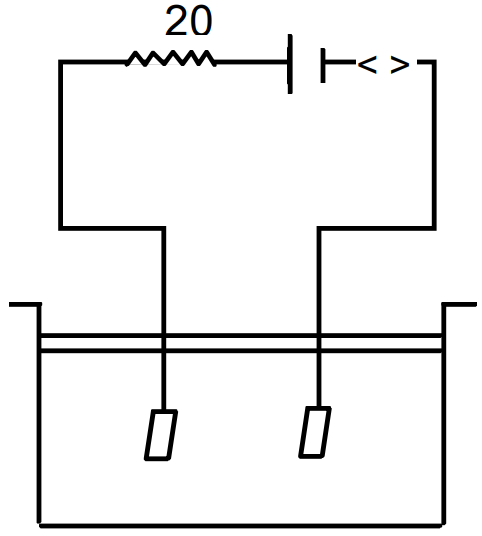
Figure shows an electrolyte of AgCl through which a current is passed. It is observed that 2.68g of silver is deposited in 10 minutes on the cathode. Find the heat developed in the $20\Omega$ resistor during this period. Atomic weight of silver is 107.9g/mole.

If the sound level in a room is increased from 50dB to 60dB, by what factor is the pressure amplitude increased?
Two bodies of masses 1kg and 2kg are located at (1, 2) and (-1, 3) respectively. Calculate the coordinates of the centre of mass.
Show that $\vec{\text{a}}.(\vec{\text{b}}\times\vec{\text{c}})$ is equal in magnitude to the volume of a parallelopiped formed by the three vectors $\vec{\text{a}},\vec{\text{b}}$ and $\vec{\text{c}}.$
An electroplating unit plates 3.0g of silver on a brass plate in 3.0 minutes. Find the current used by the unit. The electrochemical equivalent of silver is 1.12 × 10-6 kg C-1.