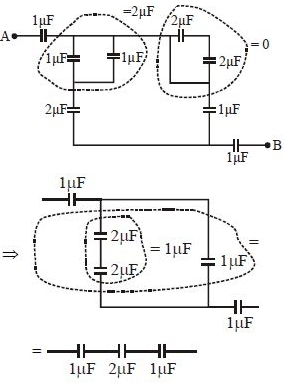
Find the equivalent capacitance between $A$ and $B$
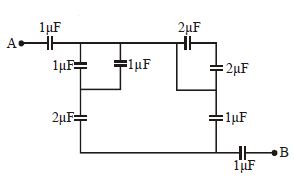
  • A$\frac{3}{5}\,\mu F$
  • B$1\, \mu F$
  • C$\frac{4}{5}\,\mu F$
  • D$\frac{2}{5}\,\mu F$
Medium
art

Download our app
and get started for free

Experience the future of education. Simply download our apps or reach out to us for more information. Let's shape the future of learning together!No signup needed.*

Similar Questions

  • 1
    A conducting sphere of radius $r$ has a charge. Then
    View Solution
  • 2
    The diagrams below show regions of equipotentials.A positive charge is moved from $A$ to $B$ in each diagram. 
    View Solution
  • 3
    Consider the shown system of two concentric thin metal shells. The inner hell has charge $Q$, while the outer shell is neutral. Potential difference between the shells is $V$. If the shell are joined by metal wire, then potential of the inner shell is
    View Solution
  • 4
    The area of the plates of a parallel plate capacitor is $A$ and the gap between them is $d$. The gap is filled with a non-homogeneous dielectric whose dielectric constant varies with the distance $‘y’$ from one plate as : $K = \lambda \ sec(\pi y/2d)$, where $\lambda $ is a dimensionless constant. The capacitance of this capacitor is
    View Solution
  • 5
    $n$ the rectangle, shown below, the two corners have charges ${q_1} = - 5\,\mu C$ and ${q_2} = + 2.0\,\mu C$. The work done in moving a charge $ + 3.0\,\mu C$ from $B$ to $A$ is.........$J$ $(1/4\pi {\varepsilon _0} = {10^{10}}\,N{\rm{ - }}{m^2}/{C^2})$
    View Solution
  • 6
    Five capacitors, each of capacitance value $C$ are connected as shown in the figure. The ratio of capacitance between $P$ and $R$, and the capacitance between $P$ and $Q$, is
    View Solution
  • 7
    Two identical capacitors, have the same capacitance $C$. One of them is charged to potential $V_1$ and the other to $V_2$. The negative ends of the capacitors are connected together. When the positive ends are also connected, the decrease in energy of the combined system is
    View Solution
  • 8
    For given $\vec E = 2x\hat i + 3y\hat j$, find the potential at $(X, Y)$ if potential at origin is $5\, volts.$
    View Solution
  • 9
    The value of electric potential at any point due to any electric dipole is
    View Solution
  • 10
    Which of the following correctly represents the variation of electric potential $(V)$ of a charged spherical conductor of radius $(R)$ with radial distance $(r)$ from the centre?
    View Solution