Question
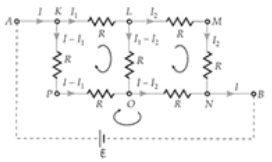
Find the equivalent resistance between the terminals A and B in the network shown in Figure. Given each resistor R is $10 \Omega$.
Image

Answer

Imagine a battery of emf , having no internal resistance, connected between the points A and B. The distribution of current through various branches is as shown in Figure. 
Image

Applying Kirchhoff's second law to loop KLOPK, we get 
$\begin{array}{l} I _1 R +\left( I _1- I _2\right) R -2\left( I - I _1\right) R =0 \\ \text { or } 4 I _1- I _2=2 I \ldots \text { (i) }\end{array}$
Similarly, from the loop LMNOL, we have 
$\begin{array}{l}2 I _2 R -\left( I - I _2\right) R -\left( I _1- I _2\right) R =0 \\ \text { or }- I _1+4 I _1= I \ldots \text { (ii) }\end{array}$
From the loop AKPONBEA, we have 
$2\left( I - I _1\right) R +\left( I - I _2\right) R =\varepsilon \ldots($ (iii $)$
Solving equations (i) and (ii), we get 
$I_1=\frac{3}{5} I$ and $I_2=\frac{2}{5} I$
Substituting these values in equation (iii), we get 
$\begin{array}{l}2\left(I-\frac{3}{5} I\right) R+\left(I-\frac{2}{5} I\right) R=\varepsilon \\ 
\text { or } \frac{7}{5} I R=\varepsilon \ldots \text { (iv) }\end{array}$
If $R^{\prime}$ is the equivalent resistance between A and B , then 
$I R^{\prime}=\varepsilon \ldots( v )$
From (iv) and (v), $I R^{\prime}=\frac{7}{5} I R$ 
or $R^{\prime}=\frac{7}{5} R=\frac{7}{5} \times 10=14 \Omega$

Need a full question paper?

Generate a complete, print-ready paper with questions like this in minutes — across 16+ boards, with answer keys.
Start Generating Free

Similar questions

A piece of wire carrying a current of 6.00A is bent in the form of a circular arc of radius 10.0cm, and it subtends an angle of 120° at the centre. Find the magnetic field B due to this piece of wire at the centre.
Consider the situation of the previous problem. Define displacement resistance $\text{R}_\text{d}=\frac{\text{V}}{\text{i}_\text{d}}$ of the space between the plates, where V is the potential difference between the plates and id is the displacement current. Show that Rd varies with time as $\text{R}_\text{d}=\text{R}\big(\text{e}^{\text{t}/\tau}-1\big)$ 
A point object is placed on the principal axis of a convex lens (f = 15cm) at a distance of 30cm from it. A glass plate $(\mu=1.50)$ of thickness 1cm is placed on the other side of the lens perpendicular to the axis. Locate the image of the point object.
A resistance of R draws current from a potentiometer. The potentiometer wire, AB, has a total resistance of Ro. A voltage V is supplied to the potentiometer. Derive an expression for the voltage across R when the sliding contact is in the middle of potentiometer wire.

How is the mutual inductance of a pair of coils affected when:
  1. Separation between the coils is increased?
  2. The number of turns of each coil is increased?
  3. A thin iron sheet is placed between the two coils, other factors remaining the same? Explain your answer in each case.
Does the temperature of a body depend on the frame from which it is observed?
  1. Define torque acting on a dipole of dipole moment $\overrightarrow{p}$ placed in a uniform electric field $\overrightarrow{\text{E}}$. Express it in the vector form and point out the direction along which it acts
  2. What happens if the field is non-uniform?
  3. What would happen if the external field $\overrightarrow{\text{E}}$ is increasing (i) parallel to $\overrightarrow{p}$ and (ii) anti-parallel to $\overrightarrow{p}$?
Consider the situation shown in figure. What are the signs of q1 and q2? If the lines are drawn in proportion to the charge, what is the ratio $\frac{\text{q}_1}{\text{q}_2}?$

Figure shows a particle sliding on a frictionless track which terminates in a straight horizontal section. If the particle starts slipping from the point A, how far away from the track will the particle hit the ground?

A parallel-plate capacitor with plate area 20cm2 and plate separation 1.0mm is connected to a battery. The resistance of the circuit is $10\text{k}\Omega.$ Find the time constant of the circuit.