MCQ
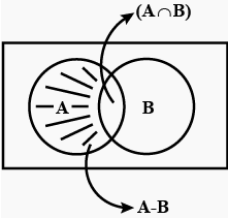
Find the equivalent set for $A − B.$
  • A
    $\text{A}\cup(\text{A}\cap\text{B})$
  • B
    $\text{A}- \text{B}$
  • $\text{A}-(\text{A}\cap\text{B})$
  • D
    $\text{A}\cap\text{B}$

Answer

Correct option: C.
$\text{A}-(\text{A}\cap\text{B})$
Hence By this graph we see that $\text{A}-\text{B}=\text{A}-(\text{A}\cap\text{B})$

Need a full question paper?

Generate a complete, print-ready paper with questions like this in minutes — across 16+ boards, with answer keys.

Start Generating Free

Similar questions

The number of different possible values for the sum $x+y+z$, where $x, y, z$ are real number such that $x^4+4 y^4+16 z^4+64=32 x y z$ is
The argument of $\frac{(1-\text{i}\sqrt{3})}{(1+\text{i}\sqrt{3})}$ is:
$\omega $ is an imaginary cube root of unity. If ${(1 + {\omega ^2})^m} = $ ${(1 + {\omega ^4})^m},$ then least positive integral value of $m$ is
The points of intersection of the line $a x+b y=0$, $( a \neq b )$ and the circle $x ^2+ y ^2-2 x =0$ are $A (\alpha, 0)$ and $B (1, \beta)$. The image of the circle with $AB$ as a diameter in the line $x + y +2=0$ is:
If $z=\frac{\sqrt{3}+i}{-2}$, then ${{z}^{69}}$ is equal to [RPET 2001]
The maximum value of the expression $E = sin \theta + cos \theta + sin2 \theta$ is-
In a certain town $25\%$ families own a phone and $15\%$ own a car, $65\%$ families own neither a phone nor a car. $2000$ families own both a car and a phone. Consider the following statements in this regard:

$1$. $10\%$ families own both a car and a phone

$2$. $35\%$ families own either a car or a phone

$3$. $40,000$ families live in the town

Which of the above statements are correct

In a hotel, four rooms are available. Six persons are to be accommodated in these four rooms in such a way that each of these rooms contains at least one person and at most two persons. Then the number of all possible ways in which this can be done is. . . . . . . . 
If ${x_n} > {x_{n - 1}} > ... > {x_2} > {x_1} > 1$ then the value of ${\log _{{x_1}}}{\log _{{x_2}}}{\log _{{x_3}}}.....{\log _{{x_n}}}{x_n}^{x_{n - 1}^{{ {\mathinner{\mkern2mu\raise1pt\hbox{.}\mkern2mu \raise4pt\hbox{.}\mkern2mu\raise7pt\hbox{.}\mkern1mu}} ^{{x_1}}}}}$ is equal to
Choose the correct answer. If $\text{P}(\text{A}\cup\text{B})=\text{P}(\text{A}\cap\text{B})$ for any two events $A$ and $B,$ then: