Question
Find the expression of the position of the center of mass of a system of n-particles.

Answer

self

Need a full question paper?

Generate a complete, print-ready paper with questions like this in minutes — across 16+ boards, with answer keys.
Start Generating Free

Similar questions

A gas is enclosed in a cylindrical can fitted with a piston. The walls of the can and the piston are adiabatic. The initial pressure, volume and temperature of the gas are $100kPa, 400cm^3$ and $300K$, respectively. The ratio of the specific heat capacities of the gas is $\frac{\text{C}_\text{P}}{\text{C}_\text{V}}=1.5.$ Find the pressure and the temperature of the gas if it is,
  1. Suddenly compressed.
  2. Slowly compressed to $100cm^3$.
${ }^{238} \mathrm{U}$ decays to ${ }^{206} \mathrm{~Pb}$ with a half-life of $4.47 \times 10^9 \mathrm{y}$. This happens in a number of steps. Can you justify a single half for this chain of processes? A sample of rock is found to contain 2.00 mg of ${ }^{238} \mathrm{U}$ and 0.600 mg of ${ }^{206} \mathrm{~Pb}$. Assuming that all the lead has come from uranium, find the life of the rock.
In changing the state of a gas adiabatically from an equilibrium state A to another equilibrium state B, an amount of work equal to 22.3J is done on the system. If the gas is taken from state A to B via a process in which the net heat absorbed by the system is 9.35 cal, how much is the net work done by the system in the latter case? (Take 1 cal = 4.19J)
Does the escape speed of a body from the earth depend on (a) the mass of the body, (b) the location from where it is projected, (c) the direction of projection, (d) the height of the location from where the body is launched?
A ball is dropped from a height of $5m$ onto a sandy floor and penetrates the sand up to $10cm$ before coming to rest. Find the retardation of the ball in sand assuming it to be uniform.
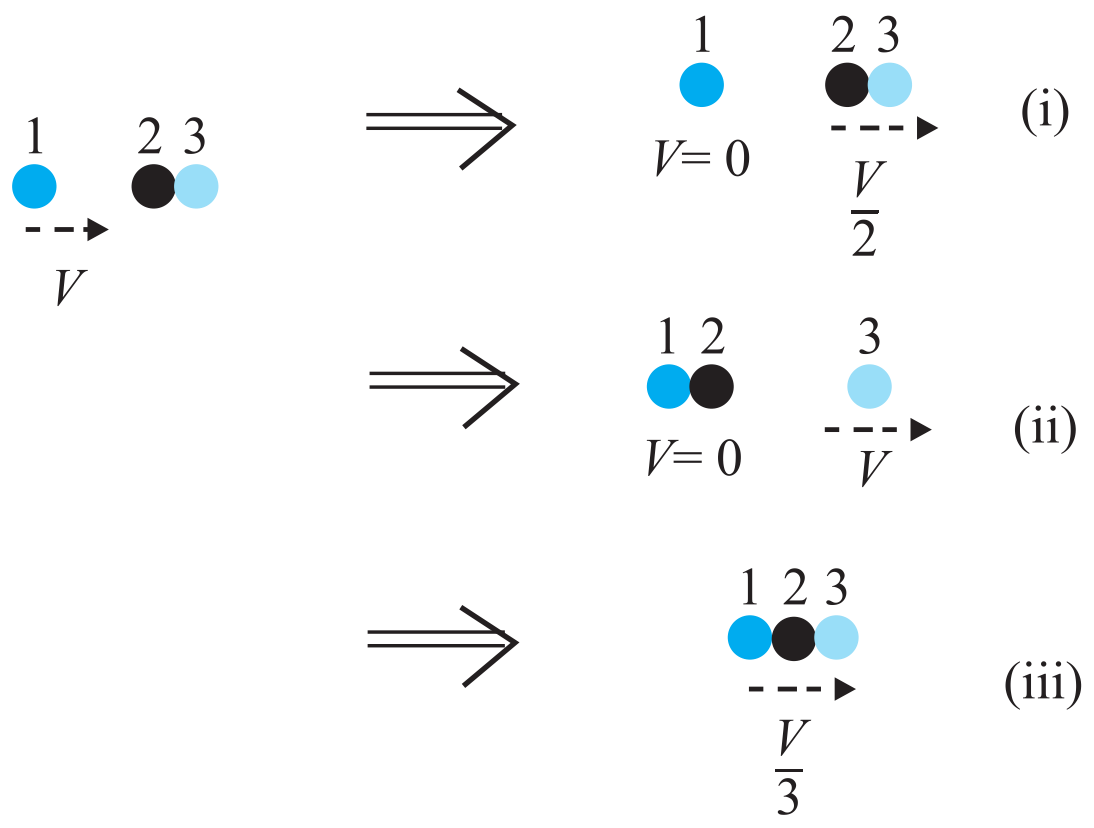
Two identical ball bearings in contact with each other and resting on a frictionless table are hit head-on by another ball bearing of the same mass moving initially with a speed V. If the collision is elastic, which of the following is a possible result after collision?
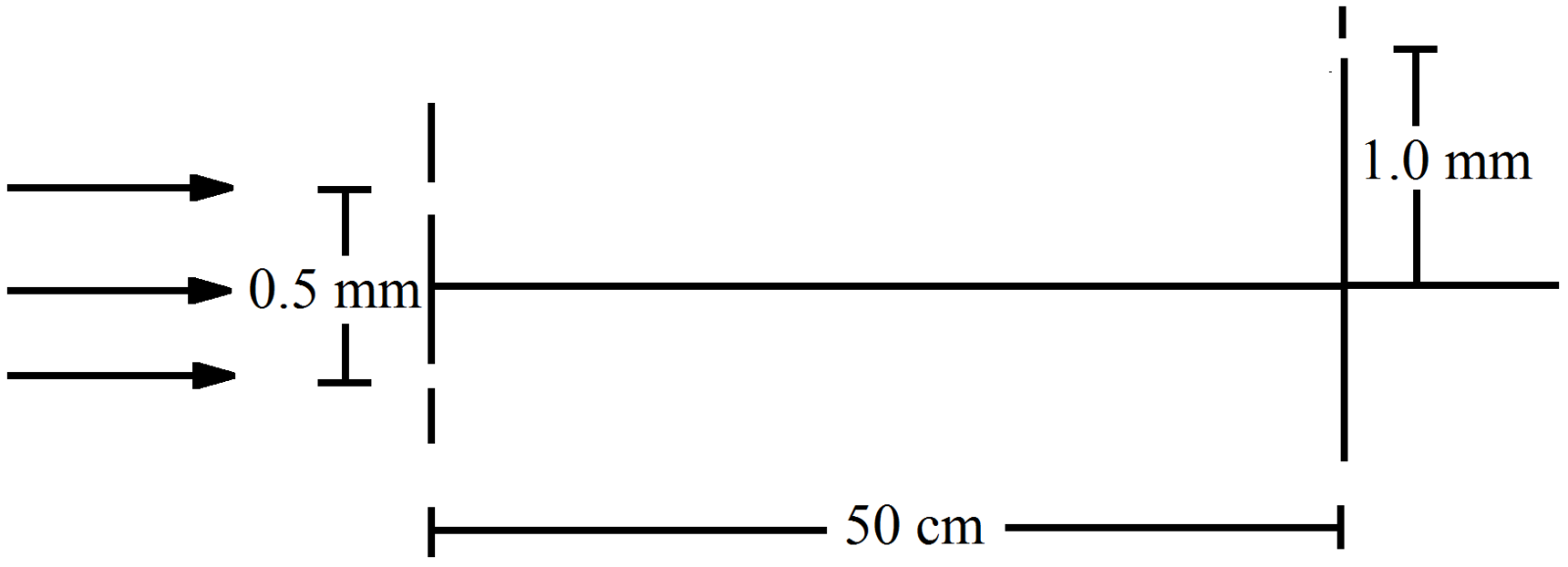
White coherent light $(400nm - 700nm)$ is sent through the slits of a Young's double slit experiment (figure.) The separation between the slits is $0.5mm$ and the screen is $50cm$ away from the slits. There is a hole in the screen at a point $1.0mm$ away (along the width of the fringes) from the central line.
  1. Which wavelength (s) will be absent in the light coming from the hole?
  2. which wavelength (s) will have a strong intensity?
A particle of mass $m$ is kept on the top of a smooth sphere of radius $R.$ It is given a sharp impulse which imparts it a horizontal speed $v.$
  1. Find the normal force between the sphere and the particle just after the impulse.
  2. What should be the minimum value of $v$ for which the particle does not slip on the sphere?
  3. Assuming the velocity $v$ to be half the minimum calculated in part.
  4. Find the angle made by the radius through the particle with the vertical when it leaves the sphere.
A tube of certain diameter and of length 48cm is open at both ends. Its fundamental frequency of resonance is found to be 320Hz. The velocity of sound in air is 320m/s. Estimate the diameter of the tube. One end of the tube is now closed, calculate the lowest frequency of resonance for the tube.
A cylindrical log of wood of height h and area of cross-section A floats in water. It is pressed and then released. Show that the log would execute S.H.M. with a time period.$\text{T}=2\pi\sqrt{\frac{\text{m}}{\text{A}\rho\text{g}}}$
where m is mass of the body and ρ is density of the liquid.