MCQ
Find the false statement.
  • A
    Sum of voltage over any closed loop is zero.
  • B
    Kirchhoff’s Laws can be applied to any circuit, regardless of its structure and composition.
  • Kirchhoff’s $2^{nd}$ law is applied at nodes.
  • D
    Kirchhoff’s $1^{th}$ law can be applied for both planar and non-planar circuits.
Answer

Correct option: C.
Kirchhoff’s $2^{nd}$ law is applied at nodes.

Kirchhoff’s $2^{nd}$ year is applied in a closed loop. Kirchhoff’s $2^{nd}$ law supports the law of conservation of energy. This means that energy is neither created nor destroyed in the closed loop. Whatever energy enters the loop, same amount leaves the loop.

Need a full question paper?

Generate a complete, print-ready paper with questions like this in minutes — across 16+ boards, with answer keys.

Start Generating Free

Similar questions

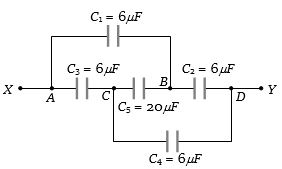
What is the effective capacitance between points $X$ and $Y$.......$\mu F$
Production of electricity from magnetism is called.
What is increased in step-down transformer
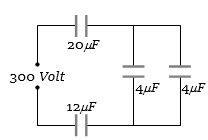
In the adjoining figure, four capacitors are shown with their respective capacities and the $P.D.$ applied. The charge and the $P.D.$ across the $4\,\mu F$ capacitor will be
Which among the following materials display higher magnetic susceptibility?
The inward and outward electric flux for a closed surface in units of $N{\rm{ - }}{m^2}/C$ are respectively $8 \times {10^3}$ and $4 \times {10^3}.$ Then the total charge inside the surface is [where ${\varepsilon _0} = $ permittivity constant]
$A$ vertical pencil of rays comes from bottom of a tank filled with a liquid. When it is accelerated with an acceleration of $7.5\, m/s^2$, the ray is seen to be totally reflected by liquid surface. What is minimum possible refractive index of liquid?
A charged particle with charge $q$ and mass $m$ starts with an initial kinetic energy $K$ at the middle of a uniformly charged spherical region of total charge $Q$ and radius $R$ . $q$ and $Q$ have opposite signs. The spherically charged region is not free to move . The value of $K_0$ is such that the particle will just reach the boundary of the spherically charged region. How much time does it take for the particle to reach the boundary of the region.
The kinetic energy possessed by a body of mass $m$  moving with a velocity $ v$  is equal to $\frac{1}{2}m{v^2}$, provided
$C^{14}$ has half life 5700 years. At the end of 11400 years, the actual amount left is