Question
Find the fourth term from the end in an A.P. $– 11, – 8, – 5, . . ., 49.$

Answer

First term from end $a = 49$
$t_n = – 11$
$t_{n – 1} = – 8$
Common difference $d = t_n – t_{n – 1} = – 11 – ( – 8) = – 11 + 8 = – 3$
Now, By using $n^{th}$ term of an A.P. formula
$t_n = a + (n – 1)d$
where n = no. of terms
$a$ = first term
$d$ = common difference
$t_n$ = $n^{th}$​​​​​​​ terms
no. of terms $n = 4$
$\Rightarrow t_4 = 49 + (4 – 1) \times ( – 3)$
$\Rightarrow t_4 = 49 + 3 \times ( – 3)$
$\Rightarrow t_4 = 49 – 9 = 40$

Need a full question paper?

Generate a complete, print-ready paper with questions like this in minutes — across 16+ boards, with answer keys.
Start Generating Free

Similar questions

Determine the nature of roots of the following quadratic equation.
$m^2+2 m+9=0$
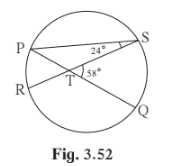
In figure 3.52 , chords $\mathrm{PQ}$ and $\mathrm{RS}$ intersect at $\mathrm{T}$.
(i) Find $m$ (arc SQ) if $m \angle \mathrm{STQ}=58^{\circ}, m \angle \mathrm{PSR}=24^{\circ}$.
(ii) Verify,
$\angle \mathrm{STQ}=\frac{1}{2}[m(\operatorname{arc} \mathrm{PR})+m(\operatorname{arcSQ})]$
(iii) Prove that :
$\angle \mathrm{STQ}=\frac{1}{2}[m(\operatorname{arc} \mathrm{PR})+m(\operatorname{arcSQ})]$ for any measure of $\angle \mathrm{STQ}$.
(iv) Write in words the property in (iii).

Image

Show that the equations $9x - 10y = 21$, $\frac{\text{3x}}{2}-\frac{\text{5y}}{3}=\frac{7}{2}$ have infinitely many solutions.
Find the roots of the following equations, if they exist, by applying the quadratic formula:
$x^2 - 4x - 1 = 0$
Solve the following quadratic equation by using formula method:
$x^2+4 x-1=0$
In a $\triangle\text{ABC},$ AB = BC = CA = 2a and $\text{AD}\perp\text{BC}.$ Prove that
Area $(\triangle\text{ABC})=\sqrt{3}\text{ a}^2$
Solve the following quadratic equations by factorization:
$3x^2 - 14x - 5 = 0$
If $\cos\theta=\frac{2}{3},$ find the value of $\frac{\sec\theta-1}{\sec\theta+1}.$
A jar contains 54 marbles, each of which some are blue, some are green and some are white. The probabiliy of selecting a blue marble at random is $\frac{1}{3}$ and the probability of selecting a green marble at random is $\frac{4}{9}.$ How many white marbles does the jar contain?
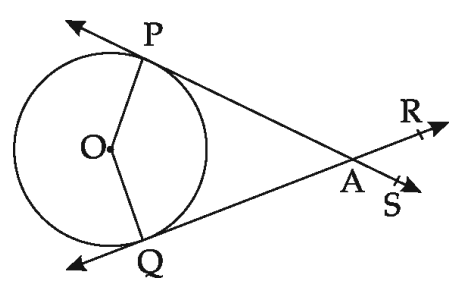
A circle with centre. O Point A is in the exterior of the circle. Line AP and line AQ are tangents at point P and point Q respectively P-A-S, Q-A-R $\angle$PAR = 130°. Find $\angle$AOP.
Image