Question
Find the integral of the function $\sin^3 (2x + 1)$

Answer

Let $I=\int \sin ^{3}(2 x+1) d x$
$= \int \sin ^{3}(2 x+1) d x=\int \sin ^{2}(2 x+1) \cdot \sin (2 x+1) d x$
$= \int\left(1-\cos ^{2}(2 x+1)\right) \sin (2 x+1) d x$
Let $\cos (2x + 1) = t$
$\Rightarrow -2 \sin(2x + 1)dx = dt$
$\Rightarrow \sin(2x + 1)dx = \frac{-\mathrm{dt}}{2}$
$\therefore~ I=\frac{-1}{2} \int\left(1-t^{2}\right) d t$
$= \frac{-1}{2}\left\{t-\frac{t^{3}}{3}\right\}$
$= \frac{-1}{2}\left\{\cos (2 \mathrm{x}+1)-\frac{\cos ^{3}(2 \mathrm{x}+1)}{3}\right\}$
$= \frac{-\cos (2 \mathrm{x}+1)}{2}+\frac{\cos ^{3}(2 \mathrm{x}+1)}{6}+\mathrm{C}$

Need a full question paper?

Generate a complete, print-ready paper with questions like this in minutes — across 16+ boards, with answer keys.
Start Generating Free

Similar questions

Find $\frac{\text{dy}}{\text{dx}},$ when
$\text{x}=\frac{\text{e}^\text{t}+\text{e}^{-\text{t}}}{2}\text{ and y}=\frac{\text{e}^\text{t}-\text{e}^\text{-t}}{2}$
If $A$ and $B$ are two independent events such that $\text{P}(\overline{\text{A}}\cap\text{B})=\frac{2}{15}$ and $\text{P}(\text{A}\cap\overline{\text{B}})=\frac{1}{6}$, then find $P(B).$
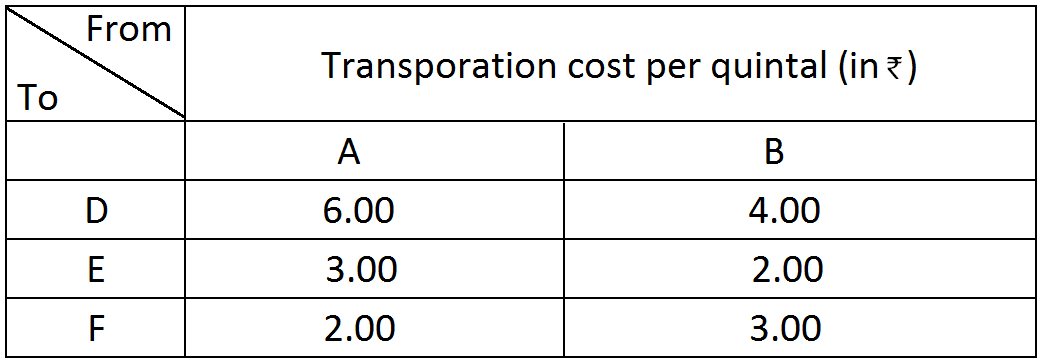
Tow godowns$, A$ and $B,$ have grain storage capacity of $100$ quintals and $50$ quintals respectively. They supply to $3$ ration shops, $D, E$ and $F,$ whose requirements are $60, 50$ and $40$ quintals respectively. The cost of transportation per quintal from the godowns to the shops are given in the following table:
How should the supplies be transported in order that the transportation cost is minimum? 
Evaluate the following integrals:
$\int\sec^4\text{x}\tan\text{x}\text{ dx}$
Solve the following systems of homogeneous linear equations by matrix method:
3x + y - 2z = 0
x + y + z = 0
x - 2y + z = 0
Evaluate the following integrals:
$\int\limits^{\text{b}}_{\text{a}}\frac{\text{x}^{\frac{1}{\text{n}}}}{\text{x}^\frac{1}{\text{n}}+\big(\text{a}+\text{b}-\text{x}\big)^{\frac{1}{\text{n}}}}\text{ dx},\text{ n}\in\text{N},\text{n}\leq2$
If $\text{x}=\text{a}(\theta+\sin\theta),\text{y}=\text{a}(1+\cos\theta),$ find $\frac{\text{dy}}{\text{dx}}.$
Evaluate the following:
$\begin{vmatrix}\text{a}+\text{x}&\text{y}&\text{z}\\\text{x}&\text{a}+\text{y}&\text{z}\\\text{x}&\text{y}&\text{a}+\text{z}\end{vmatrix}$
Show that the following curves intersect orthogonally at the indicated points:
$y^2 = 8x$ and $2x^2 + y^2 = 10$ at $\big(1,2\sqrt{2})$
Show that the lines $\frac{x-1}{3}=\frac{y+1}{2}=\frac{z-1}{5}$ and $\frac{x-2}{2}=\frac{y-1}{3}=\frac{z+1}{-2}$ intersect and find their point of intersection.