Question
Find the integrals of the functions in Exercises:
$\frac{\sin^2\text{x}}{1+\cos\text{x}}$

Answer

$\frac{\sin^2\text{x}}{1+\cos\text{x}}=\frac{\bigg(2\sin\frac{\text{x}}{2}\cos\frac{\text{x}}{2}\bigg)^2}{2\cos^2\frac{\text{x}}{2}}$ $\ \ \ \ \ \bigg[\sin\text{x}=2\sin\frac{\text{x}}{2}\cos\frac{\text{x}}{2};\cos\text{x}=2\cos^2\frac{\text{x}}{2}-1\bigg]$ $=\frac{4\sin^2\frac{\text{x}}{2}\cos^2\frac{\text{x}}{2}}{2\cos^2\frac{\text{x}}{2}}$ $=2\sin^2\frac{\text{x}}{2}$ $=1-\cos\text{x}$ $\therefore\int\frac{\sin^2\text{x}}{1+\cos\text{x}}\text{ dx}=\int(1-\cos\text{x})\text{ dx}$ $=\text{x}-\sin\text{x}+\text{C}$

Need a full question paper?

Generate a complete, print-ready paper with questions like this in minutes — across 16+ boards, with answer keys.
Start Generating Free

Similar questions

Let $A=\{1,2,3,4\} ; B=\{3,5,7,9\} ; C=\{7,23,47,79\}$ and $f: A \rightarrow B, g: B \rightarrow C$ be defined as $f(x)=2 x+1$ and $g(x)=x^2-$ 2. Express $(g \circ f)^{-1}$ and $f^{-1} \circ g^{-1}$ as the sets of ordered pairs and verify that $(g \circ f)^{-1}=f^{-1} \circ g^{-1}$.
Evaluate the following integrals:
$\int\limits^{\frac{\pi}{2}}_0\text{e}^{\text{x}}(\sin\text{x}-\cos\text{x})\text{dx}$
Find the angle between the given planes.
$\vec{\text{r}}\cdot(2\hat{\text{i}}-3\hat{\text{j}}+4\hat{\text{k}})=1$ and $\vec{\text{r}}\cdot(-\hat{\text{i}}+\hat{\text{j}})=4$
If $f'(x) = 8x^3 - 2x, f'(2) = 8$, find $f'(x)$.
Evaluate the following integrals:
$\int\frac{1}{1-\sin\text{x}}\text{dx}$
Examine the differentialiblilty of the function f defined by $\text{f(x)}=\begin{cases}2\text{x}+3 & \text{if}-3\leq\text{x}\leq-2\\\text{x}+1 & \text{if} -2\leq\text{x}\leq0\\\text{x}+2&\text{if}\ 0\leq\text{x}\leq1\end{cases}$
If $\text{y}=\tan^{-1}$ show that $(1+\text{x}^2)\frac{\text{d}^2\text{y}}{\text{dx}^2}+2\text{x}\frac{\text{dy}}{\text{dx}}=0$
Write a value of $\int\tan^3\text{x}\sec^2\text{x}\text{ dx}$
$\int\frac{1+\cos4\text{x}}{\cot\text{x}-\tan\text{x}}\text{dx}$
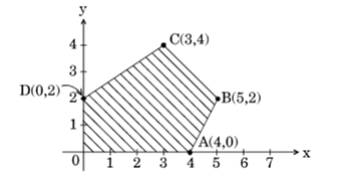
The corner points of the feasible region determined by the system of linear inequations are as shown below:
Image

Answer each of the following:
$i.$ Let $z = 13x - 15y$ be the objective function. Find the maximum and minimum values of $z$ and also the
corresponding points at which the maximum and minimum values occur.
$ii.$ Let $z = kx + y$ be the objective function. Find $k,$ if the value of $z$ at $A$ is same as the value of $z$ at $B.$