Question
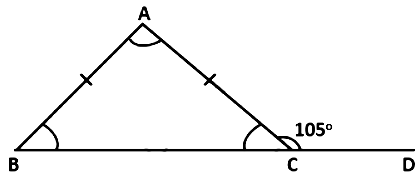
Find the interior angles of the following triangles:

Answer


In $ABC,$
$AB = AC$
$\Rightarrow \angle ACB = \angle ABC ....(1)($angles opposite two equal sides are equal$)$
Now, $\angle ACB + \angle ACD = 180^\circ ...($linear pair$)$
$\Rightarrow \angle ACB = 180^\circ - \angle ACD$
$\Rightarrow \angle ACB = 180^\circ - 105^\circ $
$\Rightarrow \angle ABC = 75^\circ $
$\Rightarrow \angle ABC = 75^\circ ....[$From $(1)]$
By angle sum property, in $\triangle ABC$
$\angle ABC + \angle ACB - \angle BAC = 180^\circ $
$\Rightarrow 75^\circ + 75^\circ + \angle BAC = 180^\circ $
$\Rightarrow 150^\circ + \angle BAC = 180^\circ $
$\Rightarrow \angle BAC = 180^\circ - 150^\circ $
$\Rightarrow \angle BAC = 30^\circ $
Hence, in $\triangle ABC, \angle A = 30^\circ , \angle B = 75^\circ $ and $\angle C = 75^\circ .$

Need a full question paper?

Generate a complete, print-ready paper with questions like this in minutes — across 16+ boards, with answer keys.
Start Generating Free

Similar questions

Find the area and perimeter of a square plot of land whose diagonal is 15 m. Give your answer correct to two decimal places.
Find the amount and the compound interest payable annually on the following :$Rs.25000$ for $1 \frac{1}{2}$years at $10\%$ per annum.
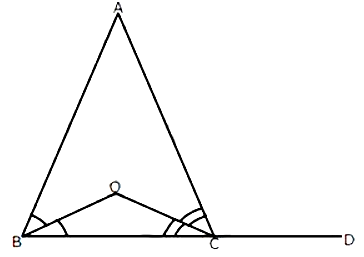
In the figure, given below, $A B=A C$.Prove that: $\angle B O C=\angle A C D$.
Solve graphically, the following equations.$x + 2y = 4; 3x - 2y = 4$.Take $2 \ cm = 1$ unit on each axis.Also, find the area of the triangle formed by the lines and the x-axis.
Use graph paper for this question. Draw the graph of $2x - y - 1 = 0$ and $2x + y = 9$ on the same axes. Use $2 \ cm = 1$ unit on both axes and plot only $3$ points per line. Write down the coordinates of the point of intersection of the two lines.
In a parallelogram $\text{PQRS, M}$ and $N$ are the midpoints of the opposite sides $PQ$ and $RS$ respectively. Prove that;$RN$ and $RM$ trisect $QS.$
Use method of contradiction to show that $\sqrt{3}$ and $\sqrt{5}$ are irrational numbers.
Draw parallelogram $\text{ABCD}$ with the following data:$A B=6 \ cm , A D=5 \ cm$ and $\angle D A B=45^{\circ}$.Let $A C$ and $D B$ meet in $O$ and let $E$ be the mid$-$point of $B C$. Join $O E$.Prove that:(i) $OE \| AB;(ii)OE =\frac{1}{2} AB$.
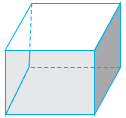
Case Study II : Manish is a carpenter. One day, he made an open cubical box of internal edge 18 cm. The thickness of the plywood is 1 cm. He painted the inner surface of the box black and the outer lateral surfaces as green.
Image
Based on the above information, answer the following questions:
1. Total area to be painted black is :
(a) 1600 $cm ^2$ (b) 1620 $cm ^2$ (c) 1650 $cm ^2$ (d) 1680 $cm ^2$
2. Length of the outer edge of the box is :
(a) 20 cm (b) 19 cm (c) 18 cm (d) 18.5 cm
3. Total outer lateral surface area to be painted green is :
(a) 1500 $cm ^2$ (b) 1510 $cm ^2$ (c) 1520 $cm ^2$ (d) 1600 $cm ^2$
4. Total outer surface area of the box (excluding the top) is :
(a) 1900 $cm ^2$ (b) 1920 $cm ^2$ (c) 2000 $cm ^2$ (d) 2320 $cm ^2$
5. Length of the longest rod that can fit inside the box is :
(a) 18cm (b) 19cm (c) 20 cm (d) 3 cm
In $ΔABC, E$ and $F$ are mid$-$points of sides $AB$ and $AC$ respectively. If $BF$ and $CE$ intersect each other at point $O$,prove that the $ΔOBC$ and quadrilateral $\text{AEOF}$ are equal in area.