Question
Find the intervals in which $f(x) = (x + 2)e^{-x}$ is increasing or decreasing.

Answer

$f(x) = (x + 2)e^{-x}$
$f'(x) = -e^{-x}(x + 2) + e^{-x}$
$= -xe^{-x} - 2e^{-x} + e^{-x}$
$= -xe^{-x} - e^{-x}$
$= e^{-x}(-x - 1)$
For $f(x)$ to be increasing, we must have
$f'(x) > 0$
$\Rightarrow e^{-x}(-x - 1) > 0$
$\Rightarrow -x - 1 > 0$
$\big[\because\ \text{e}^{-\text{x}}>0,\forall\ \text{x}\in\text{R}\big]$
$\Rightarrow -x > 1$
$\Rightarrow x < -1$
$\Rightarrow\text{x}\in(-\infty,-1)$
So, $f(x)$ is increasing on $(-\infty,-1).$
For $f(x)$ to be decreasing, we must have
$f'(x) < 0$
$\Rightarrow e^{-x}(-x - 1) < 0$
$\Rightarrow -x - 1 < 0$
$\big[\because\ \text{e}^{-\text{x}}>0,\forall\ \text{x}\in\text{R}\big]$
$\Rightarrow -x < 1$
$\Rightarrow x < -1$
$\Rightarrow\text{x}\in(-1,\infty)$
So,$ f(x)$ is decreasing on $(-1,\infty).$

Need a full question paper?

Generate a complete, print-ready paper with questions like this in minutes — across 16+ boards, with answer keys.
Start Generating Free

Similar questions

If $\text{A}=\begin{vmatrix}1&2&0\\-2&-1&-2\\0&-1&1\end{vmatrix},$ then find the value of $A^{-1}.$
Using $^{A-1}.$ solve the system of equations $x - 2y = 10, 2x - y - z = 8$ and $-2y + z = 7.$
Show that the vectors $\overrightarrow{\text{a}},\overrightarrow{\text{b}} \text{and}{\overrightarrow{\text{c}}}$ are coplanar $\overrightarrow{\text{a}} +\overrightarrow{\text{b}}, \overrightarrow{\text{b}}+\overrightarrow{\text{c}}\text{and} \overrightarrow{\text{c}} + \overrightarrow{\text{a}}$ are coplanar.
Explain if Rolle's theorem is applicable to any one of the following functions.
  1. $\text{f}(\text{x})=[\text{x}]\text{ on }\text{x}\in[5,9]$
  2. $\text{f}(\text{x})=[\text{x}]\text{ on }\text{x}\in[-2,2]$
Can you say something about the converse of Rolle's Theorem from these functions?
 If $\text{A} = \begin{bmatrix}2&-3&5\\3&2&-4\\1&1&-2\end{bmatrix},$ find $A^{-1}.$ Using $A^{-1}$ solve the system of equations:
$2x - 3y + 5z = 11$
$3x + 2y - 4z = -5$
$x + y - 2z = -3 $
Find the angle of intersection of the curves $y = 4 - x^2$ and $y = x^2.$
If the points (1, 1, p) and (-3, 0, 1) be equidistant from the plane $\vec{\text{r}}\Big(3\hat{\text{i}}+4\hat{\text{j}}-12\hat{\text{k}}\Big)+13=0,$ then find the value of p.
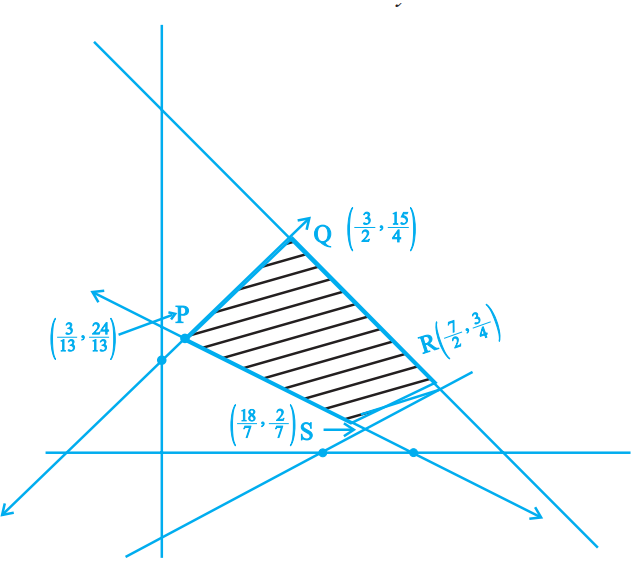
In the feasible region (shaded) for a LPP is shown. Determine the maximum and minimum value of Z = x + 2y.
Show that x = 2 is a root of the equation $\begin{vmatrix}\text{x}&-6&-1\\2&-3\text{x}&\text{x}-3\\-3&2\text{x}&\text{x}+2\end{vmatrix}=0$ and solve it completely.
$\int\limits^\pi_0\frac{\text{x}}{1+\sin\text{x}}$
If f(x), defined by the following, is continuous at x = 0, find the values of a, b and c.$\text{f(x)} = \begin{cases} \frac{\text{sin (a + 1)x + sin x}}{\text{x}},\quad&\text{if x < 0}\\ \text{c}, \quad &\text{if x = 0}\\ \frac{\sqrt{\text{x + bx}^{2}}-\sqrt{\text{x}}}{\text{bx}^{3/2}},\quad&\text{if x > 0} \end{cases}$.