Question
Find the intervals in which the function f given by $f(x) = 2x^2 – 3x$ is decreasing.

Answer

It is given that function $f(x) = 2x^2 - 3x$
$\Rightarrow f'(x) = 4x - 3$
If $f'(x) = 0,$ then we get,
$x=\frac{3}{4}$
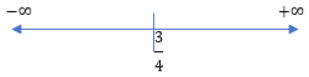
So, the point $x = \frac{3}{4}$, divides the real line into two disjoint intervals, $\left(-\infty, \frac{3}{4}\right)$ and $\left(\frac{3}{4}, \infty\right)$

Now, in interval $\left(-\infty, \frac{3}{4}\right)$, $f'(x) = 4x - 3 < 0$
Therefore, the given function (f) is strictly decreasing in interval $\left(-\infty, \frac{3}{4}\right)$

Need a full question paper?

Generate a complete, print-ready paper with questions like this in minutes — across 16+ boards, with answer keys.
Start Generating Free

Similar questions

In each of the verify that the given function (explicit or implicit) is a solution of the corresponding differential equation:
$\text{y} = \text{Ax} \ :\ \text{xy}' = \text{y} (\text{x} \neq0)$
Find the second order derivatives of the function given in Exercise:
$\text{x }\cos\text{x}$
If $\vec{\text{a}}=\hat{\text{i}}+\hat{\text{j}},\ \vec{\text{b}}=\hat{\text{j}}+\hat{\text{k}}$ and $\vec{\text{c}}=\hat{\text{k}}+\hat{\text{i}}$, write unit vectors parallel to $\vec{\text{a}}+\vec{\text{b}}-2\vec{\text{c}}$.
If $\vec{\text{a}}=\text{x}\hat{\text{i}}+2\hat{\text{j}}-\text{z}\hat{\text{k}}$ and $\vec{\text{b}}=3\hat{\text{i}}-\text{y}\hat{\text{j}}+\hat{\text{k}}$ are two equal vectors, then write the value of x + y + z.
It is given that at $x = 1$, the function $x^4 - 62x^2 + ax + 9$ attains its maximum value, on the interval $[0, 2]$. Find the value of a.
Evaluate the following integrals:
$\int\limits^1_{-2}\frac{|\text{x}|}{\text{x}}\text{ dx}$
Compute the products AB and BA whichever exists the following cases:
$[\text{a},\text{b}]\begin{bmatrix}\text{c}\\\text{d} \end{bmatrix}+\big[\text{a},\text{b},\text{c},\text{d}\big]\begin{bmatrix}\text{a}\\\text{b}\\\text{c}\\\text{d}\end{bmatrix}$
If $\vec{\text{a}}$ and $\vec{\text{b}}$ are two vectors such that $\big|\vec{\text{a}}\times\vec{\text{b}}\big|=\sqrt{3}$ and $\vec{\text{a}}.\vec{\text{b}}=1,$ find the angle between.
Find fog $(2)$ and gof $(1)$ when $: f : R \rightarrow R; f(x) = x^2 + 8$ and $g : R \rightarrow R; g(x) = 3x^3 + 1.$
A bag contains 4 red and 5 black balls, a second bag contains 3 red and 7 black balls. One ball is drawn at random from each bag, find the probability that the,
Balls are of different colours.