Question
Find the intervals in which the function$ f(x) = 3x^4- 4x^3 - 12x^2 + 5$ is
  1. strictly increasing.
  2. strictly decreasing.

Answer

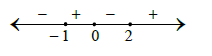
$f'(x) = 12x^3 – 12x^2 – 24x = 12x (x + 1) (x – 2)$
$f'(x) > 0, "  \forall\text{x}\in( -1 ,0)\text{U}(2,\infty)$

$f'(x) < 0, "  \forall\text{x}\in( - \infty, -1 )\text{U}(0,2)$
$\therefore\text{f}(\text{(x})$ is strictlyincreasing in $( - 1, 0 )\text{U}(0,2)$
and strictlydecreasing in $( - \infty, - 1)\text{U}(0,2).$

Need a full question paper?

Generate a complete, print-ready paper with questions like this in minutes — across 16+ boards, with answer keys.

Start Generating Free

Similar questions

Find $\frac{\text{dy}}{\text{dx}}$
$\text{y}=\text{x}^{\log\text{x}}+(\log\text{x}^\text{x})$
Using properties of determinants, prove the following:
$\begin{vmatrix} 1 & \text{1 + P} & \text{1 + p + q} \\ 2 & \text{3 + 2p} & \text{1 + 3p + 2q} \\ 3 & \text{6 + 3p} & \text{1 + 6p + 3q} \end{vmatrix}=1.$
If $(\cos\text{x})^\text{y}=(\cos\text{y})^\text{x},$ find $\frac{\text{dy}}{\text{dx}}$
Show that $\text{y}=\frac{\text{c}-\text{x}}{1+\text{cx}}$ is a solution of the differential equation $(1+\text{x}^2)\frac{\text{dy}}{\text{dx}}+(1+\text{y}^2)=0.$
$\text{If}\ \text{y}=\sin(\sin\text{x}),\ \text{prove that}\frac{\text{d}^2\text{y}}{\text{dx}^2}+\tan\text{x}\frac{\text{dy}}{\text{dx}}+\text{y}\cos^2\text{x}=0.$
If $\text{A}=\begin{bmatrix}3&2&0\\1&4&0\\0&0&5\end{bmatrix},$ show that $A^2 - 7A + 10I_3 = 0$.
Find the equation of the line passing through the points $\hat{\text{i}}+\hat{\text{j}}-3\hat{\text{k}}$ and perpendicular to the lines $\vec{\text{r}}=\hat{\text{i}}+\lambda\big(2\hat{\text{i}}+\hat{\text{j}}-3\hat{\text{k}}\big)$ and $\vec{\text{r}}=\big(2\hat{\text{i}}+\hat{\text{j}}-\hat{\text{k}}\big)+\mu\big(\hat{\text{i}}+\hat{\text{j}}+\hat{\text{k}}\big).$
Evaluate the following integrals:
$\int\text{x}^2\text{e}^{\text{x}^3}\cos\text{x}^3\text{dx}$
The relation $R$ defined on the set $A=\{1,2,3,4,5\}$ by $R=\left\{(a, b):\left|a^2-b^2\right|<16\right\}$ is given by:
Find the differential equation of system of concentric circles with centre (1, 2).