Question
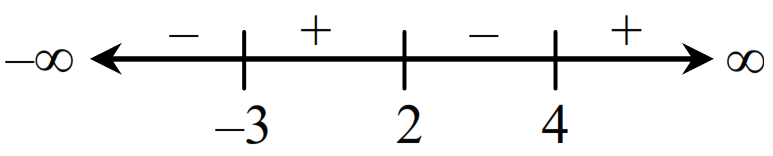
Find the intervals in which the function $\text{f(x)}=\frac{\text{x}^4}{4}-\text{x}^3-5\text{x}^2+24\text{x}+12$ is (a) strictly increasing, (b) strictly decreasing.
Answer

$\text{f(x)}=\frac{\text{x}^4}{4}-\text{x}^3-5\text{x}^2+24\text{x}+12$
$\text{f}'(\text{x})=\frac{4\text{x}^3}{4}-3\text{x}^2-10\text{x}+24$
$\text{f}'(\text{x})=0$
$\text{x}^3-3\text{x}^2-10\text{x}+24=0$
$(\text{x}-2)(\text{x}^2-\text{x}-12)=0$
$(\text{x}-2)(\text{x}-4)(\text{x}+3)=0$

increasing in interval $(-3,2)\cup(4,\infty)$
decreasing in interval $(-\infty,-3)\cup(2,4)$

Need a full question paper?

Generate a complete, print-ready paper with questions like this in minutes — across 16+ boards, with answer keys.

Start Generating Free

Similar questions

Define a binary operation * on the set ${0, 1, 2, 3, 4, 5}$ as:
$\text{a}\times\text{b}=\begin{cases}\text{a + b},&\text{if }\text{a + b}<6\\\text{a + b}-6,&\text{if }\text{a + b}\geq6\end{cases}$
Show that 0 is the identity for this operation and each element a ≠ 0 of the set is invertible with 6 − a being the inverse of a.
A fair coin is tossed four times. Let X denote the number of heads occuring. Find the probability distribution, mean and variance of X.
Solve the following systems of homogeneous linear equations by matrix method:
2x + 3y - z = 0
x - y - 2z = 0
3x + y + 3z = 0
An airline agrees to charter planes for a group. The group needs at least 160 first class seats and at least 300 tourist class seats. The airline must use at least two of its model 314 planes which have 20 first class and 30 tourist class seats. The airline will also use some of its model 535 planes which have 20 first class seats and 60 tourist class seats. Each flight of a model 314 plane costs the company Rs 100,000 and each flight of a model 535 plane costs Rs 150,000. How many of each type of plane should be used to minimize the flight cost? Formulate this as a LPP.
If the line drawn from (4, -1, 2) meets a plane at right at the point (-10, 5, 4) find the equation of the plane.
If $\hat{\text{a}}$ and $\hat{\text{b}}$ are unit vectors inclined at an angle $\theta$, prove that$\cos\frac{\theta}{2}=\frac{1}{2}\big|\hat{\text{a}}+\hat{\text{b}}\big|$
If $\text{x}\sin(\text{a}+\text{y})+\sin\text{a}\cos(\text{a}+\text{y})=0,$ prove that $\frac{\text{dy}}{\text{dx}}=\frac{\sin^2(\text{a}+\text{y})}{\sin\text{a}}$
Solve the following differential equations:$(1+\text{x})(1+\text{y}^2)\text{dx}+(1+\text{y})(1+\text{x}^2)\text{dy}=0$
State when the line $\vec{\text{r}}=\vec{\text{a}}+\lambda\vec{\text{b}}$ is parallel to the plane $\vec{\text{r}}\cdot\vec{\text{n}}=\text{d}.$ Show that the line $\vec{\text{r}}=\hat{\text{i}}+\hat{\text{j}}+\lambda(3\hat{\text{i}}-\hat{\text{j}}+2\hat{\text{k}})$ is parallel to the plane $\vec{\text{r}}\cdot(2\hat{\text{i}}+\hat{\text{k}})=3.$ Also, find the distance between the line and the plane.
Find the distance of the point (-1, -5, -10) from the point of intersection of the line $\vec{\text{r}}=2\hat{\text{i}}-\hat{\text{j}}+2\hat{\text{k}}+\lambda\Big(3\hat{\text{i}}+4\hat{\text{j}}+2\hat{\text{k}}\Big)$ and the plane $\vec{\text{r}}.\Big(\hat{\text{i}}-\hat{\text{j}}+\hat{\text{k}}\Big)=5.$