Question
Find the inverse of the following matrices $\left[\begin{array}{cc}1 & 2 \\ 2 & -1\end{array}\right]$

Answer

$\begin{array}{l}\text { Let } A=\left[\begin{array}{cc}1 & 2 \\ 2 & -1\end{array}\right] \\ \therefore|A|=\left|\begin{array}{rr}1 & 2 \\ 2 & -1\end{array}\right|=-1-4=-5 \neq 0\end{array}$
$\therefore \mathrm{A}^{-1}$ exists.
Consider $\mathrm{AA}^{-1}=\mathrm{I}$
$\therefore\left[\begin{array}{rr}1 & 2 \\2 & -1\end{array}\right] A^{-1}=\left[\begin{array}{ll}1 & 0 \\0 & 1\end{array}\right]$
By $R_2-2 R_1$, we get,
$\left[\begin{array}{rr}1 & 2 \\0 & -5\end{array}\right] A^{-1}=\left[\begin{array}{rr}1 & 0 \\-2 & 1\end{array}\right]$
By $\left(-\frac{1}{5}\right) R_2$, we get,
$\left[\begin{array}{ll}1 & 2 \\0 & 1\end{array}\right] A^{-1}=\left[\begin{array}{rr}1 & 0 \\2 / 5 & -1 / 5\end{array}\right]$
By $R_1-2 R_2$, we get,
$\begin{array}{l}{\left[\begin{array}{ll}1 & 0 \\ 0 & 1\end{array}\right] A^{-1}=\left[\begin{array}{rr}1 / 5 & 2 / 5 \\ 2 / 5 & -1 / 5\end{array}\right]} \\ \therefore A^{-1}=\frac{1}{5}\left[\begin{array}{rr}1 & 2 \\ 2 & -1\end{array}\right] .\end{array}$
The answer can be checked by finding the product $\mathrm{AA}^{-1}$
$\mathrm{AA}^{-1}=\left(\begin{array}{rr}1 & 2 \\ 2 & -1\end{array}\right]\left[\begin{array}{rr}1 / 5 & 2 / 5 \\ 2 / 5 & -1 / 5\end{array}\right] $
$=\left[\begin{array}{ll}1\left(\frac{1}{5}\right)+2\left(\frac{2}{5}\right) & 1\left(\frac{2}{5}\right)+2\left(-\frac{1}{5}\right) \\ 2\left(\frac{1}{5}\right)-1\left(\frac{2}{5}\right) & 2\left(\frac{2}{5}\right)-1\left(-\frac{1}{5}\right)\end{array}\right] $
$ =\left[\begin{array}{lll}\frac{1}{5}+\frac{4}{5} & \frac{2}{5}-\frac{2}{5} \\ \frac{2}{5}-\frac{2}{5} & \frac{4}{5}+\frac{1}{5}\end{array}\right]=\left[\begin{array}{ll}1 & 0 \\ 0 & 1\end{array}\right]=\mathrm{I} $
Hence, $\mathrm{A}^{-1}$ is the required answer.

Need a full question paper?

Generate a complete, print-ready paper with questions like this in minutes — across 16+ boards, with answer keys.

Start Generating Free

Similar questions

The position vector of points $A$ and $B$ are $6 \bar{a}+2 \bar{b}$ and $\bar{a}-3 \bar{b}$. If the point $C$ divides $A B$ in

the ratio $3: 2$ then show that the position vector of $C$ is $3 \bar{a}-\bar{b}$.
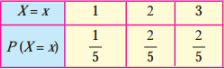
Find the expected value, variance, and standard deviation of the random variable whose p.m.f’s are given below:

Image

For each of the following differential equations, find the particular solution satisfying the given condition:

$y (1+\log x ) \frac{d x}{d y}- x \log x =0, y = e ^2$, when $x = e$

If $A=\left[\begin{array}{lll}1 & 0 & 1 \\ 0 & 2 & 3 \\ 1 & 2 & 1\end{array}\right]$ and $B=\left[\begin{array}{lll}1 & 2 & 3 \\ 1 & 1 & 5 \\ 2 & 4 & 7\end{array}\right]$, then find the matrix $X$ such that $X A=B$
In the following, find the value of the constant k so that the given function is continuous at the indicated point:
$\text{f(x)}=\begin{cases}\text{k}+1,&\text{if}\text{ x}\leq5\\3\text{x}-5,&\text{if}\text{ x}>5\end{cases}\text{at x} =5$
If $\text{y}=\sqrt{\tan\text{x}+\sqrt{\tan\text{x}+\sqrt{\tan\text{x}+\ .... \text{to }\infty}}}$ prove that $\frac{\text{dy}}{\text{dx}}=\frac{\sec^2\text{x}}{2\text{y}-1}$
For what value of k is the following function continuous at x = 2?
$\text{f(x)}=\begin{cases}2\text{x}+1,&\text{if }\text{ x}<2\\\text{k},&\text{x}=2\\3\text{x}-1,&\text{x}>2\end{cases}$
Evaluate the following integrals:
$\frac{\text{x}+1}{\text{x}(1+\text{xe}^\text{x})}\ \text{dx}$
Solve the following equations by reduction method $:3x – y = 1, 4x + y = 6$
If one of the lines given by $a x^2+2 h x y+b y^2=0$ bisects an angle between co-ordinate axesthen show that $(a+b)^2=4 h^2$.