Question
Find the inverse of the matrix (if it exists) given $\left[\begin{array}{cc}2 & -2 \\ 4 & 3\end{array}\right]$

Answer

Let $A = \left[ {\begin{array}{*{20}{c}} 2&{ - 2} \\ 4&3 \end{array}} \right]$

$\therefore \left| A \right| = \left[ {\begin{array}{*{20}{c}} 2&{ - 2} \\ 4&3 \end{array}} \right] = 6 - \left( { - 8} \right) = 6 + 8 = 14 \ne 0$

$\therefore$ Matrix A is non-singular and hence ${A^{ - 1}}$ exist.

Now adj. A $ = \left[ {\begin{array}{*{20}{c}} 3&2 \\ { - 4}&2 \end{array}} \right]$ And ${A^{ - 1}} = \frac{1}{{\left| A \right|}}adj.A = \frac{1}{{14}}\left[ {\begin{array}{*{20}{c}} 3&2 \\ { - 4}&2 \end{array}} \right]$

Need a full question paper?

Generate a complete, print-ready paper with questions like this in minutes — across 16+ boards, with answer keys.

Start Generating Free

Similar questions

$\int\sin^3(2\text{x}+1)\text{dx}$
A factory has two machines A and B. Past record shows that machine A produced 60% of the items of output and machine B produced 40% of the items. Further, 2% of the items produced by machine A and 1% produced by machine B were defective. All the items are put into one stockpile and then one item is chosen at random from this and is found to be defective. What is the probability that it was produced by machine B?
Find f(x) is continuse at x = 0, then $\text{f(x)}=\frac{\text{x}}{1-\sqrt{1-\text{x}}}$ becomes continuous at x = 0.
Solve the following differential equation:

y(1 - x2$\frac{\text{dy}}{\text{dx}}$ = x(1 + y2).
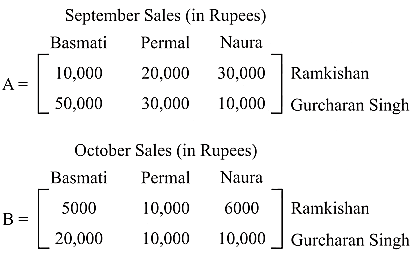
Two farmers Ramkishan and Gurcharan Singh cultivates only three varieties of rice namely Basmati, Permal and Naura. The sale (in Rupees) of these varieties of rice by both the farmers in the month of September and October are given by the following matrices A and B.

  1. Find the combined sales in September and October for each farmer in each variety.
  2. Find the decrease in sales from September to October.
  3. If both farmers receive 2% profit on gross sales, compute the profit for each farmer and for each variety sold in October.
If $\text{y}=\tan^{-1}$ show that $(1+\text{x}^2)\frac{\text{d}^2\text{y}}{\text{dx}^2}+2\text{x}\frac{\text{dy}}{\text{dx}}=0$
Evalute the following integrals:
$\int\frac{1}{\text{x}(3+\log\text{x})}\text{dx}$
Using determinants show that the following points are collinear:
(3, -2), (8, 8) and (5, 2)
$\int\frac{\text{x}^3}{\text{x}-2}\text{dx}$
Find the volume of the parallelopiped whose coterminous edges are represented by the vectors:
$\vec{\text{a}}=2\hat{\text{i}}-3\hat{\text{j}}+4\hat{\text{k}},\vec{\text{b}}=\hat{\text{i}}+2\hat{\text{j}}-\hat{\text{k}},\vec{\text{c}}=3\hat{\text{i}}-\hat{\text{j}}-2\hat{\text{k}}$