Question
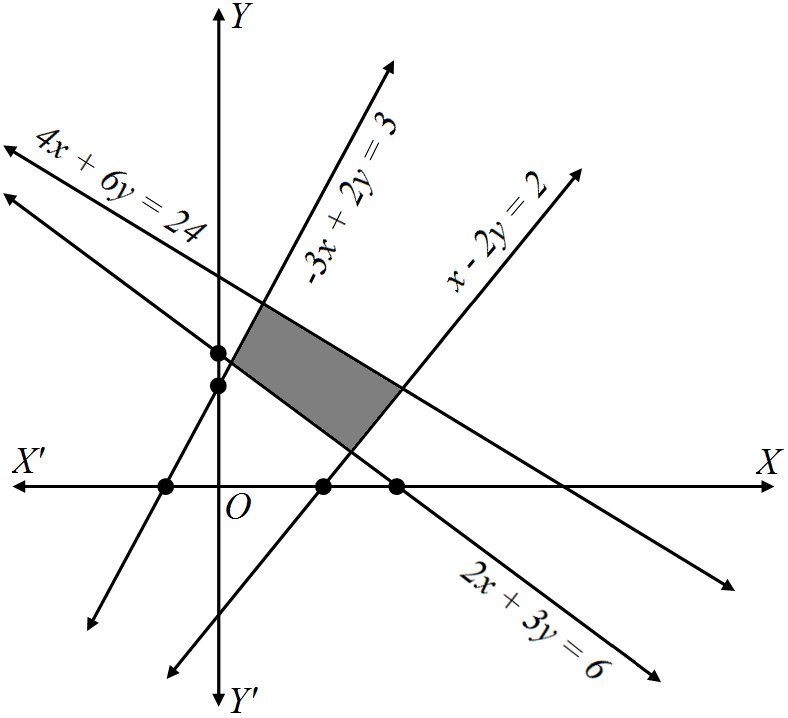
Find the linear inequations for which the shaded area in Fig. is the solution set. Draw the diagram of the solution set of the linear inequations:
Answer


Consider the line 2x + 3y = 6. we observe that the shaded region and the origin are on the opposite sides of the line 2x + 3y = 6 and (0, 0) does not satisfy the inequation 2x + 3y 2 6. So, we must have one inequations as $2\text{x} + 3\text{y}\geq 26$

Consider the line 4x + 6y = 24. we observe that the shaded region and the origin are on the same side of the line 4x + 6y = 24 and (0, 0) satisfies the linear inequation $4\text{x} + 6\text{y}\leq 24.$

So, the second inequations is $4\text{x} + 6\text{y}\leq 24.$

Consider the line - 3x + 2y = 3. We observe that the shaded region and the origin are on the same side of the line - 3x + 2y = 3 and (0, 0) satisfies the linear inequation $-3\text{x}+2\text{y}\leq3.$ so, the third inequations is $-3\text{x}+2\text{y}\leq3.$

Finaly,consider the line x - 2y = 2. We observe that the shaded region and the origin are on the same side of the line x - 2y = 2 and (0, 0) satisfies the linear inequation $\text{x} - 2\text{y}\leq2.$ so, the forth inequations is $\text{x} - 2\text{y}\leq2.$

We also notice that the shaded region is above x-axis and is on the right side of y-axis. so, we must have $\text{x}\geq0$ and $\text{y}\geq0$

Thus, the linear inequations corresponding to the given solution set are

$2\text{x}+3\text{y}\geq6,4\text{x}+6\text{y}\leq24,-3\text{x}+2\text{y}\leq3,\text{x}-2\text{y}\leq2,\text{x}\geq0,\text{y}\geq0.$

Need a full question paper?

Generate a complete, print-ready paper with questions like this in minutes — across 16+ boards, with answer keys.
Start Generating Free

Similar questions

Solve the following linear equations by using Cramer’s Rule : $\frac{-2}{x}-\frac{1}{y}-\frac{3}{z}=3, \frac{2}{x}-\frac{3}{y}+\frac{1}{z}=-13$ and $\frac{2}{x}-\frac{3}{z}=-11$
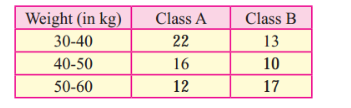
The following table gives the weights of the students of two classes. Calculate the coefficient of variation of the two distributions. Which series is more variable?

Image

Sum the following series to $n$ terms:
$\frac{1}{1.4}+\frac{1}{4.7}+\frac{1}{7.10}+\ .....$
A card is drawn from a pack of 52 cards. What is the probability that, (i) card is either red or black?

(ii) card is either black or a face card?

Evaluate the following limits:
$\lim _{x \rightarrow \frac{\pi}{6}}\left[\frac{2 \sin x-1}{\pi-6 x}\right]$
If $\text{f(x)}=\log_\text{e}(1-\text{x})$ and $\text{g(x)}=[\text{x}],$ then determine the following functions:
$\frac{\text{f}}{8}$
Life of bulbs produced by two factories $A$ and $B$ are given below:
Length of life $($in hours$):$ $550-650$ $650-750$ $750-850$ $850-950$ $950-1050$
Factory $A: ($Number of bulbs$)$ $10$ $22$ $52$ $20$ $16$
Factory $B: ($Number of bulbs$)$ $8$ $60$ $24$ $16$ $12$
The bulbs of which factory are more consistent from the point of view of length of life?
Find the equation of an ellipse, the distance between the foci is 8 units and the distance between the directrices is 18 units.
Prove the following by the principle of mathematical induction:
$\text{a}+\text{ar}+\text{ar}^2+...+\text{ar}^\text{n-1}=\text{a}\Big(\frac{\text{r}^\text{n}-1}{\text{r}-1}\Big),\text{r}\neq1$
Find the equation of the circle which circumscribes the triangle formed by the lines
$x + y = 2, 3x - 4y = 6$ and $x - y = 0$.